


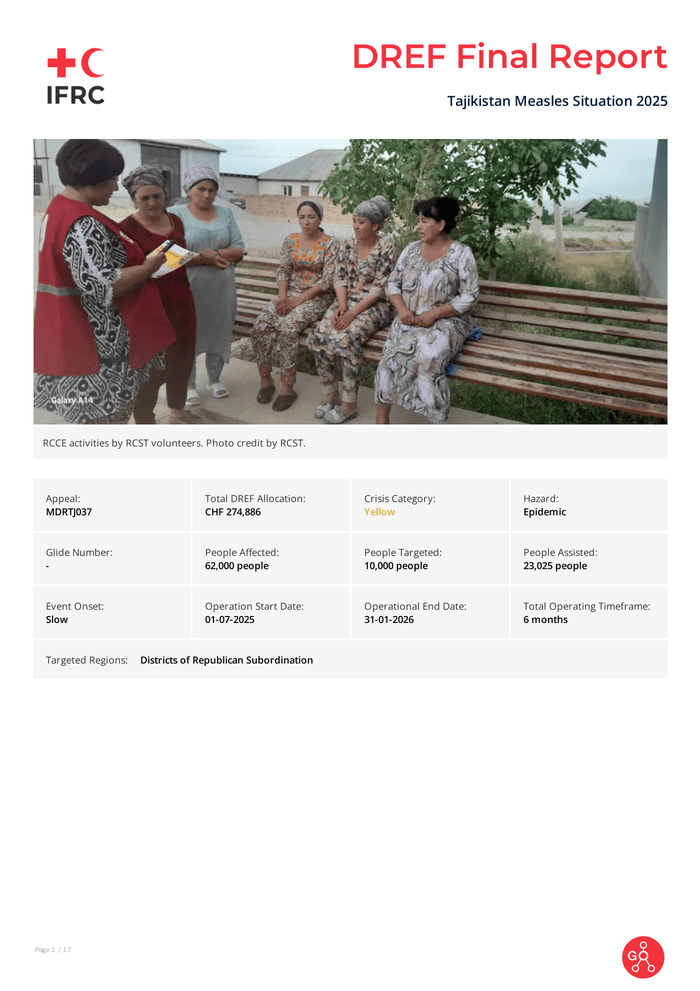
Country: Tajikistan Source: International Federation of Red Cross and Red Crescent Societies Please refer to the attached file. Description of the Event Date when the trigger was met 20-06-2025 What happened, where and when? According to data from the Republican Center for Immunoprophylaxis of the Ministry of Health of Tajikistan (RCI), the first cases of measles were recorded since January 2025. As of June 18, 2025, RCI reports that Tajikistan has recorded 5, 500 suspected cases of measles. Among these, 778 cases have been confirmed through laboratory testing, and 4, 722 have been confirmed clinically. For comparison, only seven laboratory-confirmed cases were reported in 2024. Although the government of Tajikistan has not officially declared a measles outbreak, officials from the Ministry of Health acknowledge the registration of cases. They emphasize that all relevant data is being reported daily to the WHO Representative Office in Tajikistan, UNICEF, and Rospotrebnadzor of the Russian Federation (but for internal use only). For reference, the World Health Organization’s (WHO) definition of outbreak is a suspected five or more cases of measles (with dates of rash onset occurring 7–21 days apart) that are epidemiologically linked, and the definition of a laboratory-confirmed measles outbreak is two or more laboratory-confirmed measles cases that are temporally related (with dates of rash onset occurring 7–21 days apart) and epidemiologically or virologically linked, or both. An analysis of the vaccination status of patients diagnosed with measles, conducted by RCI, shows that most of them (45%, or 2, 475 children) were not vaccinated, 34% (1, 870 children) were vaccinated once with the MMR vaccine, 7% (385 children) had medical exemptions, and 14% (770 children) fell ill before reaching the age at which they could be vaccinated. In current measles situation geographically, most cases (70%) were registered in 12 districts of republican subordination and in the country’s capital: Dushanbe – 622 cases Rudaki – 98 cases Hisar – 105 cases Vahdat – 178 cases Shahrinav – 28 cases 6. Tursunzoda – 11 cases 7. Varzob – 32 cases 8. Fayzabad – 17 cases 9. Rasht – 28 cases 10. Sangvor – 22 cases 11. Nurabad – 18 cases 12. Tajikiabad – 13 cases Childhood immunization is generally available and accepted by both mothers and fathers throughout Tajikistan. The National Immunoprophylactic Program for 2021-2025 aims to improve immunization coverage, prevent infectious disease outbreaks, and enhance the quality of healthcare services, thereby supporting longer and healthier lives for its population. Tajikistan maintains a relatively high level of childhood immunization coverage, with official statistics indicating 96. 3% of children received appropriate vaccinations in 2024 (MOHSP, 2024). According to GAVI data from 2021, 3. 6% of infants did not receive any vaccinations, indicating an overall high level of vaccination coverage, with roughly 96. 4% of infants receiving at least one vaccine. There is a slight difference in vaccination coverage based on gender, with female infants having a coverage rate of 82. 8% and male infants 81. 5% (Gender Barriers to Immunization in Tajikistan, 2024). Vaccination coverage among children living in urban areas was lower (76%) compared to those in rural areas (84%). Despite the ongoing work, there are still cases of vaccine-controlled disease. Tajikistan has recently witnessed outbreaks and is currently going through the outbreak of measles, which could be prevented if all children were fully and timely vaccinated. The most recent outbreak took place in 2023. The country experienced an outbreak of measles with 870 cases reported, and the Ministry announced additional immunization campaign against measles and rubella. As part of the campaign, more than 2 million children in all 65 districts of the republic were vaccinated against measles. According to data from the Tajikistan Ministry of Health for the last four years, COVID-19 pandemic led to reducing vaccination coverage rates which led to recurrent outbreaks of vaccine preventable diseases in the years following the COVID-19 pandemic. For this reason, the situation with measles control has also changed in Tajikistan in recent years, with sporadic cases of measles being reported in some cities and districts of the country. Children in Tajikistan are offered 2 doses of measles-containing vaccine as part of the routine immunization schedule and in line with WHO recommendations (which are conducted at 12 months and 6 years-revaccination, the first dose of the MMR vaccine (MCV1 at the age of one year old) and second dose (MCV2 at the age of two years old).



GrowthPakistan brings you the latest news to keep an eye on Pakistan’s startup ecosystem. Business keeps you growing when you stay aware of your competitors' moves. GrowthPakistan offers Business, Tech, Global Tech, Global, Auto, and Startup News straight from industries all around the globe. This platform will help you identify upcoming opportunities not only in Pakistan but worldwide.
Email : growthpakistan@gmail.com
Whatsapp : +92320-9497079
© growthpakistan