

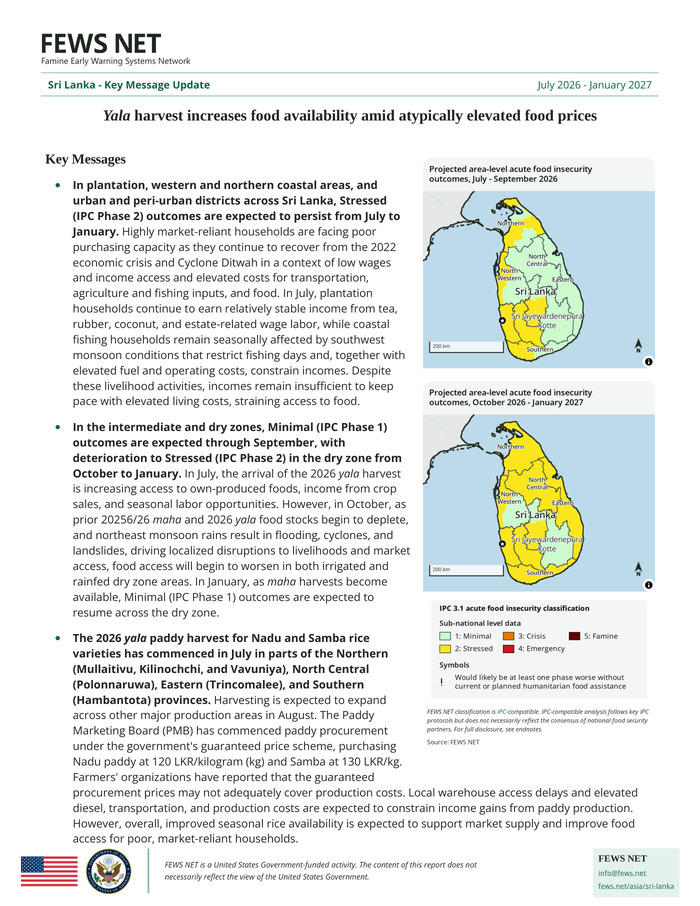
Country: Sri Lanka Source: Famine Early Warning System Network Please refer to the attached file. Key Messages In plantation, western and northern coastal areas, and urban and peri-urban districts across Sri Lanka, Stressed (IPC Phase 2) outcomes are expected to persist from July to January. Highly market-reliant households are facing poor purchasing capacity as they continue to recover from the 2022 economic crisis and Cyclone Ditwah in a context of low wages and income access and elevated costs for transportation, agriculture and fishing inputs, and food. In July, plantation households continue to earn relatively stable income from tea, rubber, coconut, and estate-related wage labor, while coastal fishing households remain seasonally affected by southwest monsoon conditions that restrict fishing days and, together with elevated fuel and operating costs, constrain incomes. Despite these livelihood activities, incomes remain insufficient to keep pace with elevated living costs, straining access to food. In the intermediate and dry zones, Minimal (IPC Phase 1) outcomes are expected through September, with deterioration to Stressed (IPC Phase 2) in the dry zone from October to January. In July, the arrival of the 2026 yala harvest is increasing access to own-produced foods, income from crop sales, and seasonal labor opportunities. However, in October, as prior20256/26 maha and 2026 yala food stocks begin to deplete, and northeast monsoon rains result in flooding, cyclones, and landslides, driving localized disruptions to livelihoods and market access, food access will begin to worsen in both irrigated and rainfed dry zone areas. In January, as maha harvests become available, Minimal (IPC Phase 1) outcomes are expected to resume across the dry zone. The 2026 yala paddy harvest for Nadu and Samba rice varieties has commenced in July in parts of the Northern (Mullaitivu, Kilinochchi, and Vavuniya), North Central (Polonnaruwa), Eastern (Trincomalee), and Southern (Hambantota) provinces. Harvesting is expected to expand across other major production areas in August. The Paddy Marketing Board (PMB) has commenced paddy procurement under the government’s guaranteed price scheme, purchasing Nadu paddy at 120 LKR/kilogram (kg) and Samba at 130 LKR/kg. Farmers’ organizations have reported that the guaranteed procurement prices may not adequately cover production costs. Local warehouse access delays and elevated diesel, transportation, and production costs are expected to constrain income gains from paddy production. However, overall, improved seasonal rice availability is expected to support market supply and improve food access for poor, market-reliant households. As of the end of June, the LKR had depreciated 7. 9 percent against the USD in the first six months of the year, and inflation continued to increase in July, driven by rising energy costs linked to the escalation in the Middle East and high food prices. Annual headline inflation (Colombo Consumer Price Index) increased from 2. 3 percent in January to 7. 3 percent in July, reaching a three-year high. This is largely tied to annual food inflation, which spiked from 0. 9 to 6. 3 percent between May and July. While rice prices eased slightly month-on-month in June with continued access to maha harvest supplies, they remained seasonally high, with Nadu and Samba rice prices elevated 11 percent and 7 percent above their five-year averages, respectively. Elevated fuel, transport, and food prices are constraining household purchasing capacity among poor, market-reliant households and limiting access to food and essential non-food items, particularly in urban, plantation, and coastal fishing areas where food expenditures account for a disproportionately large share of household income. As of July, Sri Lanka is now forecast to receive below-average southwestern monsoon rainfall and face atypically dry conditions in the dry zone from July to September. Repeated heat advisories issued from the Meteorological Department of Sri Lanka in June and July indicate persistent above-average temperatures. Elevated temperatures are expected to increase crop water requirements, particularly in irrigated and rainfed cropping areas, while reducing labor productivity during peak daytime hours. These conditions may increase production costs and constrain income-earning opportunities for poor households dependent on agricultural wage labor if high temperatures persist. However, with the forecast development of a positive Indian Ocean Dipole (IOD) in August/September, Sri Lanka will likely experience heavy, above-average rainfall during the October-November intermonsoon and December to February northeast monsoon periods.
Sri Lanka – Key Message Update: Yala harvest increases food availability amid atypically elevated food prices, July 2026 – January 2027

RELATED ARTICLES


