


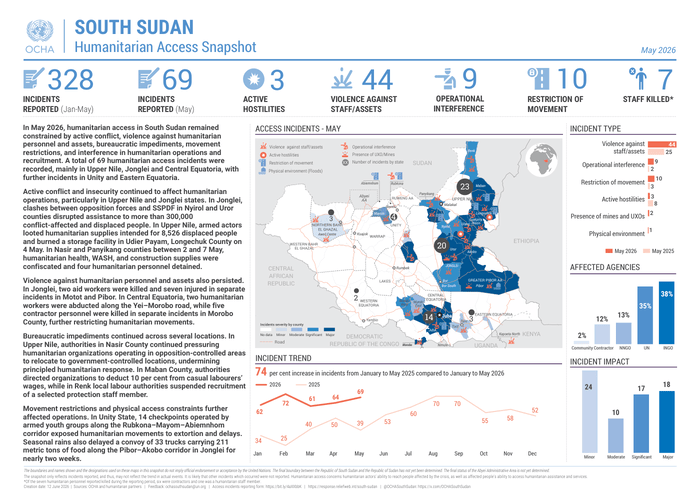
Country: South Sudan Source: UN Office for the Coordination of Humanitarian Affairs Please refer to the attached Infographic. In May 2026, humanitarian access in South Sudan remained constrained by active conflict, violence against humanitarian personnel and assets, bureaucratic impediments, movement restrictions, and interference in humanitarian operations and recruitment. A total of 69 humanitarian access incidents were recorded, mainly in Upper Nile, Jonglei and Central Equatoria, with further incidents in Unity and Eastern Equatoria. Active conflict and insecurity continued to affect humanitarian operations, particularly in Upper Nile and Jonglei states. In Jonglei, clashes between opposition forces and SSPDF in Nyirol and Uror counties disrupted assistance to more than 300, 000 conflict-affected and displaced people. In Upper Nile, armed actors looted humanitarian supplies intended for 8, 526 displaced people and burned a storage facility in Udier Payam, Longechuk County on 4 May. In Nasir and Panyikang counties between 2 and 7 May, humanitarian health, WASH, and construction supplies were confiscated and four humanitarian personnel detained. Violence against humanitarian personnel and assets also persisted. In Jonglei, two aid workers were killed and seven injured in separate incidents in Motot and Pibor. In Central Equatoria, two humanitarian workers were abducted along the Yei–Morobo road, while five contractor personnel were killed in separate incidents in Morobo County, further restricting humanitarian movements. Bureaucratic impediments continued across several locations. In Upper Nile, authorities in Nasir County continued pressuring humanitarian organizations operating in opposition-controlled areas to relocate to government-controlled locations, undermining principled humanitarian response. In Maban County, authorities directed organizations to deduct 10 per cent from casual labourers’ wages, while in Renk local labour authorities suspended recruitment of a selected protection staff member. Movement restrictions and physical access constraints further affected operations. In Unity State, 14 checkpoints operated by armed youth groups along the Rubkona–Mayom–Abiemnhom corridor exposed humanitarian movements to extortion and delays. Seasonal rains also delayed a convoy of 33 trucks carrying 211 metric tons of food along the Pibor–Akobo corridor in Jonglei for nearly two weeks.



GrowthPakistan brings you the latest news to keep an eye on Pakistan’s startup ecosystem. Business keeps you growing when you stay aware of your competitors' moves. GrowthPakistan offers Business, Tech, Global Tech, Global, Auto, and Startup News straight from industries all around the globe. This platform will help you identify upcoming opportunities not only in Pakistan but worldwide.
Email : growthpakistan@gmail.com
Whatsapp : +92320-9497079
© growthpakistan