

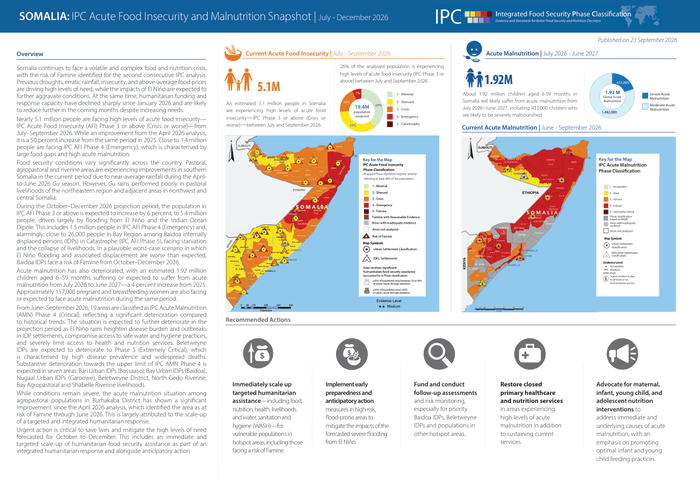
Country: Somalia Source: Food Security and Nutrition Analysis Unit – Somalia Please refer to the attached file. Overview Somalia continues to face a volatile and complex food and nutrition crisis, with the risk of Famine identified for the second consecutive IPC analysis. Previous droughts, erratic rainfall, insecurity, and above-average food prices are driving high levels of need, while the impacts of El Niño are expected to further aggravate conditions. At the same time, humanitarian funding and response capacity have declined sharply since January 2026 and are likely to reduce further in the coming months despite increasing needs. Nearly 5. 1 million people are facing high levels of acute food insecurity— IPC Acute Food Insecurity (AFI) Phase 3 or above (Crisis or worse)—from July–September 2026. While an improvement from the April 2026 analysis, it is a 50 percent increase from the same period in 2025. Close to 1. 4 million people are facing IPC AFI Phase 4 (Emergency), which is characterised by large food gaps and high acute malnutrition. Food security conditions vary significantly across the country. Pastoral, agropastoral and riverine areas are experiencing improvements in southern Somalia in the current period due to near-average rainfall during the Aprilto-June 2026 Gu season. However, Gu rains performed poorly in pastoral livelihoods of the northeastern region and adjacent areas in northwest and central Somalia. During the October–December 2026 projection period, the population in IPC AFI Phase 3 or above is expected to increase by 6 percent, to 5. 4 million people, driven largely by flooding from El Niño and the Indian Ocean Dipole. This includes 1. 5 million people in IPC AFI Phase 4 (Emergency) and, alarmingly, close to 26, 000 people in Bay Region among Baidoa internally displaced persons (IDPs) in Catastrophe (IPC AFI Phase 5), facing starvation and the collapse of livelihoods. In a plausible worst-case scenario in which El Niño flooding and associated displacement are worse than expected, Baidoa IDPs face a risk of Famine from October–December 2026. Acute malnutrition has also deteriorated, with an estimated 1. 92 million children aged 6–59 months suffering or expected to suffer from acute malnutrition from July 2026 to June 2027—a 4 percent increase from 2025. Approximately 157, 000 pregnant and breastfeeding women are also facing or expected to face acute malnutrition during the same period. From June–September 2026, 19 areas are classified as IPC Acute Malnutrition (AMN) Phase 4 (Critical), reflecting a significant deterioration compared to historical trends. The situation is expected to further deteriorate in the projection period as El Niño rains heighten disease burden and outbreaks in IDP settlements, compromise access to safe water and hygiene practices, and severely limit access to health and nutrition services. Beletweyne IDPs are expected to deteriorate to Phase 5 (Extremely Critical), which is characterised by high disease prevalence and widespread deaths. Substantive deterioration towards the upper limit of IPC AMN Phase 4 is expected in seven areas: Bari Urban IDPs (Bossaaso), Bay Urban IDPs (Baidoa), Nugaal Urban IDPs (Garoowe), Beletweyne District, North Gedo Riverine, Bay Agropastoral and Shabelle Riverine livelihoods. While conditions remain severe, the acute malnutrition situation among agropastoral populations in Burhakaba District has shown a significant improvement since the April 2026 analysis, which identified the area as at risk of Famine through June 2026. This is largely attributed to the scale-up of a targeted and integrated humanitarian response. Urgent action is critical to save lives and mitigate the high levels of need forecasted for October to December. This includes an immediate and targeted scale-up of humanitarian food security assistance as part of an integrated humanitarian response and alongside anticipatory action.
SOMALIA: IPC Acute Food Insecurity and Malnutrition Snapshot | July – December 2026

RELATED ARTICLES


