

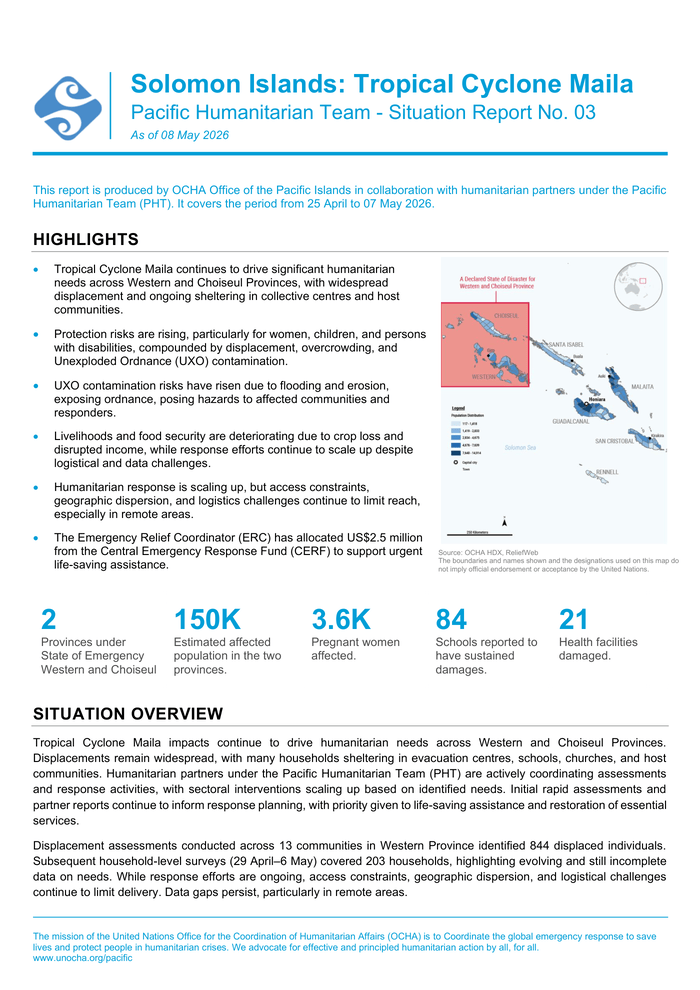
Country: Solomon Islands Sources: Pacific Humanitarian Team, UN Office for the Coordination of Humanitarian Affairs Please refer to the attached file. This report is produced by OCHA Office of the Pacific Islands in collaboration with humanitarian partners under the Pacific Humanitarian Team (PHT). It covers the period from 25 April to 07 May 2026. HIGHLIGHTS Tropical Cyclone Maila continues to drive significant humanitarian needs across Western and Choiseul Provinces, with widespread displacement and ongoing sheltering in collective centres and host communities. Protection risks are rising, particularly for women, children, and persons with disabilities, compounded by displacement, overcrowding, and Unexploded Ordnance (UXO) contamination. UXO contamination risks have risen due to flooding and erosion, exposing ordnance, posing hazards to affected communities and responders. Livelihoods and food security are deteriorating due to crop loss and disrupted income, while response efforts continue to scale up despite logistical and data challenges. Humanitarian response is scaling up, but access constraints, geographic dispersion, and logistics challenges continue to limit reach, especially in remote areas. The Emergency Relief Coordinator (ERC) has allocated US$2. 5 million from the Central Emergency Response Fund (CERF) to support urgent life-saving assistance. SITUATION OVERVIEW Tropical Cyclone Maila impacts continue to drive humanitarian needs across Western and Choiseul Provinces. Displacements remain widespread, with many households sheltering in evacuation centres, schools, churches, and host communities. Humanitarian partners under the Pacific Humanitarian Team (PHT) are actively coordinating assessments and response activities, with sectoral interventions scaling up based on identified needs. Initial rapid assessments and partner reports continue to inform response planning, with priority given to life-saving assistance and restoration of essential services. Displacement assessments conducted across 13 communities in Western Province identified 844 displaced individuals. Subsequent household-level surveys (29 April–6 May) covered 203 households, highlighting evolving and still incomplete data on needs. While response efforts are ongoing, access constraints, geographic dispersion, and logistical challenges continue to limit delivery. Data gaps persist, particularly in remote areas. The situation is further compounded by heightened risks for vulnerable groups, including people with disabilities, who face increased barriers to accessing services, mobility challenges, and heightened protection risks. Additionally, UXO contamination risks have increased, particularly in Western Province, due to flooding and erosion exposing ordnance, posing risks during response and recovery activities. Response operations have been supported by national and provincial coordination mechanisms (NDMO, PEOC), with partners actively contributing to logistics, data management, and service delivery. However, challenges remain around access to data, logistics, and reaching remote communities, particularly in Western and Choiseul provinces.
Solomon Islands: Tropical Cyclone Maila – Pacific Humanitarian Team: Situation Report No.3 (8 May 2026)

RELATED ARTICLES


