


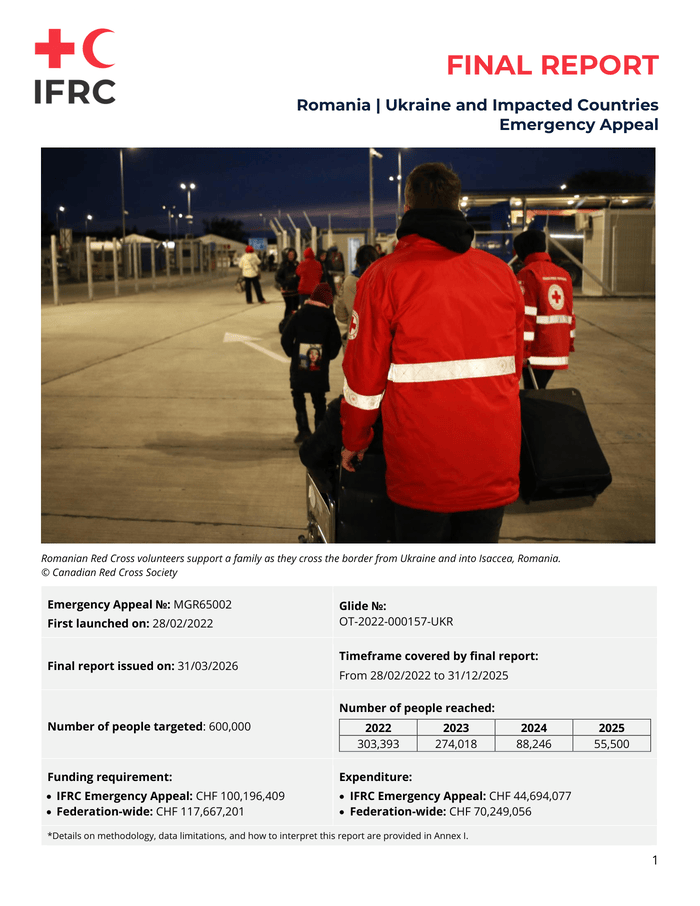
Countries: Romania, Ukraine Source: International Federation of Red Cross and Red Crescent Societies Please refer to the attached file. A. SITUATION ANALYSIS In February 2022, Romania was affected by the international armed conflict between Russia and Ukraine, which triggered one of the largest displacement crises in Europe. Within weeks, hundreds of thousands of people fleeing Ukraine crossed into Romania, primarily through the northern and eastern border points. The sudden influx placed immediate pressure on national and local systems, generating urgent humanitarian needs related to emergency accommodation, food and basic items, healthcare, protection, and information support. Initial assessments conducted by the Romanian Red Cross (RRC), in coordination with public authorities and Movement partners, identified heightened vulnerabilities among older people, women with children, and persons with disabilities, particularly regarding access to healthcare, income, and safe housing1. In response, the RRC rapidly scaled up emergency assistance, including first aid, relief item distribution, Cash and Voucher Assistance (CVA), and psychosocial support, while mobilising volunteers and expanding branch-level response capacities. Throughout 2023, the displacement situation became increasingly protracted. While many displaced people from Ukraine achieved a degree of stability, including access to employment and longer-term accommodation, significant gaps persisted for those in vulnerable situations. Humanitarian needs gradually shifted from immediate lifesaving assistance towards more stabilisation- and inclusion-oriented support, particularly in health, livelihoods, mental health and psychosocial support (MHPSS), and social integration. At the same time, rising living costs, economic uncertainty, and concerns regarding the duration and conditions of temporary protection contributed to increased financial stress, debt accumulation, and protection risks among displaced populations, underscoring the need for continued humanitarian engagement. In 2024, Romania continued to host a significant displaced population from Ukraine amid a complex regional context. Across Europe, over six million people displaced from Ukraine were recorded, with unmet needs remaining high, particularly for medical and material assistance among older people and other vulnerable groups (IFRC, 2024). In Romania, rising housing costs and the gradual reduction of subsidised accommodation and government support increased risks of housing insecurity, secondary displacement, and negative coping strategies. Simultaneously, socio-economic vulnerabilities among segments of the Romanian host population became more pronounced, particularly among low-income households, older people, and socially marginalised groups affected by inflation and rising living costs. This context heightened the risk of social tension and exclusion, reinforcing the need for inclusive, community-based approaches that addressed shared vulnerabilities and promoted social cohesion. As of 2025, the international armed conflict between Russia and Ukraine remains ongoing, with continued humanitarian repercussions across the region. In Romania, 197, 802 refugees from Ukraine were recorded in October 20252. While many displaced people are increasingly integrated into host communities, others continue to face barriers to sustainable housing, healthcare, education, and livelihoods. Vulnerable groups — including single-parent households, older people, persons with disabilities, and individuals dependent on government assistance — remain particularly exposed to economic hardship, protection risks, and deteriorating mental well-being. Against a backdrop of persistent socio-economic pressures affecting both displaced populations and host communities, humanitarian needs in Romania remain significant and evolving. Although the extension of the EU Temporary Protection Directive until at least March 2027 provides an important legal framework, shifting national support policies and broader global economic uncertainty risk exacerbating vulnerabilities. The situation therefore continues to require coordinated, flexible, and conflict-sensitive humanitarian action, informed by lessons learned since 2022 and adapted to the protracted nature of the crisis.



GrowthPakistan brings you the latest news to keep an eye on Pakistan’s startup ecosystem. Business keeps you growing when you stay aware of your competitors' moves. GrowthPakistan offers Business, Tech, Global Tech, Global, Auto, and Startup News straight from industries all around the globe. This platform will help you identify upcoming opportunities not only in Pakistan but worldwide.
Email : growthpakistan@gmail.com
Whatsapp : +92320-9497079
© growthpakistan