


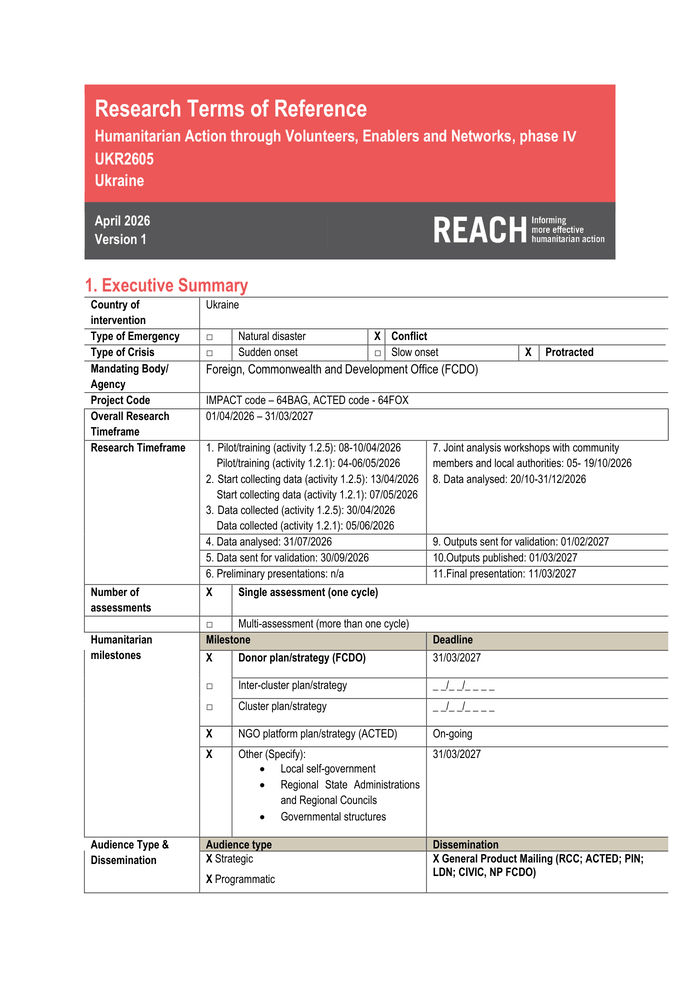
Country: Ukraine Source: REACH Initiative Please refer to the attached file. 2. Rationale 2. 1. Background The full-scale invasion has triggered a protracted humanitarian crisis in Ukraine. Intensified hostilities and systematic strikes on energy infrastructure have disrupted essential services—heating, water, and healthcare – especially in frontline areas. This collapse of critical systems, combined with a massive displacement crisis (affecting over 10 million people), has exhausted local resources. Against this backdrop, there is a growing recognition of the importance of localized recovery planning. Hromadas are uniquely positioned to identify priority needs, mobilize local resources, and coordinate stakeholders, as they possess first-hand knowledge of local conditions and community dynamics. The war has also created severe staffing challenges. The evacuation and displacement of the civilian population has resulted in the loss of experienced professionals in local government, healthcare, education, and the utility sector, reducing the quality and timeliness of service delivery. Concurrently, the weakening economy and shrinking tax base – caused by business closures, population loss, and declining incomes—have limited the financial capacity of communities to maintain services and implement development projects. The arrival of many internally displaced persons (IDPs) has placed additional strain on housing, medical, and social infrastructure. In many communities, the needs of IDPs exceed available resources, worsening access to services for all residents. Within the broader context of decentralization reforms in Ukraine, and despite the above-mentioned challenges, hromadas have emerged as primary drivers of local recovery and development processes. Furthermore, their central role in these processes has an important psycho-social effect at the community level, placing conflict-affected communities at the forefront of decision-making on future development trajectories. However, hromadas’ ability to fulfil their leading role in recovery planning effectively requires access to reliable and up-to-date data, inclusive mechanisms for engaging diverse stakeholder groups, and planning processes that are aligned with national and oblast-level recovery and development frameworks. The HAVEN programme has been supported by FCDO since June 2023, with its first phase concluding in March 2024, followed by a second phase from April 2024 to March 2025, third phase from April 2025 to March 2026, and the fourth phase covers the period from April 1, 2026, to March 31, 2027. This programme aims to strengthen humanitarian response structures and provide sustained services to war-affected communities. Specifically, programme activities are focused on addressing the priority protection needs of affected populations and strengthening the localized coordination of humanitarian assistance in close-to-frontline communities. The HAVEN programme is implemented by a large consortium of organisations, including Nonviolent Peaceforce (NP), Geneva Call (GC), Acted, IMPACT/REACH, the Relief Coordination Centre (RCC) and the Center for Civilians in Conflict (CIVIC). The HAVEN programme maintains its relevance by designing, delivering and adapting operations in line with changes in humanitarian and conflict dynamics in Ukraine. Support is informed by regular monitoring and careful analysis of the target beneficiaries’ needs ensuring support is directed to those most at risk – particularly in frontline and hard-to-access areas. Sub-granting is used in a flexible way, allowing partners to respond to emerging protection issues or support locally-driven initiatives. The HAVEN project is fundamentally designed around greater localization, centralizing the role of local authorities, CSOs, NGOs, volunteers, and networks to efficiently respond to needs on the ground and building sustainable capacity. As members of the consortium, in Phase III of HAVEN project, IMPACT responded to hromadas’ needs by supporting selected hromadas in strengthening their capacity to develop Local Recovery Plans (LRPs) and Local Development Strategies (LDSs) that are evidence-based, utilize participatory processes, and coherent with official planning processes. Building on lessons learned from previous phases of the HAVEN initiative and similar programmes, HAVEN IV recognizes that effective recovery planning must go beyond the production of formal documents. It requires a structured process that combines data review, stakeholder engagement, and institutional capacity strengthening to ensure that planning outputs are both technically sound and locally owned. Under Phase IV of the HAVEN project, IMPACT together with Acted will support 4 newly selected hromadas in Dnipropetrovska oblast with developing Local Development Strategies (LDSs). The aim is for these outputs to align with official recovery and development planning processes, ultimately enabling hromadas to attract public investment and donor funds based on data-driven resource priortisation grounded in a clearly articulated strategic vision. Experiences from previous project phases and other initiatives have demonstrated the need to increase hromadas’ use of data-based evidence and participatory mechanisms to develop long-term strategic documents that will be responsive to the specific needs and context of their hromadas, to establish a solid foundation for local resilience. By combining data-driven insights with participatory methodologies, this activity seeks to empower hromada authorities to develop recovery plans that are technically sound, reflective of community needs and aspirations as well as will be fully consistent with the development and recovery strategies of the state and regional levels. The activity is structured around three key phases: Phase 1: Hromada screening and stakeholder mapping. Drawing from lessons learned under HAVEN III and similar programming, hromada authorities’ level of buy-in and capacity to engage are critical success factors for this activity. Reflecting this, IMPACT will conduct a screening process to select hromadas in target areas based on capacity, need, and local authority buy-in. The assessment process will include consultations with consortium partners and other key stakeholders and a stakeholder mapping exercise, which will identify main local actors and civil society entities involved or interested in local development and recovery. This will ensure that the recovery planning processes include different perspectives, promote collaboration, and identify potential partners who can contribute to or benefit from the project. Phase 2: Data Review. Following the selection of target hromadas, IMPACT will collaborate with local and oblast-level authorities, and CSOs, to gather, structure, and review official data, as well as identify key data gaps. Consultations with key stakeholders, including community representatives, will be conducted to understand the unique needs and visions for each hromada. This phase of work is designed to build trust and strengthen relationships and will ensure the ability to tailor support packages to the specific contexts and priorities of each hromada. Phase 3: IMPACT will support the development of LDSs for 4 pilot hromadas selected during the Phase 4 selection process. This activity will involve guiding the entire planning process and providing tailored support to ensure the plans are data-driven, participatory, and aligned with the specific needs of each hromada. Phase 4: Continued support for hromadas from Phases 2 and 3 through the conduct of an additional assessment of the accessibility of basic services in hromadas. Based on the results of the assessment, a list of tasks and measures to improve the accessibility of basic services in hromadas will be developed, which will be incorporated into hromadas planning documents and used by ACTED as the baseline for providing further grant support to local initiatives. 2. 2 Intended Impact Through this assessment, IMPACT aims to assess the current socio-economic situation, and basic services in selected hromadas to identify challenges and a way forward. The final goal is to complement existing data to inform transition and recovery planning, providing more effective support for local entities in creating local development strategies. Additionally, through regular open data request to local authorities and joint analysis sessions following the development of planning documents, IMPACT will additionally seek to strengthen the capacity of local authorities and public service providers in gathering and using geo‐spatial and statistical data. The creation of LDS will enable hromadas to access mechanisms for co-financing investment projects, supported by the government and/or international institutions and comply with state and regional development strategies. These plans will also enable HAVEN IV consortium partners working in these areas to better target and adapt their own activities in line with the priorities identified. By integrating CSOs into decision-making processes and ensuring transparency, the strategies will reflect the collective vision of all stakeholders. IMPACT will work with hromada authorities and key civil society stakeholder to facilitate a sustained participatory process. This will involve establishing mechanisms for developing and reviewing LDSs; targeted training and sustained capacity support to strengthen local capacity for data-driven decision-making; targeted data collection and analysis to address data gaps identified in the planning process; and stakeholder engagement through workshops, events, and participatory feedback processes involving local communities themselves. Acted will continue supporting grassroots recovery initiatives new selected hromadas of Dnipropetrovska oblast through a mini-grant programme and medium grants programme in 4 hromadas from phases 2 and 3. This granular support towards small-scale initiatives on a highly localised level is essential for the effective to ensure resilience and a more rapid response to basic challenges of communities.



GrowthPakistan brings you the latest news to keep an eye on Pakistan’s startup ecosystem. Business keeps you growing when you stay aware of your competitors' moves. GrowthPakistan offers Business, Tech, Global Tech, Global, Auto, and Startup News straight from industries all around the globe. This platform will help you identify upcoming opportunities not only in Pakistan but worldwide.
Email : growthpakistan@gmail.com
Whatsapp : +92320-9497079
© growthpakistan