

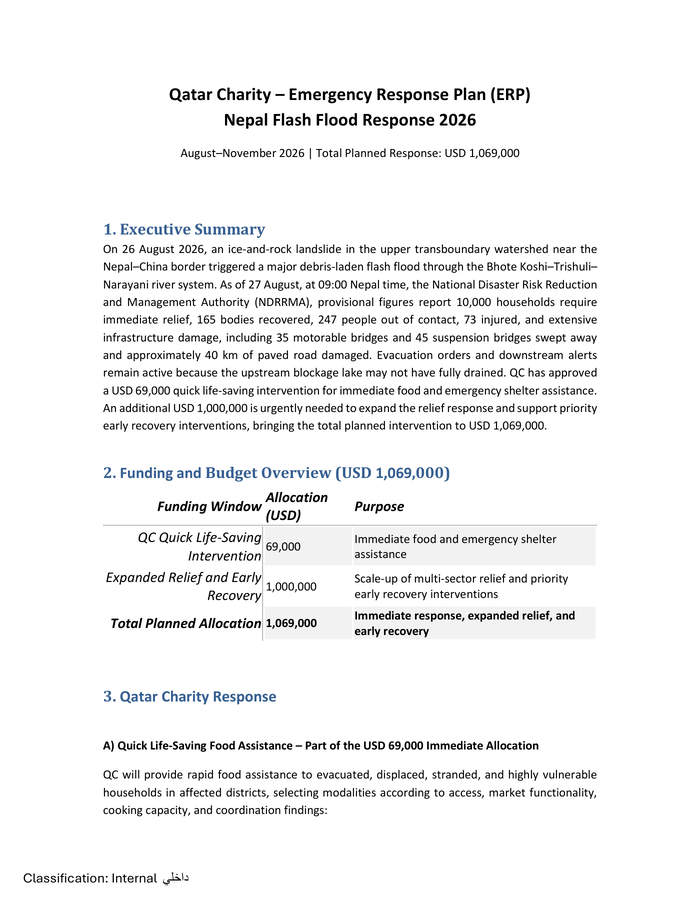
Country: Nepal Source: Qatar Charity Please refer to the attached file. August–November 2026 | Total Planned Response: USD 1, 069, 000 1. Executive Summary On 26 August 2026, an ice-and-rock landslide in the upper transboundary watershed near the Nepal–China border triggered a major debris-laden flash flood through the Bhote Koshi–Trishuli–Narayani river system. As of 27 August, at 09: 00 Nepal time, the National Disaster Risk Reduction and Management Authority (NDRRMA), provisional figures report 10, 000 households require immediate relief, 165 bodies recovered, 247 people out of contact, 73 injured, and extensive infrastructure damage, including 35 motorable bridges and 45 suspension bridges swept away and approximately 40 km of paved road damaged. Evacuation orders and downstream alerts remain active because the upstream blockage lake may not have fully drained. QC has approved a USD 69, 000 quick life-saving intervention for immediate food and emergency shelter assistance. An additional USD 1, 000, 000 is urgently needed to expand the relief response and support priority early recovery interventions, bringing the total planned intervention to USD 1, 069, 000. 2. Funding and Budget Overview (USD 1, 069, 000) Funding Window Allocation (USD) Purpose QC Quick Life-Saving Intervention 69, 000 Immediate food and emergency shelter assistance Expanded Relief and Early Recovery 1, 000, 000 Scale-up of multi-sector relief and priority early recovery interventions Total Planned Allocation 1, 069, 000 Immediate response, expanded relief, and early recovery 3. Qatar Charity Response A) Quick Life-Saving Food Assistance – Part of the USD 69, 000 Immediate Allocation QC will provide rapid food assistance to evacuated, displaced, stranded, and highly vulnerable households in affected districts, selecting modalities according to access, market functionality, cooking capacity, and coordination findings: Ready-to-eat meals and food for people in evacuation sites, temporary shelters, transit locations, and rescue staging areas. Household food parcels where families retain safe cooking capacity and access to fuel. B) Quick Life-Saving Emergency Shelter Assistance – Part of the USD 69, 000 Immediate Allocation QC will distribute context-appropriate emergency shelter and household items to evacuated and displaced families in safe temporary sites, host arrangements, and accessible affected communities, including: Blankets, sleeping mats, and family household items Hygiene kits C) Expanded Relief and Early Recovery Package (USD 1, 000, 000) Additional funding is required to expand the response across priority sectors according to verified needs, coordination findings, operational feasibility, Interventions may include: Scale-up of food assistance, emergency shelter, core relief items, WASH, health, and essential service continuity. Improvement of safe temporary accommodation and evacuation sites, including lighting, privacy, accessibility, and drainage. Early recovery support, including shelter repair, drinking-water system restoration, community infrastructure rehabilitation, livelihoods recovery, and targeted cash or voucher assistance where appropriate. Detailed sector allocations, outputs, and beneficiary targets under the USD 1, 000, 000 expansion will be finalized following rapid multi-sectoral assessments, government and cluster coordination, partner capacity review and market analysis. 4. Geographic Prioritization QC will prioritize the most severely affected and operationally accessible areas along the Bhote Koshi–Trishuli–Narayani corridor, subject to government guidance, verified needs, safety, and partner presence: Rasuwa: Rasuwagadhi, Timure, Syaphrubesi, and other affected or isolated communities Nuwakot and Dhading: riverbank settlements, evacuation sites, and access corridors Chitwan, Gorkha, Tanahun, Nawalparasi East, and Nawalparasi West: downstream affected locations based on verified impact and unmet needs 5. Response Coordination: QC will coordinate its response efforts closely with the relevant Government of Nepal counterparts, including national and district authorities, as well as UN agencies, international NGOs, local organizations, and other humanitarian partners operating on the ground. This coordination will help align interventions with national priorities and sector mechanisms, avoid duplication, address identified gaps, facilitate information sharing and referrals, and promote a coherent, complementary, and accountable response. Implementation Timeline (90 Days) Hours 0–72 / Week 1: Coordination with national and district authorities; rapid assessment; partner mapping; immediate procurement and distribution of food and shelter support to accessible sites. Weeks 2–8: Expanded multi-sector implementation; temporary shelter; post-distribution monitoring; adaptive targeting as access and official figures evolve. Weeks 9–12: Early recovery priorities, service restoration support, transition or handover, final monitoring, reporting, and lessons learned. Annex: Key References and Planning Assumptions Nepal Flash Floods Situation Report No. 01, 27 August 2026, 11: 00 hrs Nepal time. Government of Nepal, NDRRMA Bhote Koshi Flood Emergency Status Report #05, 27 August 2026, 09: 00 hrs. Department of Hydrology and Meteorology technical report on the 2083 Bhote Koshi–Trishuli–Narayani Flood. All figures, geographic priorities, targets, modalities, and budgets remain provisional and require validation through government coordination, field assessment, partner due diligence, market analysis, and internal approval.
Qatar Charity – Emergency Response Plan (ERP) – Nepal Flash Flood Response 2026

RELATED ARTICLES


