


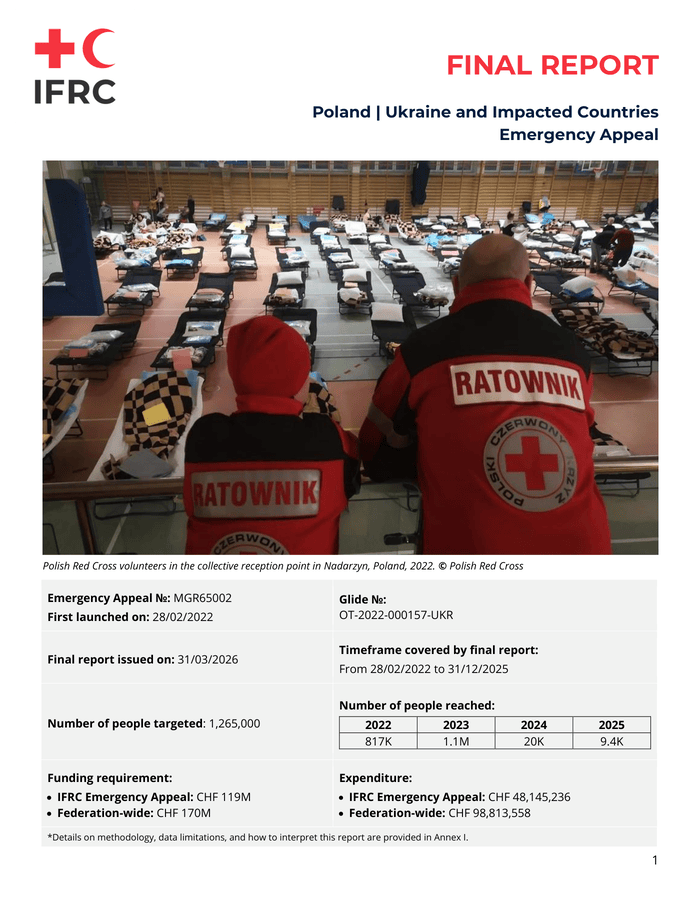
Countries: Poland, Ukraine Source: International Federation of Red Cross and Red Crescent Societies Please refer to the attached file. A. SITUATION ANALYSIS Description of the crisis Since February 2022, Poland became one of the primary destinations for people, mainly consisting of women, children and older people, fleeing Ukraine as the result of the escalation of the Russia-Ukraine international armed conflict. Based on October 2025 figures, 1 million displaced people from Ukraine are recorded in Poland, among them 960, 000 registered under the temporary protection schemes1. In responding to the situation and alleviating the suffering of the displaced population, Polish Red Cross (PRC) with the support from the IFRC network started the implementation of its largest emergency response operations providing assistance with relief through multipurpose cash, vouchers, food and NFI distributions, shelter, health and care, including with mental health, integration and inclusion services, protection, prevention and restoration of people’s livelihoods to around 1. 8 million people2. The organisation engaged a network of more than 8, 000 volunteers in 200 locations to assist displaced population in emergency including through social care, psychosocial support and integration socio-cultural and socio-economic activities. Needs assessment, conducted by UNHCR in 2023, showed that after a year from the crisis, despite humanitarian support was crucial for displaced people from Ukraine, 32% of respondents indicated that household income was insufficient to meet basic needs in Poland. People reported cash for basic needs (69%), food (40%), and accommodation (27%) as the top three priorities3. PRC/IFRC responded to this demand by completing one of its largest multipurpose cash interventions together with providing conditional shelter assistance. One of the biggest challenges was the increased rental costs coupled with changes in the governmental Special Act on Ukrainian refugees (2023) that significantly reduced the possibility of staying for free in collective sites47. It was also reported that most of the displaced relied on social benefits as their main source of income in Poland. Only half of the respondents were employed, and 63% of Ukrainians were not able to speak Polish. This increases the need for sectoral interventions focused on livelihoods, integration and inclusion programmes8. In 2024, Poland remained affected by the protracted consequences of the crisis. Moreover, Poland’s Government tightened migration measures by adopting its Migration Strategy 20305. On the base of this new strategy, a total of 49 foreigners’ integration centres were established offering Polish language courses, information sessions, psychological care, legalization support, legal assistance. Additionally, collective cites were due to close permanently and 34, 000 displaced people from Ukraine had to find alternative accommodation solutions The biggest consequence was that authorities temporarily suspended the acceptance of asylum claims6. In comparison with the beginning of the crisis, 2025 was characterized by a negative trend of “compassion fatigue” and growing xenophobia which spark debates on integration and social cohesion7. The situation created additional challenges for integration and economic security for displaced people from Ukraine in Poland8. This despite the positive impact on Polish economy, displaced people from Ukraine boosted Poland’s GDP by 2. 7%9. PRC re-focused its orientation to offering long-term assistance aimed at integrating the Ukrainian community within Polish society including offering socio-cultural activities, vocational and language courses, microentrepreneurial programmes, recreation activities for adults and children, supporting mental health and well-being, legal consultations, sectoral cash interventions among others.



GrowthPakistan brings you the latest news to keep an eye on Pakistan’s startup ecosystem. Business keeps you growing when you stay aware of your competitors' moves. GrowthPakistan offers Business, Tech, Global Tech, Global, Auto, and Startup News straight from industries all around the globe. This platform will help you identify upcoming opportunities not only in Pakistan but worldwide.
Email : growthpakistan@gmail.com
Whatsapp : +92320-9497079
© growthpakistan