


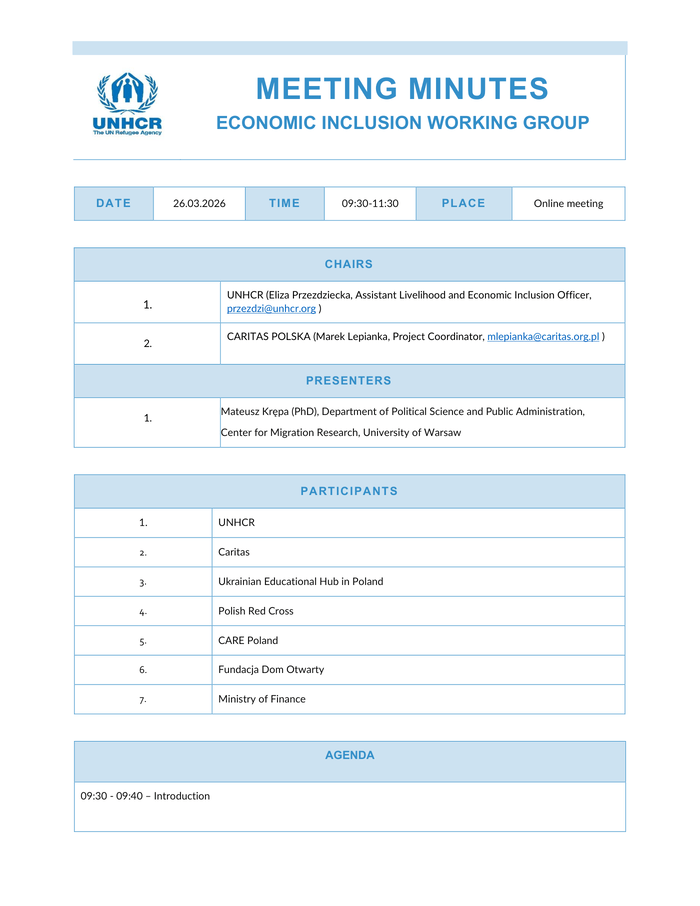
Country: Poland Source: UN High Commissioner for Refugees Please refer to the attached file. OVERVIEW OF THE SITUATION Migration and security – myths and research on migrants’ integration and crime The presenter explores what research really shows about the relationship between migration and security. Discussions about migration are often highly politicized, which makes the topic difficult to study objectively. Despite this, the overall conclusion from international studies is clear: there is no solid evidence that migration leads to higher crime or lower security. Research from countries like Australia, Switzerland, and Germany shows that immigration itself does not increase violent crime. When risks do appear, they are linked not to being a migrant, but to specific circumstances. Even then, the impact on local security is small, and integration policies such as access to the labor market significantly reduce these risks. A recent literature review (Marie & Pinotti, 2024) explains why immigrants sometimes appear overrepresented in arrest or prison statistics. Possible reasons include discrimination by police or courts, displacement of native offenders in certain illegal markets, or simply the fact that immigrants make up too small a share of the population to affect overall crime rates. Media coverage also plays a major role in reinforcing the belief that migration increases crime. The presenter also explains integration as a two‐way process in which migrants become active participants in the host society while maintaining their culture. Successful integration strengthens social cohesion and reduces potential risks. Finally, the presenter discusses the securitization of migration, meaning the framing of migration as a security threat. This process mixes real risks with generalization, and manipulation, allowing migration to be used for political purposes. Factors that make societies more susceptible include lack of personal contact with migrants, distrust of elites, feelings of cultural superiority, information overload, and fear of social change. Overall, the main message is that the link between migration and security is overstated. Risks exist but are specific, limited, and manageable, and integration is key to reducing them.



GrowthPakistan brings you the latest news to keep an eye on Pakistan’s startup ecosystem. Business keeps you growing when you stay aware of your competitors' moves. GrowthPakistan offers Business, Tech, Global Tech, Global, Auto, and Startup News straight from industries all around the globe. This platform will help you identify upcoming opportunities not only in Pakistan but worldwide.
Email : growthpakistan@gmail.com
Whatsapp : +92320-9497079
© growthpakistan