

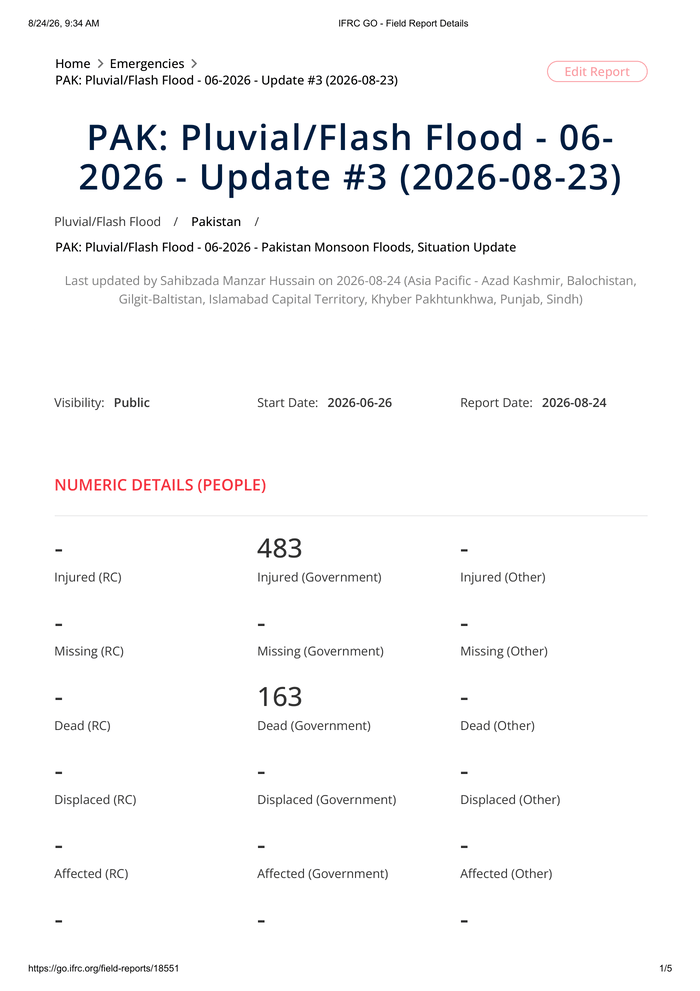
Country: Pakistan Sources: International Federation of Red Cross and Red Crescent Societies, Pakistan Red Crescent Society Please refer to the attached file. Description Situation Overview Pakistan’s 2026 monsoon season began around 26 June, with the Pakistan Meteorological Department (PMD) declaring the formal onset in the first week of July. PMD’s seasonal outlook points to below-normal rainfall nationally, but officials have cautioned that below-normal totals do not equate to low risk, as short and intense rain spells continue to trigger flash flooding, urban flooding and landslides, particularly in the north and northeast. As of the latest NDMA daily situation report (21 August), the cumulative death toll since 26 June has crossed 163, with over 483 people injured nationwide. Khyber Pakhtunkhwa has recorded the highest number of fatalities, followed by Punjab, Sindh, Azad Jammu and Kashmir (AJK) and Baluchistan. House and roof collapses account for majority of all deaths, followed by flash floods, drowning and lightning strikes. Rainfall has arrived in successive spells rather than a single peak. Active flood alerts were held on the Chenab, Jhelum and Ravi through late July, with the Flood Forecasting Division reported high-level flooding on the Chenab at Chiniot and moderate flooding at Marala, Khanki and Qadirabad. Chitral has sustained the most severe and most structurally damaging impact of the 2026 season. On the night of Monday 3 August a cloudburst over Broz, combined with a glacial lake outburst flood and an abnormal surge in temperature, generated flood torrents through Gumbas Gol and Broz Gol. Destruction extends across the district from Sheshi Koh Valley and Drosh in Lower Chitral to Mastuj in Upper Chitral, where swollen streams and mountain nullahs tore through Reshun, Zait, Kuragh, Charun, Booni, Awi, Parwak, Mastuj Khas and Parkusap. At Prayet Gol, high-level flooding carrying heavy sludge blocked the main flow of the Chitral River for several hours. A second event on 12 August triggered renewed flash flooding in the Broz and Gumbas Gol streams, closing the Chitral–Peshawar Road again and cutting off Baroz Gol and Sheedi village. Weather Forecast (21–27 August 2026) Monsoon currents and a westerly wave are expected to continue affecting the northern and upper parts of Pakistan, with rain-wind/thunderstorms and isolated heavy rainfall forecast on 21–22 August across Islamabad, Punjab, Kashmir, Khyber Pakhtunkhwa and Gilgit-Baltistan. Heavy rainfall is particularly possible in parts of Battagram, Buner, Abbottabad and Haripur on 22 August. From 23 August onward, conditions are expected to become predominantly hot and humid, with isolated thunderstorms possible in parts of Kashmir, Khyber Pakhtunkhwa, Punjab and northeast Baluchistan on 23 August. Mostly hot and humid weather is expected through 26 August, while rain/thunderstorms may return to Kashmir and Gilgit-Baltistan on 27 August. Request For Assistance Government Requests International Assistance: No NS Requests International Assistance: No Information Bulletin Published No Actions taken by National Society General Damage/Needs assessment Water & Sanitation Food aid Shelter Relief/Supply distribution Summary Pakistan Red Crescent Society (PRCS) Actions • PRCS continues to closely monitor the evolving monsoon situation through its National Headquarters and Provincial/State Branches, maintaining regular coordination with the National Disaster Management Authority (NDMA), Provincial Disaster Management Authorities (PDMA), district administrations, and other relevant government departments to assess humanitarian needs and support preparedness and response efforts. • The PRCS Emergency Operations Centre (EOC) remains operational on a 24/7 basis, continuously monitoring weather forecasts, official advisories, and field information to facilitate timely information sharing, situational analysis, and operational coordination. Emergency Operations Centers at national and branch levels remain on standby, while National Disaster Response Teams (NDRTs), District Disaster Response Teams (DDRTs), Community Disaster Response Teams (CDRTs), first aid volunteers, and trained staff are ready for rapid deployment. Pre-positioned emergency relief stocks are available for immediate mobilization based on assessed needs. • Following the cloudburst in District Neelum, Azad Jammu and Kashmir (AJK) on 19 July 2026, the PRCS AJK State and District Neelum Branches promptly coordinated with the district administration, supported rapid needs assessments, and shared initial situation reports. PRCS continues to closely monitor the situation in coordination with NDMA, PDMA and local authorities and remains prepared to provide humanitarian assistance should additional needs arise. • To further strengthen preparedness and Movement-wide coordination ahead of the peak monsoon period, PRCS convened the Movement Coordination Meeting on 22 July 2026. The meeting brought together Movement partners to review the evolving monsoon situation, share preparedness measures, identify potential operational and resource gaps, and reinforce coordinated planning to ensure a timely and effective humanitarian response if required. • Following the GLOF and cloudburst impacts in August at Chitral, PRCS Khyber Pakhtunkhwa received relief assistance from Provincial Disaster Management Authority Sindh, which was subsequently distributed to 400 affected families. The relief assistance comprised 400 ration bags containing approximately 27. 8 kg of dry food commodities per family, along with 400 tents, 400 kitchen sets and 2, 000 blankets (five per family) to address immediate shelter and household needs. In response to the acute shortage of safe drinking water caused by damage to local water supply systems, PRCS also provided 18 water filtration units and 30 water tanks to support affected communities. The transportation and distribution of relief packages were supported through the ongoing Monsoon EA MDRPK028. This support enabled PRCS to facilitate the timely movement and delivery of essential relief items to the affected communities and complemented the response efforts following the flooding. • PRCS has planned to distribute 50 hygiene kits to flood-affected households in District Ghizer and 45 hygiene kits to affected households in District Astore, Gilgit-Baltistan. Actions taken by Federation General Other Summary IFRC Actions • The IFRC Country Delegation continues to provide technical and coordination support to PRCS, maintaining close engagement with the National Society to monitor the evolving monsoon situation and analyze potential humanitarian impacts. • IFRC is supporting PRCS through regular information exchange, preparedness planning, and operational coordination, while maintaining close liaison with Movement partners to facilitate a coordinated response should the situation deteriorate. • With the support of IFRC, PRCS NHQ has transferred PKR 300000/- to each provincial branch to initiate response actions in their respective areas. These funds are part of the ongoing Monsoon EA MDRPK028, which enables the branches to undertake rapid assessments and initiate immediate response activities as required. • The IFRC Country Delegation remains ready to mobilize additional technical, operational and resource support to complement the National Society’s response, based on evolving humanitarian needs and government requests. Actions taken by others • NDMA has issued nationwide high alerts for flash floods, urban flooding and landslides, and directed provincial and district administrations to continuously monitor rivers and streams, pre-position emergency response teams and relief supplies in vulnerable areas, and advise the public to avoid unnecessary travel to flood-prone and mountainous areas. • Prime Minister Shehbaz Sharif on Saturday directed the National Disaster Management Authority (NDMA) to mobilize all available resources to provide all-out assistance and relief to people affected by floods. • PMD’s Flood Forecasting Division continues to issue river-by-river flow bulletins to inform evacuation planning and barrage management decisions. • Authorities providing relief assistance in flood affected areas. • Humanitarian partners, including UN agencies, NGOs and other members of the humanitarian community, are coordinating with government authorities through existing coordination mechanisms to support the government-led monsoon response. Partners continue to monitor the evolving situation and stand ready to scale up response if needed.
Pakistan: PAK: Pluvial/Flash Flood – 06-2026 – Update #3 (2026-08-23)

RELATED ARTICLES


