


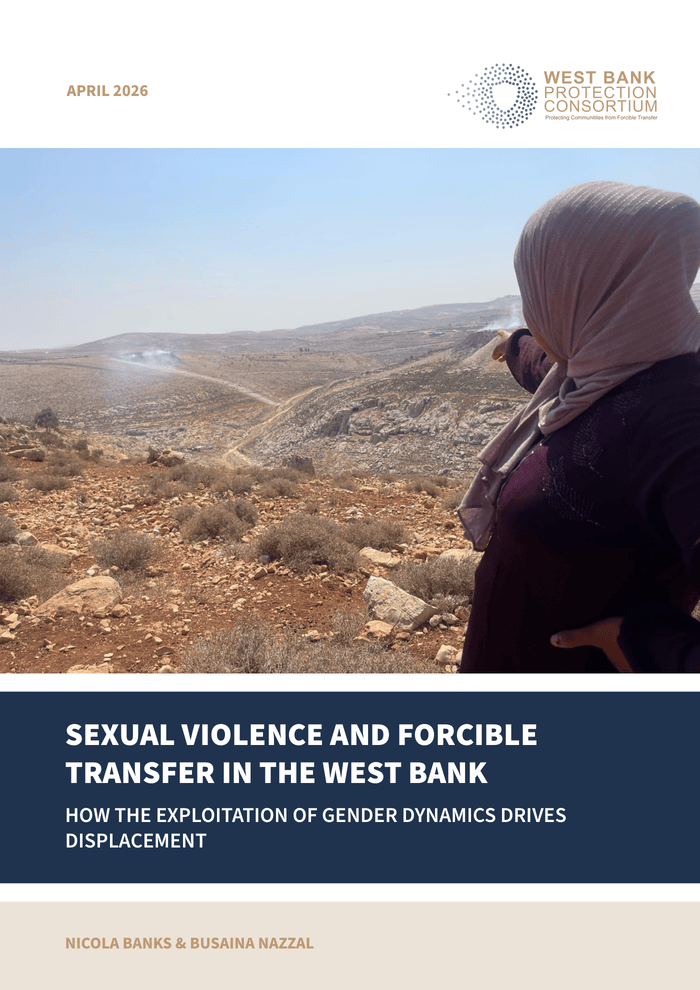
Country: occupied Palestinian territory Source: Norwegian Refugee Council Please refer to the attached file. NICOLA BANKS & BUSAINA NAZZAL This report documents gender-based and sexualised violence perpetrated by Israeli settlers against Palestinians in Area C of the West Bank in contexts where Israeli forces were present and did not prevent or halt the violence, nor effectively investigate the abuses. In these circumstances, such violence is not occuring in isolation. It operates within a coercive environment that contributes to the forcible transfer of Palestinian communities. The research results of this report found at least 16 cases of conflict-related sexual violence attributed to Israeli settlers and soldiers. These cases form part of a broader pattern of sexualised harassment, intimidation and humiliation, much of which remains underreported. Taken together, the evidence shows how sexualised violence is used to pressure communities, shape decisions about remaining or leaving their homes and land, and alter patterns of daily life. EXECUTIVE SUMMARY This report documents gender-based and sexualised violence perpetrated by Israeli settlers against Palestinians in Area C of the West Bank in contexts where Israeli forces were present and did not prevent or halt the violence, nor effectively investigate the abuses. In these circumstances, such violence is not occurring in isolation. It operates within a coercive environment that contributes to the forcible transfer of Palestinian communities. The research results of this report found at least 16 cases of conflict-related sexual violence attributed to Israeli settlers and soldiers. These cases form part of a broader pattern of sexualised harassment, intimidation and humiliation, much of which remains underreported. Taken together, the evidence shows how sexualised violence is used to pressure communities, shape decisions about remaining or leaving their homes and land, and alter patterns of daily life. Gender-based violence, including conflict-related sexual violence, constitutes a grave violation of bodily integrity and personal dignity. In the cases documented, it functions as a coercive tool that penetrates domestic space, fractures family life and renders continued civilian residence untenable. More than 70% of displaced households interviewed identified threats to women and children, particularly sexualised violence, as the decisive reason for leaving. In response, families adopt gendered protective strategies, including the partial transfer of women and children and recourse to early marriage, in an effort to reduce exposure to harm. These abuses occur within a broader environment shaped by systematic discrimination and persistent impunity. It is reinforced by restrictions on access to land and resources, attacks on homes and civilian infrastructure, and rhetoric advocating the removal of Palestinian communities. Over time, these conditions create a coercive environment that pushes families and communities to leave their homes. When people are driven from their homes because remaining has become impossible, the displacement may amount to forcible transfer under international humanitarian law. Forcible transfer does not require physical force. It occurs when coercive conditions leave civilians with no genuine choice but to flee. This pattern reflects several warning signs identified in the United Nations Framework of Analysis for Atrocity Crimes, including discrimination targeting a civilian population, tolerance of violence by non-state actors, and the absence of effective accountability. A gender perspective shows that this pressure extends beyond public violence into the private sphere. Women and girls face heightened risks to bodily autonomy and personal safety. Families struggle to sustain livelihoods and maintain household stability. Community decision making and social cohesion weaken as insecurity deepens and access to resources declines. Early-warning frameworks are designed for situations where repeated abuses and impunity signal escalating risk. Under Common Article 1 of the Geneva Conventions, States must respect and ensure respect for international humanitarian law. When credible information indicates a foreseeable risk of serious violations, States must use the diplomatic, political, economic and legal tools available to them to help prevent violations and bring them to an end. In its 2024 Advisory Opinion on the legal consequences arising from Israel’s policies and practices in the occupied Palestinian territory, including East Jerusalem, the International Court of Justice reaffirmed that serious breaches of peremptory norms trigger obligations for all States. These include non-recognition of the unlawful situation, non-assistance in maintaining it, and cooperation to bring it to an end. To the extent that the patterns documented in this report form part of, or contribute to, such serious breaches, these obligations are engaged.



GrowthPakistan brings you the latest news to keep an eye on Pakistan’s startup ecosystem. Business keeps you growing when you stay aware of your competitors' moves. GrowthPakistan offers Business, Tech, Global Tech, Global, Auto, and Startup News straight from industries all around the globe. This platform will help you identify upcoming opportunities not only in Pakistan but worldwide.
Email : growthpakistan@gmail.com
Whatsapp : +92320-9497079
© growthpakistan