


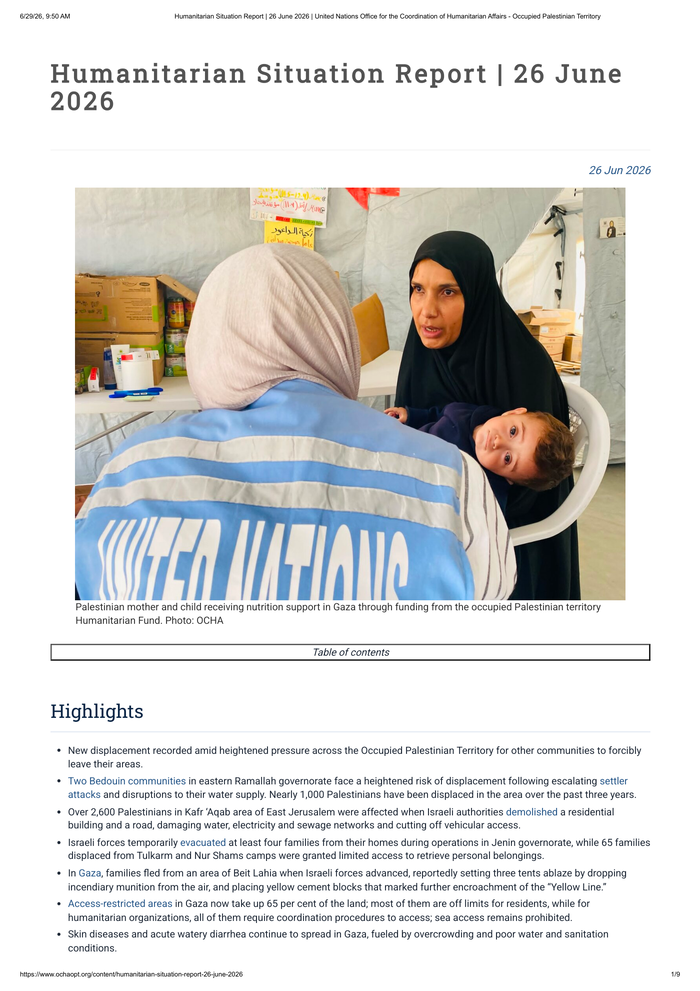
Country: occupied Palestinian territory Source: UN Office for the Coordination of Humanitarian Affairs Please refer to the attached file. Highlights New displacement recorded amid heightened pressure across the Occupied Palestinian Territory for other communities to forcibly leave their areas. Two Bedouin communities in eastern Ramallah governorate face a heightened risk of displacement following escalating settler attacks and disruptions to their water supply. Nearly 1, 000 Palestinians have been displaced in the area over the past three years. Over 2, 600 Palestinians in Kafr ‘Aqab area of East Jerusalem were affected when Israeli authorities demolished a residential building and a road, damaging water, electricity and sewage networks and cutting off vehicular access. Israeli forces temporarily evacuated at least four families from their homes during operations in Jenin governorate, while 65 families displaced from Tulkarm and Nur Shams camps were granted limited access to retrieve personal belongings. In Gaza, families fled from an area of Beit Lahia when Israeli forces advanced, reportedly setting three tents ablaze by dropping incendiary munition from the air, and placing yellow cement blocks that marked further encroachment of the “Yellow Line. ” Access-restricted areas in Gaza now take up 65 per cent of the land; most of them are off limits for residents, while for humanitarian organizations, all of them require coordination procedures to access; sea access remains prohibited. Skin diseases and acute watery diarrhea continue to spread in Gaza, fueled by overcrowding and poor water and sanitation conditions. Notwithstanding restrictions and funding shortfalls, relief efforts continue at scale across all sectors. Overview Across the Occupied Palestinian Territory (OPT), aid workers continue to respond to people’s needs. For example, they provide food assistance to those who cannot access or afford sufficient, nutritious, and diverse diets. They deliver tents and other shelter items to newly displaced people and to those in protracted displacement whose shelters have been damaged or worn out. They support the local health system by deploying specialized teams and replenishing medical supplies. And they facilitate alternative education for those who have been deprived of schooling opportunities. However, there are limits to what humanitarian action can achieve. Funding for relief efforts remains insufficient, with less than 25 per cent of the requirements for this year covered so far. Access restrictions on humanitarian partners to people in need and to essential facilities are severe. And above all, the root causes of humanitarian needs remain unaddressed – both in the West Bank, including East Jerusalem, and in the Gaza Strip.



GrowthPakistan brings you the latest news to keep an eye on Pakistan’s startup ecosystem. Business keeps you growing when you stay aware of your competitors' moves. GrowthPakistan offers Business, Tech, Global Tech, Global, Auto, and Startup News straight from industries all around the globe. This platform will help you identify upcoming opportunities not only in Pakistan but worldwide.
Email : growthpakistan@gmail.com
Whatsapp : +92320-9497079
© growthpakistan