


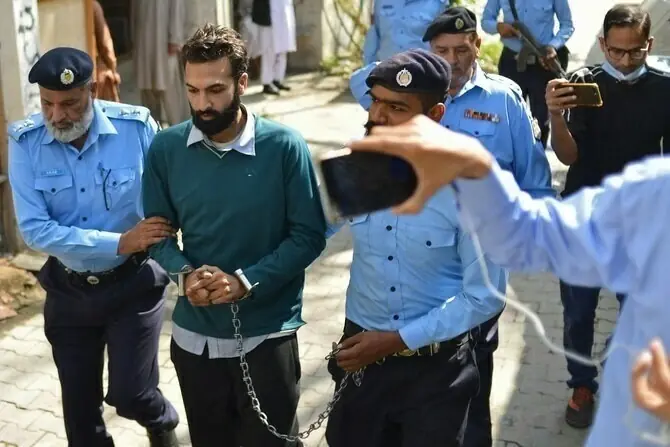
The Supreme Court, while announcing its short verdict in the Noor Muqaddam murder case, on Thursday dismissed the review petition of convict Zahir Jaffer against his death sentence and maintained the capital punishment, Aaj News reported. The apex court also rejected the plea to constitute a medical board to assess Zahir’s mental health. On Thursday, a three-member bench of the Supreme Court, headed by Justice Hashim Kakar and comprising Justice Salahuddin Panhwar and Justice Ishtiaq Ibrahim, heard the review petition filed by convict Zahir against his death sentence in the Noor Muqaddam murder case. At the beginning of the arguments, Khawaja Haris, the counsel for the primary convict Zahir, adopted the stance, “First of all, I admit that an atrocity was committed against the deceased Noor Muqaddam, and I apologise to the victim’s family. However, the focus of my arguments is the mental state of the convict at the time of the incident. I admit my client was present at the scene. ” Zahir’s counsel stated, “I will not say my client did not commit the murder. My client’s mental state was not sound at the time of the incident and during the trial. The convict was continuously given medications in prison during the trial as well. Records exist showing that Zahir Jaffer used to take medications for bipolar disorder, schizophrenia, and depression. These are illnesses in which a patient develops aggressive behaviour. ” Justice Ishtiaq Ibrahim remarked, “Show such a record detailing when the convict’s treatment started, and whether the treatment was ongoing at the time of the incident or not. ” Justice Salahuddin Panhwar noted, “Prove this as well: when did the convict contracted this disease, which doctor treated him? Zahir Jaffer must have had friends, and there would be a complete medical history from his school, college, or university. ” When Khawaja Haris presented a letter from London’s Harley Street Clinic in court, Justice Salahuddin Panhwar remarked, “This letter is dated the year 2022. Did the convict go to London himself after the incident to fetch this letter? Your argument is that the convict did not get a lawyer of his choice. It is quite astonishing that the convict could not get a lawyer of his choice, yet a letter arrived for him from London. ” The convict’s counsel further stated it is surprising that while the deceased underwent tests, no drug test was conducted on the convict. “My question is, why did the prosecution not conduct a drug test on the convict? Given the nature of the reporting during the trial, the prosecution succumbed to pressure and did not test my client, ” he said. At that time, he said social media was dominated by claims that the convict would be saved by proving him a drug addict. With all due respect, the judge also took pressure from the media during the trial, he maintained. Justice Kakar remarked, “This court neither decides on newspaper reporting nor do we succumb to social media pressure. We settled this issue a few days ago in the Sunny Masih case. ” Justice Panhwar observed, “Khawaja Haris Sahab, your arguments are contradictory. You are saying his mental state was not sound at the time of the incident; this means you are validating the social media commentaries. Suppose we accept that the convict’s mental state was not sound. ” In this situation, Justice Kakar added, what relief do you seek in the review petition? Even if a drug test had been conducted, what benefit would it have brought you? Haris said that during the trial, he requested the formation of a medical board for the convict’s examination, which was rejected. “We also filed a miscellaneous application for a medical board in the main case before the Supreme Court. My plea is that in light of past judgements, the court can look into the merits during a review. The Supreme Court has ordered retrials in its previous judgements. I am not pleading for a retrial, but rather for leniency in the sentence. The court should have kept the complete facts in view while awarding the death penalty. “ Justice Kakar remarked, “Khawaja Haris Sahab, if the services of a lawyer like you had been engaged right from the beginning, the convict would not have had to see this day. We have been listening to you for so long, please show some grace; for three hours you have kept us following a wild goose chase. ” Justice Ishtiaq Ibrahim remarked, “The trial court rejected the application for a medical board. The non-formation of the medical board was not challenged in the High Court; that matter has already attained finality. ” Announcing its short verdict on the application, the court dismissed the review petition of the primary convict Zahir Jaffer and upheld the death sentence. Advocate Shah Khawar represented Noor Muqaddam’s parents. The Supreme Court also rejected the plea to constitute a medical board to examine Zahir’s mental health. Haris contended, “It was reported in the trial court that the convict considered himself a spiritual leader and the deceased a sacrificial animal. My client is a mental patient who cannot even sign properly. ” Justice Kakar remarked the judges too get distressed reading the newspapers in the morning. Some people have a habit of vlogging in loud voices, he added. Justice Panhwar observed, “A medical history is usually very lengthy. ” Justice Kakar added, “Today we are adjourning all remaining cases. Besides, our children are not present here today. ” During the hearing, the convict’s counsel Haris referred to the newspaper reporting during the trial, upon which Justice Ishtiaq Ibrahim stated, “We are not sitting here to listen to the news. ” Justice Kakar remarked, “Sometimes we say something and something else gets reported; the reporting in the newspaper is one thing, while something entirely different is said in a vlog. ” Justice Panhwar said everyone expresses their own opinion. Case background The murder of Noor Muqaddam occurred on July 20, 2021, when the victim’s body was recovered from a house located in Sector F-7/4, Islamabad. On the same day, the police registered a murder case and arrested the primary accused, Zahir Jaffer, from the crime scene. This murder triggered intense grief and anger across the country and marked the beginning of a lengthy legal battle. In February 2022, the trial court sentenced Zahir Jaffer to death for the crime of murder and awarded him 25 years of rigorous imprisonment on the rape charge. His two employees, Muhammad Iftikhar and Jan Muhammad, who were present in the house at the time of the incident, were sentenced to 10 years of imprisonment each. In the same case, Zahir’s parents, well-known business personalities Zakir Jaffer and Asmat Adamjee, were indicted in October 2021; however, the court later acquitted them both on the basis of insufficient evidence. Similarly, six employees of Therapy Works, who had reached the crime scene before the police, were initially named as accused but were later acquitted by the court as well. The challan had alleged that the parents and the Therapy Works personnel attempted to conceal the crime and destroy evidence. In March 2023, the Islamabad High Court rejected Zahir Jaffer’s appeal and maintained the death sentence for murder. Delivering an even harsher verdict, it also converted the 25-year imprisonment awarded on the rape charge into a death sentence. The appeals filed against the sentences of the employees were also dismissed. Following this decision, the next month, Zahir Jaffer filed an appeal in the Supreme Court, adopting the stance that his sentence was the result of a “faulty assessment of evidence” and that the subordinate courts failed to understand the “fundamental flaws” present in the FIR. In May of this year, the Supreme Court maintained Zahir Jaffer’s death sentence for the crime of murder, while commuting the death sentence awarded on the rape charge to life imprisonment.



GrowthPakistan brings you the latest news to keep an eye on Pakistan’s startup ecosystem. Business keeps you growing when you stay aware of your competitors' moves. GrowthPakistan offers Business, Tech, Global Tech, Global, Auto, and Startup News straight from industries all around the globe. This platform will help you identify upcoming opportunities not only in Pakistan but worldwide.
Email : growthpakistan@gmail.com
Whatsapp : +92320-9497079
© growthpakistan