

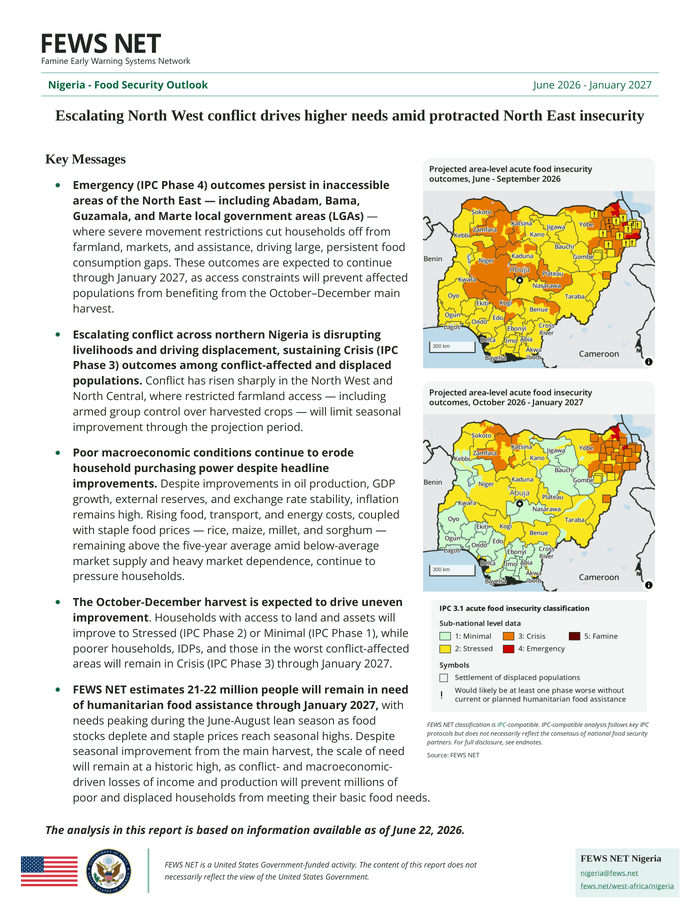
Country: Nigeria Source: Famine Early Warning System Network Please refer to the attached file. Key Messages Emergency (IPC Phase 4) outcomes persist in inaccessible areas of the North East — including Abadam, Bama, Guzamala, and Marte local government areas (LGAs) — where severe movement restrictions cut households off from farmland, markets, and assistance, driving large, persistent food consumption gaps. These outcomes are expected to continue through January 2027, as access constraints will prevent affected populations from benefiting from the October–December main harvest Escalating conflict across northern Nigeria is disrupting livelihoods and driving displacement, sustaining Crisis (IPC Phase 3) outcomes among conflict-affected and displaced populations. Conflict has risen sharply in the North West and North Central, where restricted farmland access — including armed group control over harvested crops — will limit seasonal improvement through the projection period. Poor macroeconomic conditions continue to erode household purchasing power despite headline improvements. Despite improvements in oil production, GDP growth, external reserves, and exchange rate stability, inflation remains high. Rising food, transport, and energy costs, coupled with staple food prices — rice, maize, millet, and sorghum — remaining above the five-year average amid below-average market supply and heavy market dependence, continue to pressure households. The October-December harvest is expected to drive uneven improvement. Households with access to land and assets will improve to Stressed (IPC Phase 2) or Minimal (IPC Phase 1), while poorer households, IDPs, and those in the worst conflict-affected areas will remain in Crisis (IPC Phase 3) through January 2027. FEWS NET estimates 21-22 million people will remain in need of humanitarian food assistance through January 2027, with needs peaking during the June-August lean season as food stocks deplete and staple prices reach seasonal highs. Despite seasonal improvement from the main harvest, the scale of need will remain at a historic high, as conflict- and macroeconomicdriven losses of income and production will prevent millions of poor and displaced households from meeting their basic food needs.
Nigeria Food Security Outlook Update, June 2026 – January 2027: Escalating North West conflict drives higher needs amid protracted North East insecurity

RELATED ARTICLES


