

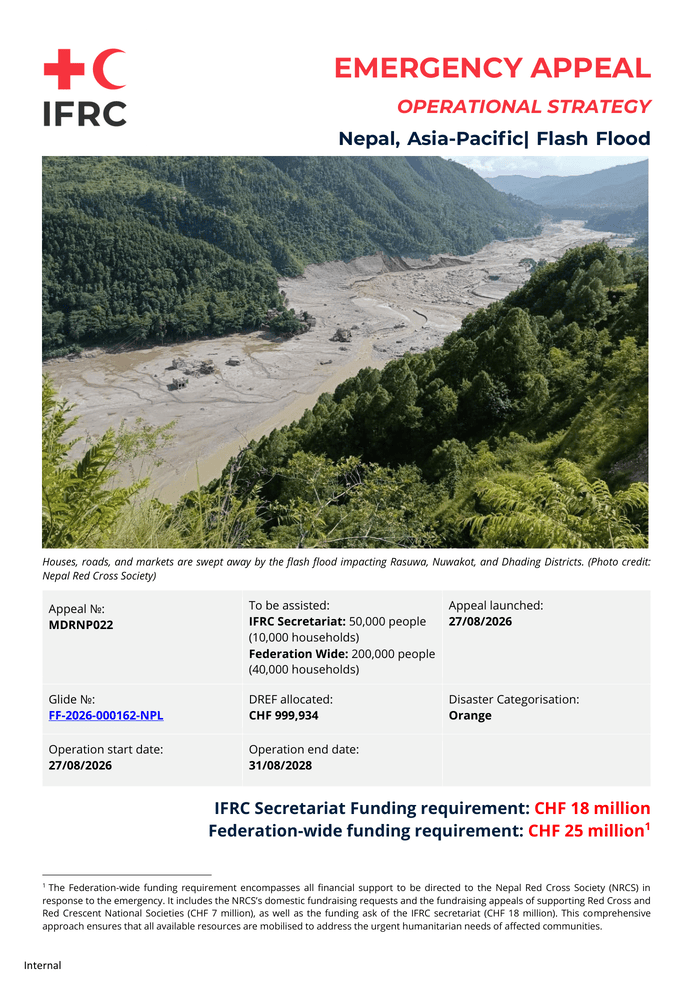
Country: Nepal Source: International Federation of Red Cross and Red Crescent Societies Please refer to the attached file. TIMELINE 26 August 2026: A massive surge of water enters the Bhote Koshi River bordering China. Floodwaters rapidly impact Timure, Rasuwaghadi, and Syafrubeshi towns in Rasuwa District and other towns further downstream in Nuwakot and Dhading Districts. The Government of Nepal issues evacuation orders and mobilises security forces. The Prime Minister’s Office convenes a high-level emergency meeting to assess the evolving situation and coordinate response measures. Additionally, the government holds a second emergency meeting and declares three districts and 15 municipalities as crisis-affected areas for three months while expediting relief and rescue operations. 26 August 2026: The NRCS activates its EOC on 26 August 2026. The NRCS is supporting the response through the mobilisation of staff and volunteers, search and rescue support, first aid and health assistance, emergency relief distributions, shelter and household items, WASH support, and dead body management, including the recovery, safe handling, identification, and dignified management of deceased persons. Other humanitarian partners are supporting complementary food, shelter, health, WASH, and protection activities, while international assistance and funding continue to be mobilised. 26 August 2026: The IFRC allocates CHF 999, 934 from its Disaster Response Emergency Fund (DREF) to support the immediate response, targeting 20, 000 of the most affected people in Rasuwa, Nuwakot, and Dhading. A CHF 100, 000 Emergency Advance Payment request is signed enabling immediate access to funding. 28 August 2026: The IFRC launches a Federation-wide Emergency Appeal of CHF 25 million (CHF 18 million secretariat) to provide early recovery and recovery support to approximately 28, 000 people in three districts. 28 August 2026: Multiple IFRC surge role alerts are issued, and the Regional Operational Coordinator, Communications Coordinator, and WASH Coordinator arrive in Nepal to provide technical support. DESCRIPTION OF THE EVENT On 26 August 2026, a major ice–rock avalanche occurred in the upper Bhote Koshi watershed near the China–Nepal border. An estimated 1km2 of ice and rock detached from a slope, picking up loose proglacial sediments downstream and transforming into a highly mobile sediment- and water-laden debris flow. Initial assessments suggest that the resulting outburst flood in the upper watershed was an order of magnitude or more greater than normal seasonal flooding. A powerful debris flow of sediment moved rapidly downstream, causing widespread destruction across Rasuwa, Nuwakot, and Dhading districts. Reports indicate that water levels in the Trishuli River rose up to nine metres above normal levels, inundating settlements and damaging critical infrastructure, including roads, bridges, schools, police stations, markets, health facilities, telecommunication towers, electricity poles, financial institutions, vehicles, hydrometeorological stations, customs infrastructure, and multiple hydropower projects. Timure border market was among the hardest-hit areas. The disaster has disrupted transportation along several key highways and roads, while authorities have restricted accessto river corridors due to ongoing risks. The National Disaster Risk Reduction and Management Authority (NDRRMA) issued a red alert for downstream districts, while the Government of Nepal convened an Emergency Disaster Council meeting chaired by the Prime Minister to coordinate search and rescue operations, damage assessments, and humanitarian response. Relief supplies have been mobilised from the Kathmandu Humanitarian Staging Area, with health response coordination led through national emergency mechanisms and partners. The scale of the physical damage, service disruption, and impacts on communities along the river corridor has created significant humanitarian needs requiring immediate relief and early recovery support.
Nepal, Asia-Pacific | Flash Flood – Emergency Appeal Operational Strategy (MDRNP022)

RELATED ARTICLES


