


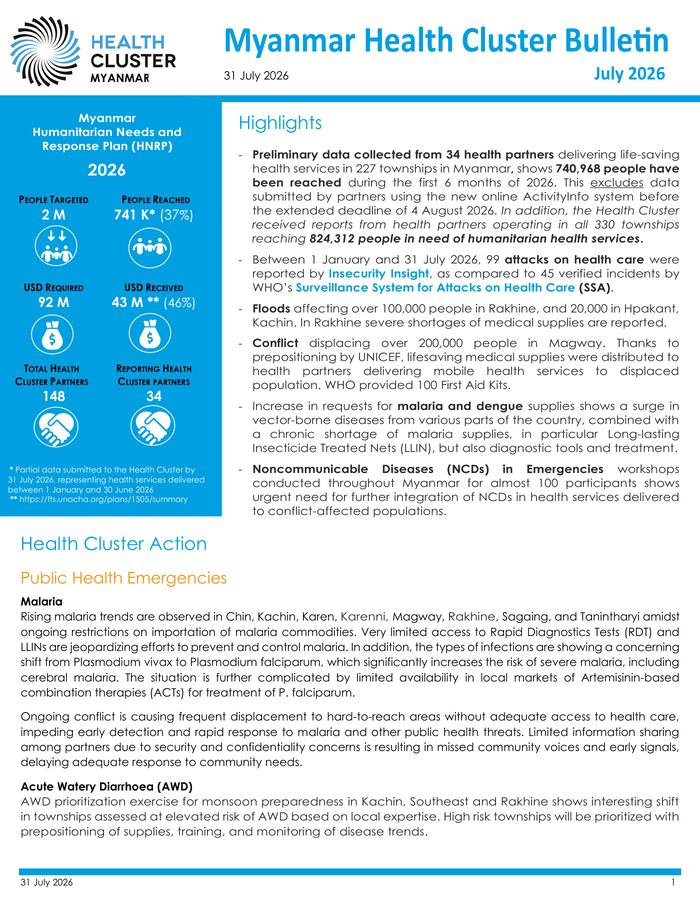
Country: Myanmar Sources: Health Cluster, World Health Organization Please refer to the attached file. Highlights – Preliminary data collected from 34 health partners delivering life-saving health services in 227 townships in Myanmar, shows 740, 968 people have been reached during the first 6 months of 2026. This excludes data submitted by partners using the new online ActivityInfo system before the extended deadline of 4 August 2026. In addition, the Health Cluster received reports from health partners operating in all 330 townships reaching 824, 312 people in need of humanitarian health services. – Between 1 January and 31 July 2026, 99 attacks on health care were reported by Insecurity Insight, as compared to 45 verified incidents by WHO’s Surveillance System for Attacks on Health Care (SSA). – Floods affecting over 100, 000 people in Rakhine, and 20, 000 in Hpakant, Kachin. In Rakhine severe shortages of medical supplies are reported. – Conflict displacing over 200, 000 people in Magway. Thanks to prepositioning by UNICEF, lifesaving medical supplies were distributed to health partners delivering mobile health services to displaced population. WHO provided 100 First Aid Kits. – Increase in requests for malaria and dengue supplies shows a surge in vector-borne diseases from various parts of the country, combined with a chronic shortage of malaria supplies, in particular Long-lasting Insecticide Treated Nets (LLIN), but also diagnostic tools and treatment. – Noncommunicable Diseases (NCDs) in Emergencies workshops conducted throughout Myanmar for almost 100 participants shows urgent need for further integration of NCDs in health services delivered to conflict-affected populations.



GrowthPakistan brings you the latest news to keep an eye on Pakistan’s startup ecosystem. Business keeps you growing when you stay aware of your competitors' moves. GrowthPakistan offers Business, Tech, Global Tech, Global, Auto, and Startup News straight from industries all around the globe. This platform will help you identify upcoming opportunities not only in Pakistan but worldwide.
Email : growthpakistan@gmail.com
Whatsapp : +92320-9497079
© growthpakistan