


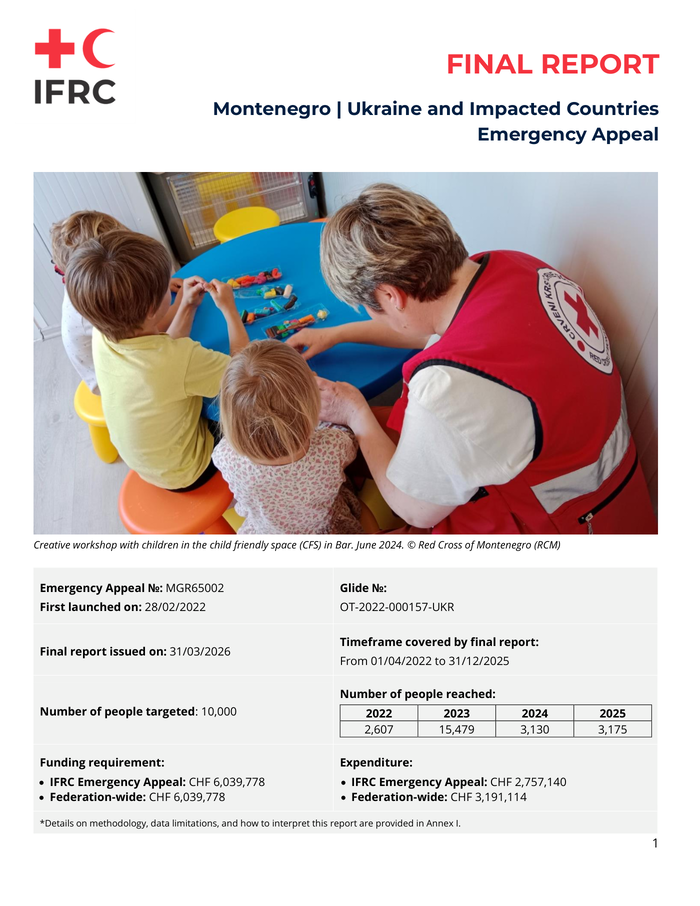
Countries: Montenegro, Ukraine Source: International Federation of Red Cross and Red Crescent Societies Please refer to the attached file. A. SITUATION ANALYSIS Description of the crisis International armed conflict between Russia and Ukraine resulted in widespread displacement, extensive damage to critical infrastructure, loss of life and significant human suffering. The international armed conflict led to immediate humanitarian consequences, particularly in the areas of health, shelter, food security and protection. Although Montenegro does not share its borders with Ukraine, since 24 February 2022 until 23 January 2023, more than 91, 500 displaced people from Ukraine entered Montenegro1, prompting an urgent response from the Red Cross of Montenegro (RCM). Through its activities, the RCM provided essential humanitarian aid, particularly in the sectors of basic needs, seasonal assistance for winters, health and care, mental health and psychosocial support (MHPSS) and protection, gender and inclusion (PGI). Needs assessment conducted by the RCM in December 2022 showed that between 18% and 20% of respondents faced an urgent need for food, hygiene items, clothing and mental or physical health services. In total, 60% of respondents indicated that such support was needed but not urgent. Additionally, 49. 4% reported that their mental or physical health, or that of a household member, has deteriorated since leaving Ukraine and that they require assistance. Furthermore, the needs assessments revealed that a significant number of displaced people from Ukraine intended to stay in Montenegro for as long as the international armed conflict continues in their home country. Throughout 2023, Montenegro continued to experience the evolving impacts of the international armed conflict between Russia and Ukraine, with 186, 128 people2 entering the country since the start of the conflict, reflecting a significant influx. While initial emergency needs were partially addressed, new challenges emerged, including access to rights under temporary protection status (TPS), such as healthcare, education, accommodation and access to the labour market. An increasing number of displaced people from Ukraine sought psychosocial support (PSS) to cope with stress, anxiety, grief and loss, underscoring the critical need for comprehensive MHPSS services. In addition, the operating context became increasingly complex due to political instability, with Montenegro operating under a technical government at the time, economic challenges stemming from the COVID-19 pandemic which disrupted state-level operations, including services for displaced people from Ukraine. These developments required more coordinated and intensified efforts from the RCM to ensure continuity of support and an effective response. By 2024, the situation of displaced people from Ukraine in Montenegro had evolved, with needs shifting from short-term relief to long-term integration and ongoing support. The extension of the temporary protection until 11 March 2025 helped reduce legal uncertainty and stress, particularly for families who had been living in the country for more than two years. Findings from the RCM’s needs assessment conducted in March 2024 clearly reflected this transition, highlighting growing needs related to integration and inclusion, as well as long-term physical and PSS. The focus of response began to include more sustainable, community-based interventions alongside ongoing emergency support. In 2025, the situation in Montenegro remained protracted with ongoing humanitarian needs among people in vulnerable situations. Since the beginning of 2025, 2, 529 displaced people from Ukraine have applied for TPS, while 5, 487 have requested an extension of their status, reflecting the continued presence and needs of displaced population. 3 Interventions under the RCM planned for 2025 were designed to address both immediate and longer-term needs, building on lessons learned from previous years and the evolving context.



GrowthPakistan brings you the latest news to keep an eye on Pakistan’s startup ecosystem. Business keeps you growing when you stay aware of your competitors' moves. GrowthPakistan offers Business, Tech, Global Tech, Global, Auto, and Startup News straight from industries all around the globe. This platform will help you identify upcoming opportunities not only in Pakistan but worldwide.
Email : growthpakistan@gmail.com
Whatsapp : +92320-9497079
© growthpakistan