


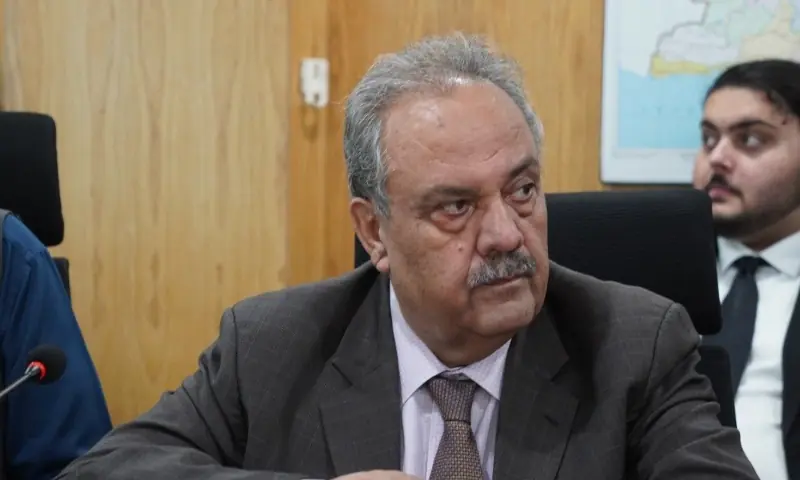
KARACHI: Former Ambassador of Pakistan to Iran Asif Ali Khan Durrani has said the recent conflict between Iran and the United States has highlighted one fundamental reality that military superiority no longer guarantees political success. Speaking at a seminar organised by the Pakistan Institute of International Affairs (PIIA) here on Saturday, he pointed out: “The United States remains the world’s foremost military power, while Israel retains overwhelming conventional military superiority in the region. Yet neither has been able to compel Iran to abandon its strategic posture. ” While presenting his paper on ‘Beyond the Iran-US War: Changing Dynamics of Power in the Middle East and the Search for a New Regional Security Architecture’, Mr Durrani, who also served as ambassador to the United Arab Emirates and Special Representative of Pakistan to Afghanistan, said: “At the same time, Iran has demonstrated remarkable resilience but has paid a heavy economic and human price. The lesson is clear. Modern wars may destroy infrastructure, but they rarely eliminate political systems or resolve deep-rooted strategic disputes. “This reality makes diplomacy not a matter of choice but of necessity. The renewed hostilities have undoubtedly placed the Islamabad Memorandum under severe strain. Nevertheless, its importance should not be underestimated. It demonstrated that diplomacy can halt escalation even after intense military confrontation. The challenge now is to transform a fragile ceasefire into a sustainable political process addressing the underlying causes of conflict, ” Ambassador Durrani. Ambassador Durrani says Iran-US war has become a defining moment in the evolution of a new Middle Eastern order He also said that looking ahead, four broad scenarios are possible. “The first is renewed escalation through missile exchanges, proxy warfare, cyber operations and maritime disruptions. This would increase regional instability and threaten the global economy without producing lasting security for any party. “The second is a prolonged ‘cold peace’, characterised by deterrence, sanctions and intermittent crises. While preferable to open war, it would leave the Middle East trapped in strategic uncertainty, ” he said, adding: “The third is a comprehensive political settlement addressing the nuclear issue, sanctions, maritime security and regional confidence-building. Such an agreement would require difficult compromises from both Washington and Tehran but remains the only durable path to peace. ” He said: “The fourth, and, in my view, the most promising, is the gradual emergence of an inclusive regional security architecture. Such a framework should include Iran, Saudi Arabia, the Gulf states, Iraq, Turkiye, Egypt and other regional actors, supported by external powers rather than dominated by them. Confidence-building measures, military communication channels, maritime security arrangements and economic cooperation should become the foundations of this new order, ” he said. Ambassador Durrani added: “Pakistan has an important role to play in this evolving landscape. Few countries enjoy constructive relations with Iran, Saudi Arabia, the Gulf monarchies, China, Turkiye and the United States simultaneously. This gives Pakistan a diplomatic advantage that should not be underestimated. Our strength lies not in choosing sides but in building bridges. “Pakistan should continue facilitating dialogue whenever communication between adversaries becomes difficult. It should advocate freedom of navigation in the Strait of Hormuz, encourage regional economic connectivity, support confidence-building measures and promote an inclusive regional dialogue in which every stakeholder has a legitimate voice. ” He went on to say: “The Iran-US war was not simply another military confrontation. It has become a defining moment in the evolution of a new Middle Eastern order. The real question before us is not who won the last battle, but who possesses the vision to shape the next generation of peace. The Islamabad Memorandum should not be remembered merely as a ceasefire that temporarily silenced the guns. It should become the first building block of a broader regional security architecture based on mutual respect, sovereign equality and collective security. “The changing dynamics of power in the Middle East demand a new strategic imagination. If the leaders of our region can replace the logic of confrontation with the logic of cooperation, future generations may remember this turbulent period not as the beginning of a wider conflict, but as the moment when the Middle East finally embarked upon a more stable, inclusive and peaceful future. The challenge before us is therefore not to win the next war, but to build the next peace, ” he concluded. Another speaker, retired Lt Col Dr Muhammad Ali Ehsan spoke on ‘The New Middle East: Reality Illusion or Strategic Mirage? ’ He wondered if the Iran war was really creating conditions for the emergence of a new Middle East? “For a very long time, the audience, whether domestic or international, has mistaken the short-term military developments for a long-term strategic change. The emergence of the Middle East may just be an illusion. I feel that a new Middle East can only emerge if there is a change in the existing strategic balance, ” he said. Dr Naeem Ahmed, chairman of the Department of International Relations at the University of Karachi, spoke on ‘Reimagining Gulf Security in the Changing International Dis(order)’. He said that the Iran war has significantly altered the security scenario of the Gulf region and at the same time put a dent in the existing US-led international order though not completely changed it as China has yet to pose a Soviet like challenge to the US hegemony in the international system. “However, the toll on the global political order would grow further if the war prolongs or even if it ends earlier the world would continue to feel its aftershocks for decades. Moreover, some scholars believe that the current war in the Gulf is a prelude to a major world war, maybe World War III, ” he said. PIIA Chairperson Dr Masuma Hasan also spoke. Published in Dawn, July 26th, 2026



GrowthPakistan brings you the latest news to keep an eye on Pakistan’s startup ecosystem. Business keeps you growing when you stay aware of your competitors' moves. GrowthPakistan offers Business, Tech, Global Tech, Global, Auto, and Startup News straight from industries all around the globe. This platform will help you identify upcoming opportunities not only in Pakistan but worldwide.
Email : growthpakistan@gmail.com
Whatsapp : +92320-9497079
© growthpakistan