


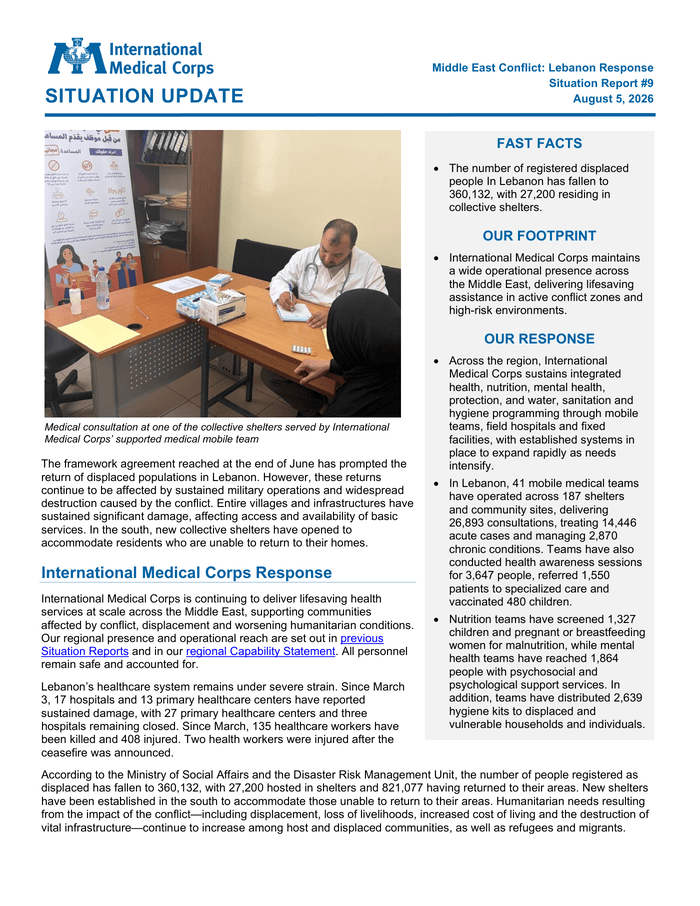
Country: Lebanon Source: International Medical Corps Please refer to the attached file. FAST FACTS The number of registered displaced people In Lebanon has fallen to 360, 132, with 27, 200 residing in collective shelters. OUR FOOTPRINT International Medical Corps maintains a wide operational presence across the Middle East, delivering lifesaving assistance in active conflict zones and high-risk environments. OUR RESPONSE Across the region, International Medical Corps sustains integrated health, nutrition, mental health, protection, and water, sanitation and hygiene programming through mobile teams, field hospitals and fixed facilities, with established systems in place to expand rapidly as needs intensify. In Lebanon, 41 mobile medical teams have operated across 187 shelters and community sites, delivering 26, 893 consultations, treating 14, 446 acute cases and managing 2, 870 chronic conditions. Teams have also conducted health awareness sessions for 3, 647 people, referred 1, 550 patients to specialized care and vaccinated 480 children. Nutrition teams have screened 1, 327 children and pregnant or breastfeeding women for malnutrition, while mental health teams have reached 1, 864 people with psychosocial and psychological support services. In addition, teams have distributed 2, 639 hygiene kits to displaced and vulnerable households and individuals. Across the Middle East region, humanitarian needs remain severe and increasingly complex. In Gaza, the ongoing crisis, repeated displacement and the widespread destruction of critical infrastructure continue to leave millions in urgent need of support across multiple sectors. In Syria, fragile institutions and political uncertainty have weakened the delivery of essential services while increasing protection concerns for vulnerable communities. Yemen faces persistently high levels of acute food insecurity, compounded by reduced access to basic care. International Medical Corps continues to adapt our operations across the region, drawing on decades of experience, trusted local partnerships and well-established emergency response systems. This enables us to deliver timely, effective and lifesaving assistance to communities affected by crisis, while remaining responsive to evolving humanitarian needs.



GrowthPakistan brings you the latest news to keep an eye on Pakistan’s startup ecosystem. Business keeps you growing when you stay aware of your competitors' moves. GrowthPakistan offers Business, Tech, Global Tech, Global, Auto, and Startup News straight from industries all around the globe. This platform will help you identify upcoming opportunities not only in Pakistan but worldwide.
Email : growthpakistan@gmail.com
Whatsapp : +92320-9497079
© growthpakistan