

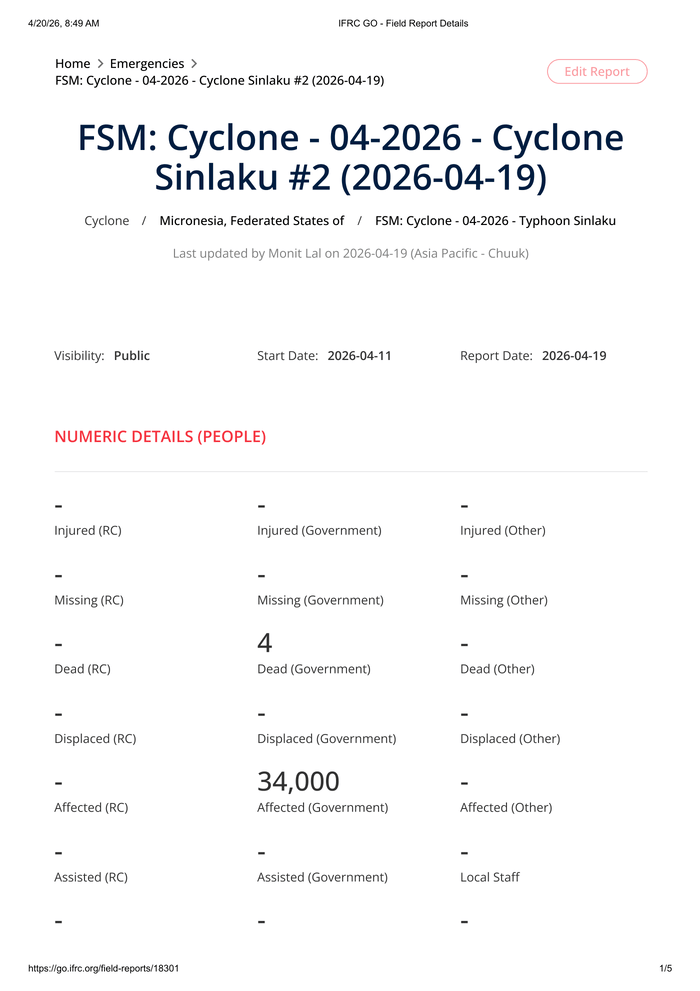
Country: Micronesia (Federated States of) Sources: International Federation of Red Cross and Red Crescent Societies, Micronesia Red Cross Society Please refer to the attached file. Description Typhoon Sinlaku was classified as a Category 5 storm when it affected the Federated States of Micronesia (FSM) and the Chuuk region. It intensified rapidly, reaching maximum sustained winds of 185 mph on 12 April 2026, and caused significant damage across the islands. Chuuk State is experiencing severe and widespread humanitarian impacts following the passage and stalling of Tropical Storm (Typhoon) Sinlaku, which remained near-stationary just offshore and subjected the islands to prolonged exposure to extreme winds, storm surge, and heavy rainfall. The intensity and slow movement of the system resulted in extensive destruction across both lagoon and outer islands, including Weno, Fananu, Piherarh, Tamatam, Onoun, Uman, and Parem. The hazard has caused significant damage to housing, infrastructure, and essential services. Many homes have been destroyed or severely damaged by strong winds and coastal flooding, with debris carried into residential areas. Critical infrastructure has been heavily affected, including power generation systems, water supply, communication networks, roads, and port facilities. Large portions of the population are experiencing prolonged power outages, with up to 75 per cent of distribution networks damaged in some areas and complete outages reported elsewhere. Communication systems, including telephone lines and emergency services, remain largely non-functional, significantly constraining coordination and response efforts. Access constraints continue to compound the situation. Roads across multiple islands remain blocked by debris, floodwaters, and fallen trees, limiting the movement of emergency services and delaying assessments. Damage to the main dock and underwater debris is restricting the ability of cargo vessels to offload critical supplies, further exacerbating shortages. Fuel infrastructure has also been compromised due to seawater contamination and electrical damage, raising concerns over the continuity of power supply, which is currently dependent on limited reserves. An estimated 34, 000 people have been affected across Chuuk State, with displacement reported and at least 100 individuals currently sheltering in evacuation centres. However, the full scale of impact remains unclear due to communication blackouts, particularly in remote outer islands. Initial reports confirm at least four fatalities, with the risk of additional casualties and injuries likely as information from isolated communities becomes available. The affected population is facing acute shortages of essential items, including safe drinking water, food, fuel, and basic household supplies. Damage to local businesses, including food storage and fuel distribution systems, has disrupted supply chains and reduced access to basic goods. There is increasing concern over public health risks, including the potential rise in communicable diseases due to limited access to clean water, sanitation, and healthcare services. The hospital is operating on emergency backup power, posing a critical risk to the continuity of life-saving services. In addition to material losses, the situation is contributing to rising community stress and reports of civil unrest linked to shortages of essential supplies. Many communities have lost not only their homes and assets but also access to basic services and livelihoods, particularly where food crops and local infrastructure have been destroyed. Immediate humanitarian needs include food assistance, safe water, emergency shelter, and support for debris clearance and early recovery. Overall, the situation remains critical, with compounded impacts from infrastructure damage, access constraints, and limited information from affected areas. Further assessments are urgently required to fully understand the scale of needs and to guide a coordinated humanitarian response. Request For Assistance Government Requests International Assistance Yes NS Requests International Assistance Yes Information Bulletin Published No Actions taken by RCRC General Other Summary American Red Cross have released Quick Action Fund or USD 25, 000 to MRCS to support with the response. American Red Cross NHQ in the US mainland is providing remote tech support to set up the comms link. Actions taken by Federation General Other Summary IFRC is supporting the MRCS, in the overall coordination of the response, including technical guidance and operational support to ongoing emergency activities. IFRC is working closely with MRCS to support the development and submission of a DREF request, ensuring that the application reflects priority needs and aligns with the evolving situation on the ground. Continuous coordination is being maintained between IFRC, MRCS, government authorities, and humanitarian partners to ensure complementarity of response efforts and avoid duplication. IFRC is supporting information management and situational reporting, contributing to the consolidation of data and analysis to inform decision-making and response prioritisation. Technical support is being provided to MRCS across key sectors, including relief, logistics, and planning, to strengthen the effectiveness and timeliness of the response. Actions taken by National Society General Water & Sanitation Evacuation Other Summary The MRCS is working closely with authorities and partners to assess needs and support affected communities through emergency response and relief efforts. MRCS has requested a DREF application. Joint operations with NDMO in Chuuk with the use of 6 drums of gasoline secured by MRCS from UNICEF. MRCS relief supplies are part of the inventory of the ship loading for Chuuk. MRCS will be distributing 200 Sawyer portable water filtration system to households donated by UNICEF (200 units) and the Pohnpei State Health Department (200 units). Starlink unit procured in Guam and will be dropped off in Chuuk (on 19 April) to establish stable communication on the ground. To ensure operational continuity, MRCS is using propane powered gensets. Actions taken by others The Chuuk Disaster and Emergency Operation Center (CDEOC) has been activated by government authorities to coordinate the response, including issuing situation reports, public announcements, and overseeing overall emergency operations. Government and public utility teams are working to restore critical services, prioritising power and water supply to essential facilities such as hospitals, communication centres, and disaster management offices. Government authorities have mobilised relief supplies from Pohnpei, including 3, 000 bottles of drinking water and 1, 000 sacks of rice (40 lb), while also facilitating shipment of additional humanitarian cargo to Chuuk. Assessment efforts are being coordinated by the government, including deployment of patrol boats and teams to conduct initial damage assessments in outer islands, despite access constraints and communication outages. International Organization for Migration (IOM) has committed essential relief items, including water containers (jerry cans), to support safe water storage and distribution. Catholic Relief Services (CRS), alongside MRCS and other partners, has committed to providing cleaning, hygiene, and essential household kits to affected populations. Multi-agency coordination is ongoing among government authorities, MRCS, UN agencies, and partners to address urgent needs, including food, water, shelter, and logistics support, with additional assistance pending formal requests and further assessments.
Micronesia: FSM: Cyclone – 04-2026 – Cyclone Sinlaku #2 (2026-04-19)

RELATED ARTICLES


