

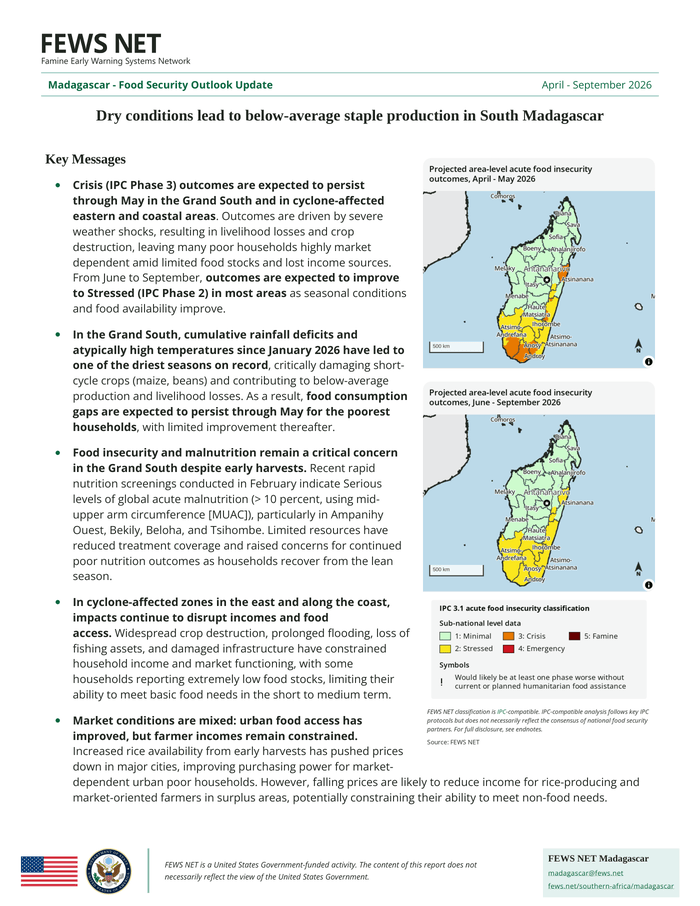
Country: Madagascar Source: Famine Early Warning System Network Please refer to the attached file. Key Messages Crisis (IPC Phase 3) outcomes are expected to persist through May in the Grand South and in cyclone-affected eastern and coastal areas. Outcomes are driven by severe weather shocks, resulting in livelihood losses and crop destruction, leaving many poor households highly market dependent amid limited food stocks and lost income sources. From June to September, outcomes are expected to improve to Stressed (IPC Phase 2) in most areas as seasonal conditions and food availability improve. In the Grand South, cumulative rainfall deficits and atypically high temperatures since January 2026 have led to one of the driest seasons on record, critically damaging short-cycle crops (maize, beans) and contributing to below-average production and livelihood losses. As a result, food consumption gaps are expected to persist through May for the poorest households, with limited improvement thereafter. Food insecurity and malnutrition remain a critical concern in the Grand South despite early harvests. Recent rapid nutrition screenings conducted in February indicate Serious levels of global acute malnutrition (> 10 percent, using mid-upper arm circumference [MUAC]), particularly in Ampanihy Ouest, Bekily, Beloha, and Tsihombe. Limited resources have reduced treatment coverage and raised concerns for continued poor nutrition outcomes as households recover from the lean season. In cyclone-affected zones in the east and along the coast, impacts continue to disrupt incomes and food access. Widespread crop destruction, prolonged flooding, loss of fishing assets, and damaged infrastructure have constrained household income and market functioning, with some households reporting extremely low food stocks, limiting their ability to meet basic food needs in the short to medium term. Market conditions are mixed: urban food access has improved, but farmer incomes remain constrained. Increased rice availability from early harvests has pushed prices down in major cities, improving purchasing power for market-dependent urban poor households. However, falling prices are likely to reduce income for rice-producing and market-oriented farmers in surplus areas, potentially constraining their ability to meet non-food needs. This report provides an update to the February to September 2026 Food Security Outlook and March 2026 Key Message Update. The analysis is based on information available as of April 20, 2026.
Madagascar Food Security Outlook Update: Dry conditions lead to below-average staple production in South Madagascar, April – September 2026

RELATED ARTICLES


