


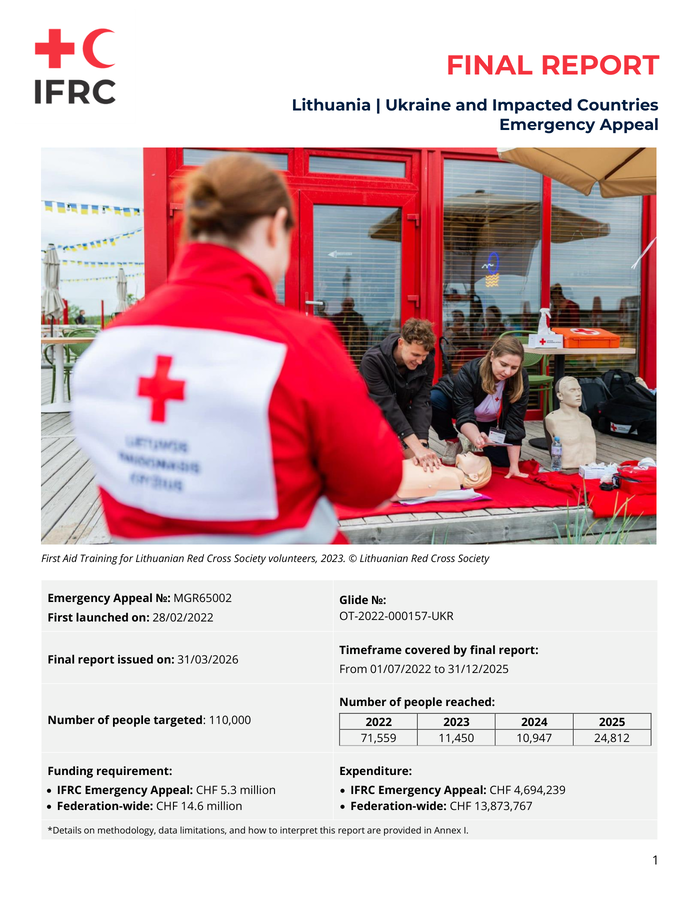
Countries: Lithuania, Ukraine Source: International Federation of Red Cross and Red Crescent Societies Please refer to the attached file. A. SITUATION ANALYSIS Description of the crisis 24 February 2022, following the escalation of the Russia-Ukraine international armed conflict, a significant number of people displaced from Ukraine entered Lithuania and registered with national authorities. Since 24 February 2022 a total of 73, 774 displaced people from Ukraine arrived in Lithuania and applied for temporary protection1. At the onset of the emergency, the Lithuanian government organised temporary accommodation for the displaced people from Ukraine, while Lithuanian citizens also opened their homes to those fleeing the conflict. Displaced people applying for temporary protection were granted access to healthcare services and the right to work in Lithuania. However, a 2022 survey conducted by IOM revealed that the most pressing needs among the displaced were financial support (44%), healthcare services (42%), and access to personal hygiene items, medicines, and language courses (34%)2. Lithuanian Red Cross Society (LRCS) has been actively involved in the response since the early days of the conflict. In cooperation with NGOs in Lithuania, LRCS supported joint fundraising efforts and provided hygiene, clothing, and food packages to the people displaced from Ukraine. Psychosocial Support (PSS) kits for children and voucher assistance were also distributed. In addition, Lithuanian Red Cross Society played a key role in registration centres across the country by delivering legal assistance, PSS, information, and by operating hotlines and helpdesks through its 15 branches. Throughout 2023, the situation continued to evolve as the international armed conflict persisted. While initial emergency needs were partially addressed, longer-term challenges became more prominent, particularly in relation to livelihoods and housing stability. By mid-2023, humanitarian needs increasingly shifted from immediate life-saving assistance towards stabilisation-oriented support, with a stronger focus on livelihoods and mental health and psychosocial support. The operational context became more complex, reflecting the differing needs of newly arrived individuals and those intending to remain in Lithuania for an extended period. In 2024, Lithuania continued to experience the humanitarian consequences of the protracted conflict. Although conditions improved for some people displaced from Ukraine and in certain sectors, others continued to face unemployment, protection risks, and limited access to services. Prolonged displacement affected mental health and reduced household savings for some families. While many displaced people secured employment, these positions were often lower paid than their previous occupations in Ukraine. As of October 2025, 50, 380 people displaced from Ukraine were recorded as residing in Lithuania3. The situation continues to require coordinated humanitarian action, particularly in support of long-term integration and mental health and psychosocial support needs. According to data from the Lithuanian State Social Insurance Fund, 33, 200 displaced people are employed and 2, 700 are registered as unemployed. Among those employed, 68 per cent work in medium-skilled occupations such as customer service, retail, construction, and transportation. Available data indicates that many are employed below their qualifications, primarily due to language barriers and the non-recognition of professional qualifications obtained in Ukraine. Access to healthcare, particularly mental health services, remains a critical concern, as many people displaced from Ukraine continue to experience distress related to the conflict and require sustained support. Housing also remains a challenge, with some individuals residing in temporary accommodation and others facing difficulties in meeting rental costs. During the implementation of the Ukraine and Impacted Countries Emergency Appeal, LRCS prioritised support to people in the most vulnerable situations, including older people, people with disabilities, single-parent families, women and girls, and people with chronic illnesses. These groups often face additional barriers to labour market participation and integration. Planned and implemented support focused on the following sectors: •Health and Care: Provision of MHPSS activities and First Aid (FA), trainings for PFA (Psychological First Aid) and FA for the community. •Water, Sanitation and Hygiene (WASH): Distribution of hygiene kits. •Shelter, Housing and Settlements: Distribution of shelter items, information provision of accommodation opportunities. •Cash and Voucher Assistance (CVA): Provision of supermarket vouchers and multipurpose cash, as well as cash support for rental assistance. •Livelihoods: support in accessing the labour market. •Protection, Gender and Inclusion (PGI): setting up child-friendly spaces and strengthening inclusion of diverse groups. •Community Engagement and Accountability (CEA): consulting, taking feedback from the community.



GrowthPakistan brings you the latest news to keep an eye on Pakistan’s startup ecosystem. Business keeps you growing when you stay aware of your competitors' moves. GrowthPakistan offers Business, Tech, Global Tech, Global, Auto, and Startup News straight from industries all around the globe. This platform will help you identify upcoming opportunities not only in Pakistan but worldwide.
Email : growthpakistan@gmail.com
Whatsapp : +92320-9497079
© growthpakistan