


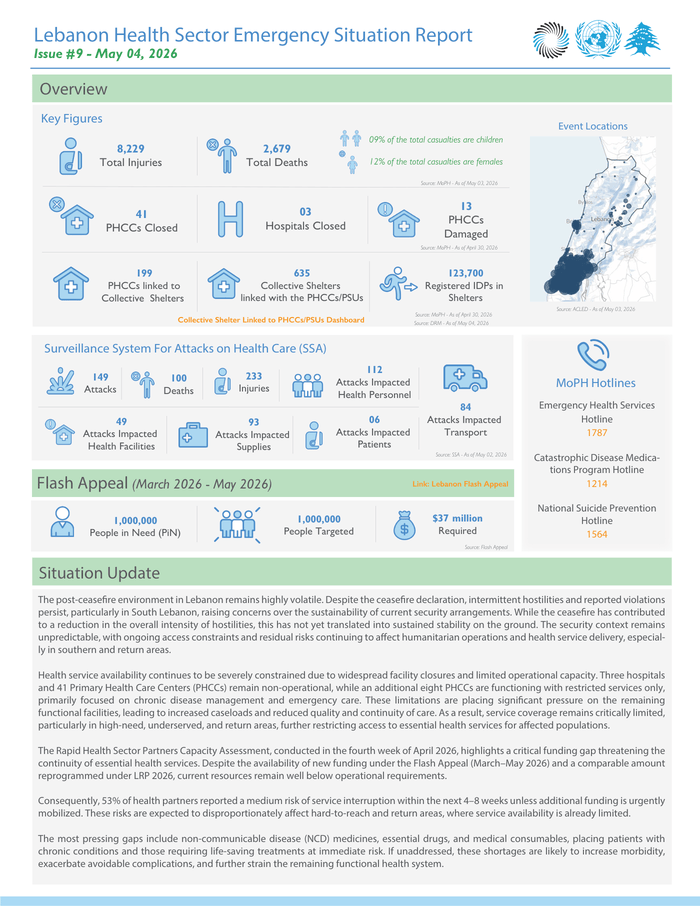
Country: Lebanon Sources: Health Cluster, World Health Organization Please refer to the attached file. Situation Update The post-ceasefire environment in Lebanon remains highly volatile. Despite the ceasefire declaration, intermittent hostilities and reported violations persist, particularly in South Lebanon, raising concerns over the sustainability of current security arrangements. While the ceasefire has contributed to a reduction in the overall intensity of hostilities, this has not yet translated into sustained stability on the ground. The security context remains unpredictable, with ongoing access constraints and residual risks continuing to affect humanitarian operations and health service delivery, especially in southern and return areas. Health service availability continues to be severely constrained due to widespread facility closures and limited operational capacity. Three hospitals and 41 Primary Health Care Centers (PHCCs) remain non-operational, while an additional eight PHCCs are functioning with restricted services only, primarily focused on chronic disease management and emergency care. These limitations are placing significant pressure on the remaining functional facilities, leading to increased caseloads and reduced quality and continuity of care. As a result, service coverage remains critically limited, particularly in high-need, underserved, and return areas, further restricting access to essential health services for affected populations. The Rapid Health Sector Partners Capacity Assessment, conducted in the fourth week of April 2026, highlights a critical funding gap threatening the continuity of essential health services. Despite the availability of new funding under the Flash Appeal (March–May 2026) and a comparable amount reprogrammed under LRP 2026, current resources remain well below operational requirements. Consequently, 53% of health partners reported a medium risk of service interruption within the next 4–8 weeks unless additional funding is urgently mobilized. These risks are expected to disproportionately affect hard-to-reach and return areas, where service availability is already limited. The most pressing gaps include non-communicable disease (NCD) medicines, essential drugs, and medical consumables, placing patients with chronic conditions and those requiring life-saving treatments at immediate risk. If unaddressed, these shortages are likely to increase morbidity, exacerbate avoidable complications, and further strain the remaining functional health system. In coordination with the National Tuberculosis (TB) and Acquired Immunodeficiency Syndrome (AIDS) Control Programme (NTAP), Health Sector partners have been scaling up TB screening activities among displaced populations. A total of 754 IDPs were screened across targeted locations. Of these, 44 individuals were identified as presumptive TB cases and assessed on site using a portable AI-enabled X-ray machine. No abnormal findings were detected.



GrowthPakistan brings you the latest news to keep an eye on Pakistan’s startup ecosystem. Business keeps you growing when you stay aware of your competitors' moves. GrowthPakistan offers Business, Tech, Global Tech, Global, Auto, and Startup News straight from industries all around the globe. This platform will help you identify upcoming opportunities not only in Pakistan but worldwide.
Email : growthpakistan@gmail.com
Whatsapp : +92320-9497079
© growthpakistan