

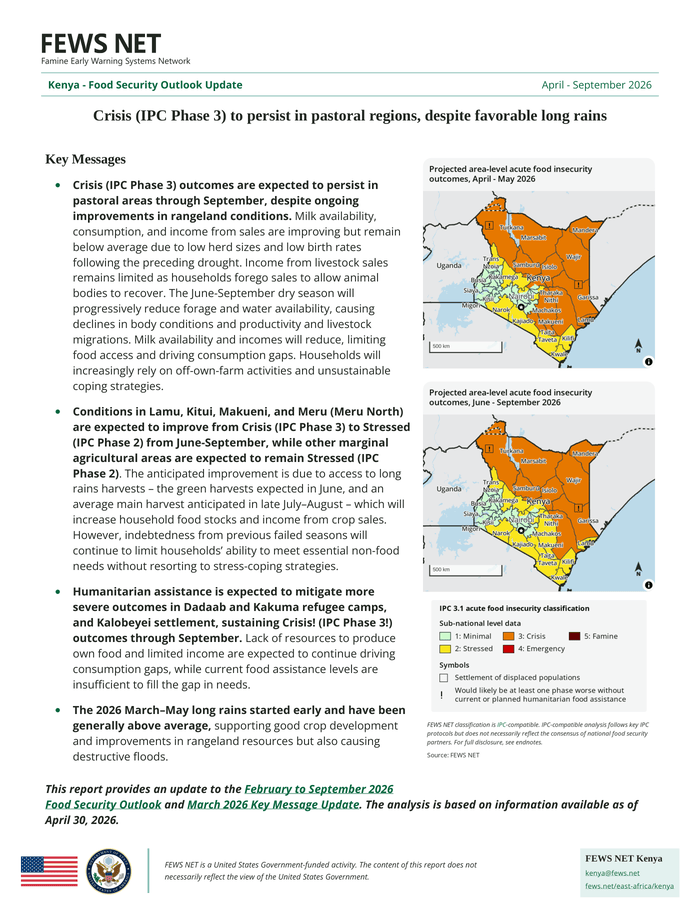
Country: Kenya Source: Famine Early Warning System Network Please refer to the attached file. Key Messages Crisis (IPC Phase 3) outcomes are expected to persist in pastoral areas through September, despite ongoing improvements in rangeland conditions. Milk availability, consumption, and income from sales are improving but remain below average due to low herd sizes and low birth rates following the preceding drought. Income from livestock sales remains limited as households forego sales to allow animal bodies to recover. The June-September dry season will progressively reduce forage and water availability, causing declines in body conditions and productivity and livestock migrations. Milk availability and incomes will reduce, limiting food access and driving consumption gaps. Households will increasingly rely on off-own-farm activities and unsustainable coping strategies. Conditions in Lamu, Kitui, Makueni, and Meru (Meru North) are expected to improve from Crisis (IPC Phase 3) to Stressed (IPC Phase 2) from June-September, while other marginal agricultural areas are expected to remain Stressed (IPC Phase 2). The anticipated improvement is due to access to long rains harvests – the green harvests expected in June, and an average main harvest anticipated in late July–August – which will increase household food stocks and income from crop sales. However, indebtedness from previous failed seasons will continue to limit households’ ability to meet essential non-food needs without resorting to stress-coping strategies. Humanitarian assistance is expected to mitigate more severe outcomes in Dadaab and Kakuma refugee camps, and Kalobeyei settlement, sustaining Crisis! (IPC Phase 3!) outcomes through September. Lack of resources to produce own food and limited income are expected to continue driving consumption gaps, while current food assistance levels are insufficient to fill the gap in needs. The 2026 March–May long rains started early and have been generally above average, supporting good crop development and improvements in rangeland resources but also causing destructive floods. This report provides an update to the February to September 2026 Food Security Outlook and March 2026 Key Message Update. The analysis is based on information available as of April 30, 2026.
Kenya Food Security Outlook Update, April – September 2026 – Crisis (IPC Phase 3) to persist in pastoral regions, despite favorable long rains

RELATED ARTICLES


