


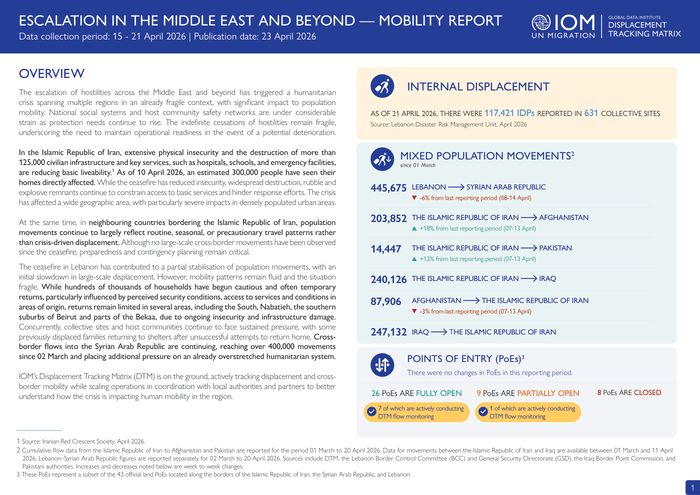
Countries: Iran (Islamic Republic of), Afghanistan, Armenia, Azerbaijan, Iraq, Lebanon, Pakistan, Syrian Arab Republic, Türkiye, Turkmenistan Source: International Organization for Migration Please refer to the attached file. The escalation of hostilities across the Middle East and beyond has triggered a humanitarian crisis spanning multiple regions in an already fragile context, with significant impact to population mobility. National social systems and host community safety networks are under considerable strain as protection needs continue to rise. The indefinite cessations of hostilities remain fragile, underscoring the need to maintain operational readiness in the event of a potential deterioration. In the Islamic Republic of Iran, extensive physical insecurity and the destruction of more than 125, 000 civilian infrastructure and key services, such as hospitals, schools, and emergency facilities, are reducing basic liveability. As of 10 April 2026, an estimated 300, 000 people have seen their homes directly affected. While the ceasefire has reduced insecurity, widespread destruction, rubble and explosive remnants continue to constrain access to basic services and hinder response efforts. At the same time, in neighbouring countries bordering the Islamic Republic of Iran, population movements continue to largely reflect routine, seasonal, or precautionary travel patterns rather than crisis‐driven displacement. The ceasefire in Lebanon has contributed to a partial stabilisation of population movements, with an initial slowdown in large‐scale displacement. However, mobility patterns remain fluid and the situation fragile. While hundreds of thousands of households have begun cautious and often temporary returns, particularly influenced by perceived security conditions, access to services and conditions in areas of origin, returns remain limited in several areas, including the South, Nabatieh, the southern suburbs of Beirut and parts of the Bekaa, due to ongoing insecurity and infrastructure damage. Crossborder flows into the Syrian Arab Republic are continuing, reaching over 400, 000 movements since 02 March and placing additional pressure on an already overstretched humanitarian system.



GrowthPakistan brings you the latest news to keep an eye on Pakistan’s startup ecosystem. Business keeps you growing when you stay aware of your competitors' moves. GrowthPakistan offers Business, Tech, Global Tech, Global, Auto, and Startup News straight from industries all around the globe. This platform will help you identify upcoming opportunities not only in Pakistan but worldwide.
Email : growthpakistan@gmail.com
Whatsapp : +92320-9497079
© growthpakistan