


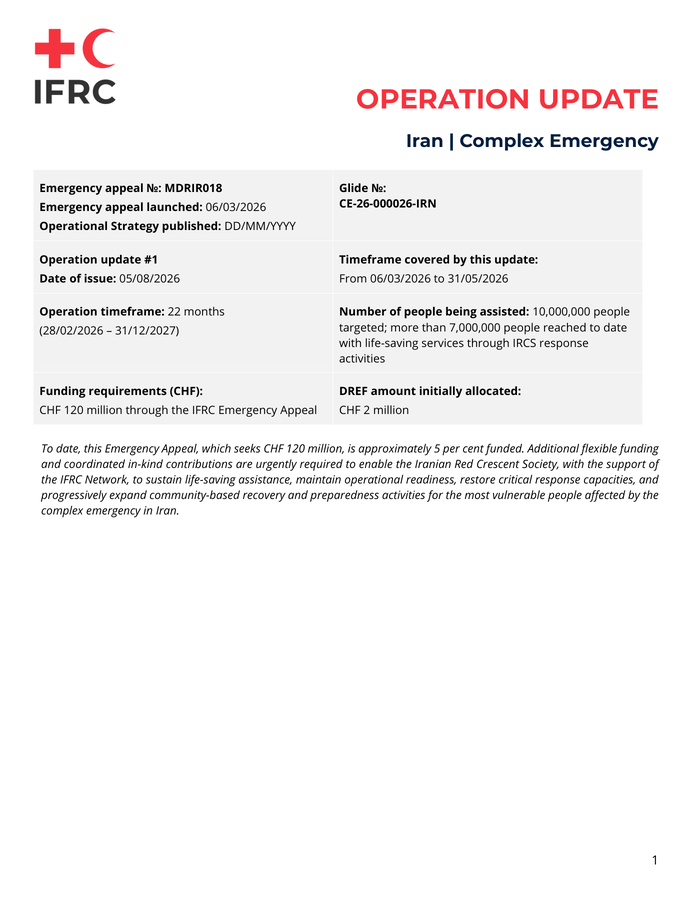
Country: Iran (Islamic Republic of) Source: International Federation of Red Cross and Red Crescent Societies Please refer to the attached file. A. SITUATION ANALYSIS Description of the crisis Since the escalation of hostilities on 28 February 2026, the Islamic Republic of Iran has experienced a nationwide complex emergency with severe humanitarian, social and economic consequences. What began as an acute conflict emergency rapidly expanded across the country, with incidents reported across 30 of 31 provinces and 275 counties, and with 262 districts affected. Following 40 consecutive days of strikes, a ceasefire reduced the immediate intensity of hostilities; however, the situation remains fragile and humanitarian needs continue to deepen. The direct impact of the crisis has been severe. By the end of May 2026, approximately 60 million people were considered affected, of whom 10 million are among the most vulnerable and targeted through the Emergency Appeal. Reported casualties include more than 3, 465 deaths, including approximately 1, 460 civilians, and more than 34, 000 people injured. Around 3. 2 million people are estimated to have been internally displaced, placing additional pressure on host communities, urban infrastructure, public services and local economies. The crisis has also caused widespread damage to civilian and humanitarian infrastructure. More than 149, 000 civilian units have been damaged, including over 123, 000 residential units, more than 24, 000 commercial or business units, over 350 health facilities, 993 schools and 32 universities or research institutions. IRCS assets were also directly affected, including Red Crescent centres, logistics assets, ambulances and helicopters. Damage to homes, health facilities, schools, water and electricity systems, and humanitarian infrastructure has disrupted access to essential services and increased exposure to health, protection and socioeconomic risks. While active hostilities have decreased under the ceasefire, the crisis is increasingly defined by indirect socioeconomic impacts. Inflation, food price increases, currency depreciation, disruption of trade and supply chains, unemployment, reduced household purchasing power, and constrained access to medicines and medical equipment are eroding coping capacities. These pressures are particularly severe for displaced people, low-income households, informal workers, women-headed households, migrants and refugees, older people, youth, persons with disabilities and people living with chronic illness. The operational environment remains highly constrained. Sanctions-related restrictions, financial and banking limitations, procurement delays, shipping constraints, supplier hesitancy, damaged infrastructure, communications disruptions and the fragile security situation continue to affect the timely delivery of assistance. At the same time, the risk of renewed escalation remains present, requiring IRCS and IFRC to maintain full emergency response readiness while progressively expanding recovery-oriented and community-based interventions where conditions allow.



GrowthPakistan brings you the latest news to keep an eye on Pakistan’s startup ecosystem. Business keeps you growing when you stay aware of your competitors' moves. GrowthPakistan offers Business, Tech, Global Tech, Global, Auto, and Startup News straight from industries all around the globe. This platform will help you identify upcoming opportunities not only in Pakistan but worldwide.
Email : growthpakistan@gmail.com
Whatsapp : +92320-9497079
© growthpakistan