


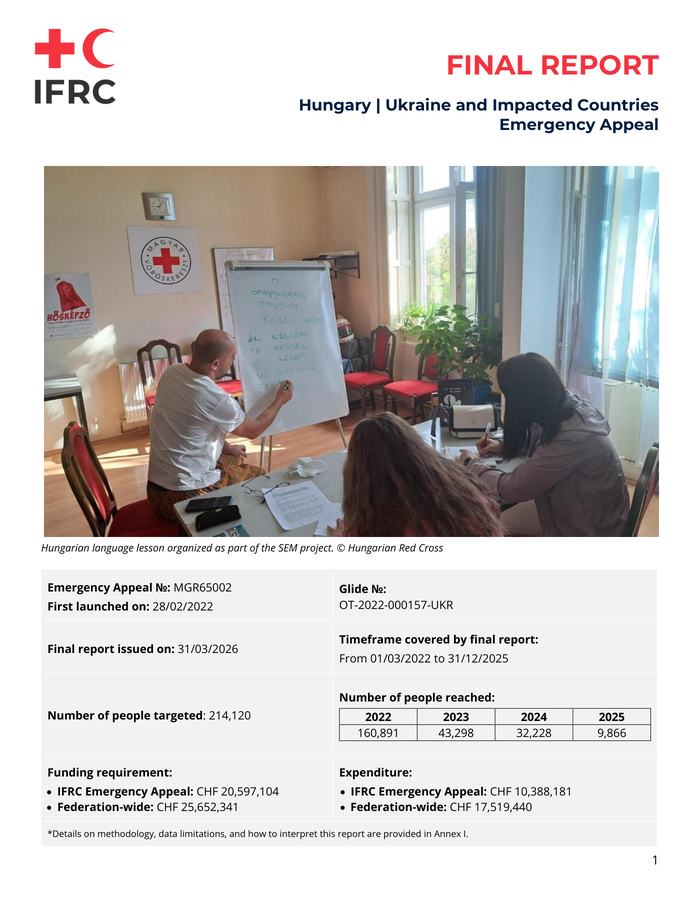
Countries: Hungary, Ukraine Source: International Federation of Red Cross and Red Crescent Societies Please refer to the attached file. A. SITUATION ANALYSIS Description of the crisis In February 2022, Hungary was directly impacted by the escalation of the international armed conflict in Ukraine, which began on 24 February 2022. As one of Ukraine’s immediate neighbours, Hungary became a key transit and destination country for people fleeing the violence. The sudden and large-scale emergency escalation resulted in mass displacement, with over 1. 8 million people crossing into Hungary from Ukraine and 1. 7 million from Romania between February and November 2022. As of end of November 2025, 64, 883 refugees were recorded from Ukraine in Hungary. 1 The conflict created immediate and widespread humanitarian needs, primarily in the sectors of emergency shelter, health, protection, food security, and access to basic services. The majority of those displaced were women and children, many of whom arrived in Hungary without adequate documentation, resources, or access to medical and social support. Vulnerable groups also included older people, individuals with chronic illnesses or disabilities, and third-country nationals previously residing in Ukraine who lacked legal clarity and social protection entitlements in Hungary. Initial assessments conducted by humanitarian actors, including UNHCR, IOM, and the IFRC, identified critical vulnerabilities. These included urgent shelter needs (especially in colder months), language barriers impeding access to healthcare and legal services, and limited information available to displaced persons about their rights and entitlements in Hungary. By November 2022, 32, 522 people had applied for Temporary Protection Status (TPS) in Hungary, of whom 28, 379 were granted status, offering them limited access to Hungary’s social protection system. 2 The Hungarian Red Cross (HRC), with support from the IFRC, was mobilized to address these needs under the Ukraine and Impacted Countries Emergency Appeal (MGR65002). The response included: •Provision of food and non-food relief items, •Establishment of temporary accommodation (supported by UNHCR), •Deployment of DM team including Health-HERO units, •Launch of multi-purpose cash assistance programmes, •Distribution of winterization kits, and •Coordination with government and humanitarian partners to ensure the inclusion of marginalized and undocumented groups. The situation continued to evolve rapidly throughout 2022. While many refugees moved onward to other European countries, tens of thousands remained in Hungary. Some staying in over 800 temporary centres, others hosted by relatives or in private accommodation. The high volume of arrivals strained Hungary’s border regions and public services, especially in Szabolcs-Szatmár-Bereg, Borsod-Abaúj-Zemplén, and urban centres such as Budapest, where needs remained acute. Compounding the humanitarian challenges were economic pressures, including rising fuel and energy prices and pre-existing vulnerabilities in Hungary’s poorest counties. These developments influenced both the humanitarian context and the planning of interventions, necessitating a more holistic approach that included support for both displaced and host communities. Throughout 2023, the humanitarian situation in Hungary continued to evolve in the context of the protracted international armed conflict in Ukraine. While large-scale movements across borders had declined compared to the initial months of 2022, the humanitarian impact remained significant. The emergency prolonged, with new waves of displacement, a continued need for temporary protection, and emerging pressures on host communities and national systems. Although many of the initial emergency needs had been partially addressed through coordinated response efforts by humanitarian actors and the Hungarian government, new and more complex challenges emerged. These included: •A harsh winter period requiring winter-specific relief items (e. g. clothing, shelter heating, heating support), •Economic pressures linked to inflation and rising energy prices affecting both displaced populations and host communities, •Ongoing legal and administrative challenges in accessing services, particularly for third-country nationals and persons with dual citizenship who were often excluded from Hungary’s social protection mechanisms, •Barriers to social and economic integration, especially in relation to language, employment, education, and housing. By mid-2023, humanitarian needs in Hungary had shifted from acute, life-saving assistance to stabilization-oriented support, particularly in the sectors of primary healthcare, mental health and psychosocial support (MHPSS), livelihoods, and social integration. Many displaced families remained in Hungary, but some have required support to transition from temporary accommodation to dignified, longer-term housing solutions. Simultaneously, an increasing number of children needed access to education, and single-headed households, especially those led by women, faced heightened vulnerability. The operational context became increasingly complex due to a combination of factors: •Persistent language barriers and limited access to employment for displaced individuals, •Funding constraints and increasing competition for donor attention across multiple global emergencies, The beginning of regional discussions on transitioning from Temporary Protection frameworks, raising concerns about future legal status and entitlements of displaced individuals. The HRC, with technical leadership from IFRC, responded to these evolving needs by adjusting programming. This included the continuation of multi-purpose unconditional cash assistance, increased focus on protection-sensitive programming, and deeper engagement in social inclusion activities, especially targeting marginalized groups such as the Roma community, persons with disabilities, and older persons. At the same time, National Society Development (NSD) investments continued to support the transformation of HRC’s internal capacity, enhancing branch development, volunteer engagement, and staff training, in preparation for a more durable and inclusive response strategy. In 2024, Hungary remained affected by the protracted consequences of the international armed conflict in Ukraine, with approximately 63, 775 refugees from Ukraine still present in the country as of the end of 2023, and a projected caseload of 85, 000 people requiring assistance during the year. While the situation improved for some displaced individuals, particularly those with access to stable housing, employment, and social services, many others continued to face critical challenges, including uncertain legal status, limited integration opportunities, and ongoing protection risks, especially for children, single mothers, older persons, and people with disabilities. Key developments in 2024 significantly influenced the humanitarian landscape in Hungary: •Return movements to Ukraine became more frequent, often driven by economic pressures and the erosion of social support in host countries, although many returns were premature and not yet fully voluntary. •The extension of the EU Temporary Protection Directive (TPD) to March 2025 created a temporary sense of legal stability but also raised uncertainty and planning challenges for responders. •Some policy shifts began to emerge, with signs of scaling down financial assistance across Europe, including Hungary, reinforcing the need to transition from dependency-based aid to self-reliance and inclusion-focused approaches. The humanitarian focus in Hungary therefore started to shift toward longer-term, community-based interventions, complementing residual emergency support. The Hungarian Red Cross, with support from IFRC, increasingly prioritized: •Local integration efforts through social care, volunteer networks, and community outreach, •Support for dignified housing via host family programmes and rental assistance pilots, •Livelihood and employment support for displaced persons, •Expansion of mental health and psychosocial support (MHPSS) services, especially for vulnerable groups. Despite these gains, gaps in inclusion, access to national systems, and sustainability of support remained key barriers. The operating environment also became more constrained due to donor fatigue, overlapping global emergencies, and inflationary pressures, which particularly impacted localized service providers and stretched host community resources. In this context, 2024 represented a transition phase, from acute emergency operations to a hybrid approach that emphasized inclusion, protection, and resilience, paving the way for recovery and longer-term planning ahead of the anticipated policy shifts in 2025. As of 2025, the international armed conflict between Russia and Ukraine remains unresolved, and Hungary continues to host tens of thousands of displaced persons under Temporary Protection, which the EU extended until March 2026. Humanitarian needs remain significant, particularly among elderly individuals with chronic illnesses, people with disabilities, women, single-parent households, children, Roma and third-country nationals without formal residency status. Although some indicators improved, such as increased access to language training and expanding health services, recent economic instability, rising inflation, and donor fatigue threaten service continuity. The transition from the Emergency Appeal (EA) to the IFRC Unified Country Plan (2025–2027) signals a shift toward sustainable, community-based interventions, particularly in: 1. Health access, 2. International relations and communications, 3. Counselling and protection support, 4. NSD (particularly for resource mobilization, digitalization and system development, branch development, and volunteer capacity building). At the same time, Hungary’s shrinking humanitarian space, restrictive migration discourse, and complex regulatory landscape continue to pose risks to service delivery and peoples’ inclusion. The humanitarian actors remain flexible and coordinated, drawing on lessons from the past three years to effectively balance immediate needs with longer-term inclusion and resilience strategies. Amid ongoing global instability, including economic volatility, shifting donor priorities, and rising geopolitical tensions, concerns are mounting that external pressures could reduce access to essential services or increase vulnerabilities for at-risk populations in Hungary. In this context, both 2024-2025 represented critical years of transition, where Red Cross must balance the delivery of life-sustaining support with investment in durable solutions, inclusive systems, and preparedness for the post-TPD policy environment.



GrowthPakistan brings you the latest news to keep an eye on Pakistan’s startup ecosystem. Business keeps you growing when you stay aware of your competitors' moves. GrowthPakistan offers Business, Tech, Global Tech, Global, Auto, and Startup News straight from industries all around the globe. This platform will help you identify upcoming opportunities not only in Pakistan but worldwide.
Email : growthpakistan@gmail.com
Whatsapp : +92320-9497079
© growthpakistan