


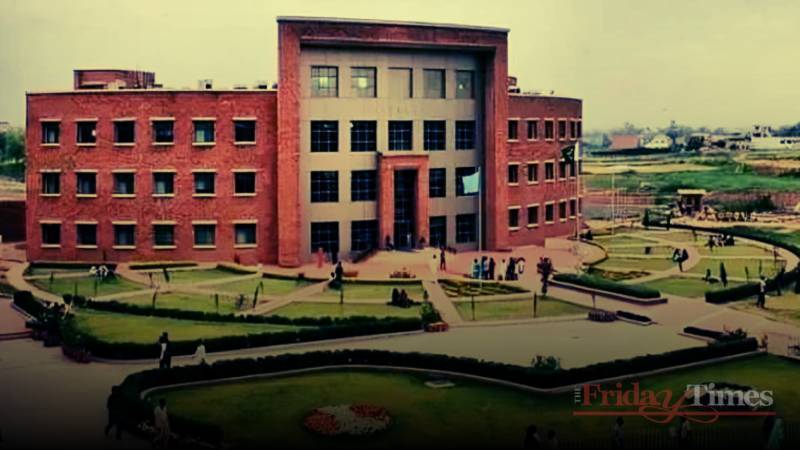
Quaid-i-Azam University is once again in crisis. With midterm examinations scheduled this week, the administration has issued a firm notification: classes will continue, and exams will be held. The Academic Staff Association has publicly backed this decision. Yet, familiarly, a small but organised group of students has blocked transport at the main “Point”, attempted to shut departmental gates, and disrupted normal campus life. What is being presented as a cultural grievance is, in reality, a confrontation over the enforcement of basic university rules. The immediate trigger is straightforward. The university, facing a severe financial crisis, required students to complete course registration and clear dues before appearing in exams. This is a standard academic requirement. However, a segment of students—many residing in hostels but not formally registered or not paying fees—mobilised under ethnic councils and the umbrella of the Quaidian Students Federation (QSF). The Mehran Council took the lead, quickly joined by others. The protests escalated to physical obstruction of university operations, including the reported manhandling of a female head of department when faculty resisted the forced closure of academic spaces. The claim that Acting Vice Chancellor Dr Zafar N. Jaspal disrespected a cultural symbol has been used to mobilise sentiment. The facts indicate otherwise: he intervened to protect faculty and restore order. The episode reflects a recurring pattern—administrative enforcement is reframed as grievance, and grievance is used to justify disruption. This is not an isolated incident. It is the continuation of a decade-long cycle. Violent clashes between ethnic student councils have repeatedly led to injuries, damage to property, and complete campus shutdowns. In 2023, clashes between student groups resulted in over two dozen injuries and forced the university to close indefinitely. In 2018, armed confrontations between rival groups involved sticks, firearms, and the destruction of vehicles. These are not sporadic protests; they are organised confrontations rooted in entrenched campus structures. University Of Sindh Pro-VC Suspended By Sindh Govt Following Viral Intoxication Videos At the centre of this structure are the hostels. Over time, they have ceased to function as regulated student accommodation. A significant number of occupants are no longer enrolled students—some have graduated, others have been expelled, and many delay the submission of their theses for years to retain residence. When the administration, with police support, attempted to vacate hostels in 2025, over 70 individuals were taken into custody—many identified as outsiders or former students. This is not a marginal issue; it is systemic. A university cannot function where rules are optional, authority is contested, and violence carries no consequence The financial cost is equally stark. Maintaining hostels costs the university tens of millions of rupees per month—around Rs44 million during the semester and even higher during vacations—while many residents either do not pay dues or consume subsidised facilities without authorisation. The university has, despite this, disbursed over Rs208 million in scholarships and financial assistance between 2019 and 2022, alongside multiple support schemes. The claim of exclusion does not stand against this record. The problem extends beyond non-payment. Reports over the years have consistently pointed to the availability of drugs—hashish, heroin, and more recently ice—within hostels, facilitated by networks that include outsiders. Late-night gatherings, music programmes, and open rowdyism are routine. Vandalism of university property, theft, and intimidation have become common features of campus life. Faculty members have reported being unable to move freely during periods of unrest. Families of faculty and staff residing on campus often remain confined to their homes during strikes, unable to leave due to blockades. There is also evidence of collusion. During protests against the CDA’s anti-encroachment operations around the university, students mobilised in defence of illegal structures. These were not abstract solidarities. Some of these encroachments were linked to lower-tier staff, with students occupying or benefiting from these arrangements. This episode made one thing clear: the problem is known to the capital administration and law enforcement agencies. It is neither hidden nor new. Citizens Archive Of Pakistan And Aga Khan University Sign MoU To Upgrade National Museum The deeper institutional context cannot be ignored. QAU was established as a postgraduate research institution. The expansion of undergraduate programmes—without proportional increases in faculty, infrastructure, and administrative capacity—has fundamentally altered the campus. Enrolment has grown, including evening programmes, largely as a response to financial pressures. The result is a strain on facilities and a dilution of the academic environment the university was designed to sustain. The emergence of ethnic councils is itself a by-product of policy failure. With student unions banned, informal ethnic groupings filled the vacuum. In principle, a university like QAU—drawing students from across Pakistan—should have reflected diversity as a strength. Instead, these councils have evolved into competing power centres. Violent clashes between Punjabi, Pashtun, Baloch, Sindhi, and Seraiki groups have become a recurring feature. There have even been instances where students linked to such networks were later associated with militant organisations. Successive vice chancellors have faced the same dilemma: enforce discipline and risk escalation, or accommodate disruption to preserve temporary calm. Most have oscillated between the two, without resolving the underlying problem. The current administration’s attempt to enforce registration and reclaim hostels is not unprecedented—it is overdue. What is new is the intensity of resistance. But the most critical failure lies beyond the university. This is no longer merely a campus issue. The presence of illegal occupants, organised coercion, and physical obstruction of institutional functioning constitutes a law-and-order problem. The capital administration and police are fully aware of the situation. They have intervened episodically, but not consistently. Without sustained enforcement, the university’s writ cannot be restored. The cost of inaction is borne by the silent majority. Thousands of students who want to study find their education repeatedly disrupted. When buses are stopped and gates are closed, they cannot attend classes. When semesters are delayed or cancelled—as in 2025—their academic progression suffers. Their right to education is subordinated to the demands of a small but organised minority. Pakistan’s First Intelligence And Security Studies Graduates Mark Historic Milestone At University Of Lahore QAU still features in global rankings and remains one of Pakistan’s leading academic institutions. But a reputation cannot survive indefinitely without order. A university cannot function where rules are optional, authority is contested, and violence carries no consequence. The current crisis is not about a single protest, a single council, or a single administration. It is about the absence of consistent state backing for institutional authority. Until the rule of law is enforced—within and beyond the campus—QAU will remain what it has increasingly become: a hostage institution struggling to perform its most basic function.



GrowthPakistan brings you the latest news to keep an eye on Pakistan’s startup ecosystem. Business keeps you growing when you stay aware of your competitors' moves. GrowthPakistan offers Business, Tech, Global Tech, Global, Auto, and Startup News straight from industries all around the globe. This platform will help you identify upcoming opportunities not only in Pakistan but worldwide.
Email : growthpakistan@gmail.com
Whatsapp : +92320-9497079
© growthpakistan