


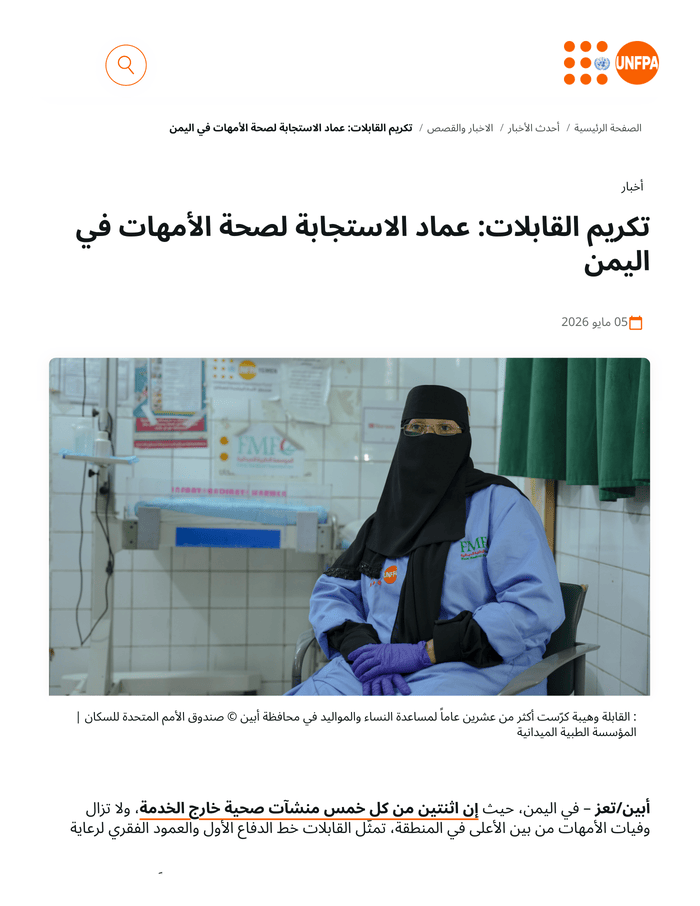
Country: Yemen Source: United Nations Population Fund Please refer to the attached file. Abyan/Tai’z – In Yemen, where two out of five health facilities are non-functional and maternal mortality remains among the highest in the region, midwives help to serve as the backbone of maternal care. With only three in five births attended by a skilled provider, midwives are often the only link to safe motherhood for countless women. Midwives prevent maternal and newborn deaths from complications during pregnancy and childbirth. With a midwife present, women have a far greater chance of safe delivery and healthy babies. In fragile, crisis-affected settings like Yemen, midwives are often the first—and only—providers of maternal healthcare. Beyond delivery, midwives provide family planning, antenatal and postnatal care, nutrition counseling, cancer screenings, and other essential health services. UNFPA research shows that every $1 invested in midwifery yields up to $16 in social and economic returns —making it a smart, cost-effective strategy for expanding healthcare and improving development outcomes. Racing against time to save a life On 18 April 2025, in the outskirts of Tai’z Governorate, UNFPA-supported midwife Enas received an urgent call. Amira, eight months pregnant, had gone into labour. Enas traveled over three hours across treacherous terrain to reach her. After six hours of labour, Amira delivered her baby safely—but moments later, she began hemorrhaging severely. Enas acted with precision and calm. She performed a uterine massage, administered injections to control the bleeding, and replaced lost fluids through IV drips; as a result, Amira’s life was saved – highlighting the lifesaving role of midwives who reach women where hospitals are too far and time is too short. A trusted presence In Zinjibar District of Abyan Governorate where women seek care only from female providers, midwife Wahiba is far more than a healthcare worker. She is a trusted presence—the person families call in the middle of the night, the face a frightened mother searches for when pain becomes unbearable. Medicine shortages, power outages, and overcrowded facilities are her daily reality. Sometimes she works by the light of her mobile phone. Still, she returns every morning, driven by the love and trust of her community. Wahiba knows that saving lives doesn’t end in the delivery room. In her community, deeply rooted misconceptions put mothers and newborns at risk. Some women refuse prenatal vitamins, fearing they will make the baby too large and delivery more difficult—unaware that these supplements protect both mother and child. “We need to raise awareness. Many misconceptions put mothers and babies at risk,” she tells UNFPA. She advocates quietly and consistently—in conversations at the health center, during home visits, in every interaction with women who trust her enough to ask. Through UNFPA’s support, Wahiba continues serving her community with the tools, training, and supplies she needs to save lives every day. A home turned midwifery clinic In a remote village in Abyan Governorate, where roads are broken and hospitals distant, midwife Najeeba did not wait for a facility to be built—she built one inside her home. A midwife and trainer, Najeeba graduated in nursing in 1984 and later studied midwifery in Germany. Since 1989, she has trained generations of midwives and served women in the most remote areas of Abyan. Even after retirement, she continues receiving women in need—sometimes while cooking for her grandchildren. Her home is her clinic. Her bed is her examination table. Her old blood pressure monitor and sterilized delivery kit are her tools. When women have nowhere else to turn, they turn to Najeeba. She remembers one night when she delivered a baby under intense fighting. She stayed and saved both mother and child. “Sometimes I find myself in a difficult position — I cannot provide complete care because the resources simply are not there.” What we need most is a nearby clinic that provides the basics maternal health services, ” she tells UNFPA. Through UNFPA, she now receives financial support to maintain her home clinic and a delivery ki, which includes tools that help her continue her mission to save lives. Building a strong midwifery workforce In Yemen, UNFPA continues to invest in thousands of midwives in partnership with the Ministry of Public Health and Population and local actors. Under the National Midwifery Strategy 2024–2026, UNFPA supported the development of the National Education Standards and the National Professional Framework, aligned with international midwifery standards—marking a critical step toward empowering midwives to provide high-quality, lifesaving care across the country. In 2026, UNFPA is supporting 100 students enrolled in a three-year midwifery diploma. Seventy frontline community midwives are also being mobilized to underserved and conflict-affected areas with limited access to health services. On the International Day of the Midwife, UNFPA celebrates midwives as the backbone of health systems, and call for urgent investment in their education, leadership, and protection – essential actions if we are to expand the midwifery workforce by 1 million.



GrowthPakistan brings you the latest news to keep an eye on Pakistan’s startup ecosystem. Business keeps you growing when you stay aware of your competitors' moves. GrowthPakistan offers Business, Tech, Global Tech, Global, Auto, and Startup News straight from industries all around the globe. This platform will help you identify upcoming opportunities not only in Pakistan but worldwide.
Email : growthpakistan@gmail.com
Whatsapp : +92320-9497079
© growthpakistan