


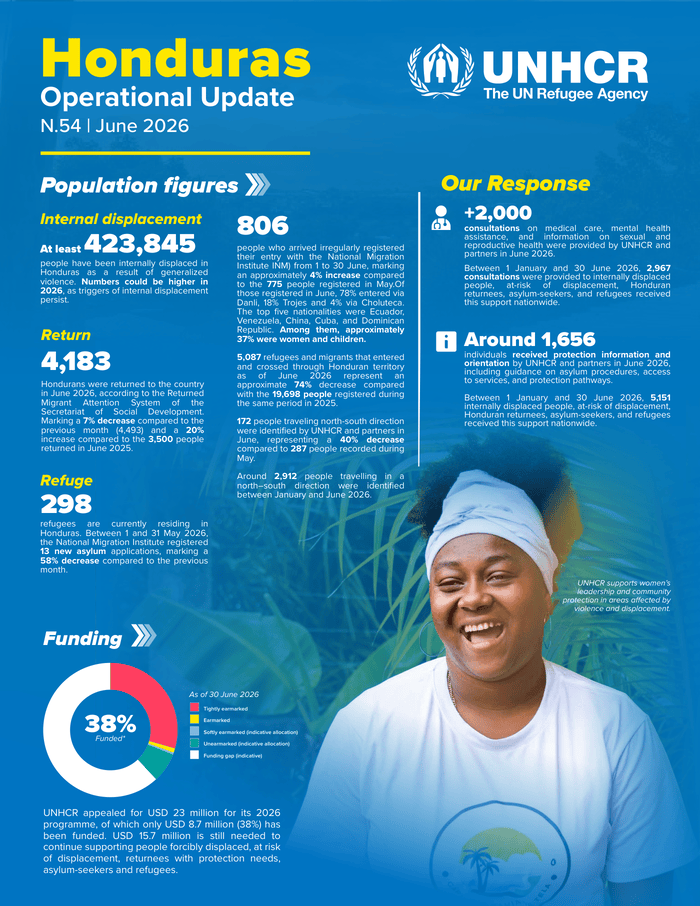
Country: Honduras Source: UN High Commissioner for Refugees Please refer to the attached file. Context June was marked by continued violence, insecurity, forced displacement risks and legal developments affecting the protection environment in Honduras. Reports during the month highlighted the persistence of organized criminal activity, extortion, violence against women, land-related conflicts, risks affecting children and adolescents, and climate-related pressures on communities with limited livelihood opportunities. Forced displacement remained a key concern. The Norwegian Refugee Council ranked Honduras among the world’s ten most neglected displacement crises, citing limited international attention, insufficient humanitarian funding and reduced political engagement. National human rights institutions also warned that violence continues to drive displacement, with many families facing insecurity and limited access to protection before leaving their communities or the country. Violence continued to affect community safety and mobility. The Violence Observatory of the National Autonomous University of Honduras reported that some smaller municipalities are recording higher homicide rates than major urban centres, linking these trends to the expansion of organized crime and drug trafficking outside the country’s largest cities. Authorities also reported increasingly fragmented extortion dynamics, with independent criminal actors accounting for a large share of complaints in recent years. Women, children and adolescents remained exposed to heightened protection risks. Civil society organizations reported at least 135 femicides so far in 2026, while child protection actors documented a 12 per cent increase in violent deaths of children, adolescents and young people compared to the same period in 2025. During the reporting period, the National Congress approved legal reforms to increase penalties for femicide and strengthen sanctions under the Law against Domestic Violence. The National Congress approved the Agro-industrial, Energy and Tourism Promotion Law and related reforms regulating evictions from occupied agricultural land. Indigenous, campesino and human rights organizations expressed concerns that the measures could increase risks of criminalization, displacement and tensions around longstanding land disputes. Climate-related shocks added pressure to communities already affected by violence. National authorities warned that a prolonged dry spell could reduce basic grain production and affect food security for thousands of families. In southern Honduras, coastal communities in Cedeño, experienced impacts from storm surges associated with Tropical Storm Cristina, while human rights organizations called for a rights-based approach to the planned relocation of Cedeño.



GrowthPakistan brings you the latest news to keep an eye on Pakistan’s startup ecosystem. Business keeps you growing when you stay aware of your competitors' moves. GrowthPakistan offers Business, Tech, Global Tech, Global, Auto, and Startup News straight from industries all around the globe. This platform will help you identify upcoming opportunities not only in Pakistan but worldwide.
Email : growthpakistan@gmail.com
Whatsapp : +92320-9497079
© growthpakistan