


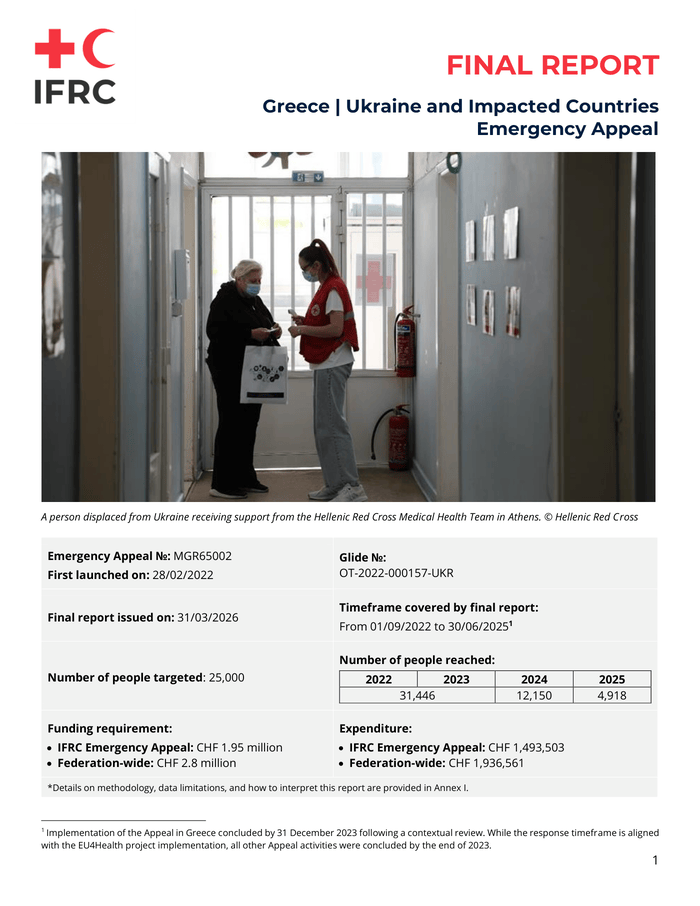
Countries: Greece, Ukraine Source: International Federation of Red Cross and Red Crescent Societies Please refer to the attached file. A. SITUATION ANALYSIS Description of the crisis In 2022, following the escalation of the international armed conflict between Russia and Ukraine, the International Federation of Red Cross and Red Crescent Societies launched the Ukraine and Impacted Countries Emergency Appeal to assist more than 3. 6 million people affected by the humanitarian consequences of the conflict. As needs evolved across the region and additional National Societies requested support, the IFRC progressively scaled up its response both within Ukraine and in neighbouring countries. The Emergency Appeal was subsequently revised to include a total of 17 National Societies, delivering critical and longer-term humanitarian assistance ranging from cash and voucher assistance to mental health and psychosocial support services. Within this framework, selected programmes and activities of Hellenic Red Cross were funded to support people affected by the international armed conflict in Greece. The humanitarian consequences of the international armed conflict have included widespread displacement, extensive damage to civilian infrastructure, and growing humanitarian needs. Millions of people have been affected, both within Ukraine and across borders. Many people who fled Ukraine have been unable to return, while those remaining continue to face challenging conditions, including constrained access to healthcare and other essential services. The prolonged nature of the conflict has also had a significant and cumulative impact on mental wellbeing, resulting in increased levels of stress, anxiety, and trauma among affected populations and a growing demand for mental health and psychosocial support services. Greece continued to experience the humanitarian consequences of the international armed conflict due to the arrival and presence of people displaced from Ukraine. As of December 2023, an estimated 27, 365 people displaced from Ukraine were recorded in Greece2. Many were residing in temporary accommodation settings, such as the Serres site, hosted by family members, living in shelters, or independently. Displaced people faced a complex and evolving set of challenges, including barriers to accessing healthcare, education, and sustainable employment, largely linked to language barriers and the non-recognition of qualifications obtained in Ukraine. The psychosocial impact of displacement remained a key concern throughout the reporting period. Hellenic Red Cross reported a significant increase in demand for mental health and psychosocial support services, with many people displaced from Ukraine experiencing high levels of stress, anxiety, and trauma. In response, Hellenic Red Cross expanded its psychosocial support programming, providing services such as individual counselling, group-based support activities, and stress management interventions aimed at strengthening coping mechanisms and resilience. In July 2023, the IFRC, in consultation with Hellenic Red Cross, decided to conclude the implementation of the Ukraine and Impacted Countries Emergency Appeal in Greece by 31 December 2023. This decision followed a careful assessment of the evolving humanitarian context and operational priorities within the country. While the Emergency Appeal was planned to continue globally until December 2025, Hellenic Red Cross determined that the relatively limited number of people eligible to be reached under the Appeal in Greece, combined with the availability of other IFRC-supported initiatives, including the EU4Health programme and the Global Route-Based Migration Programme, as well as changes in the broader humanitarian landscape, required a shift in focus. Hellenic Red Cross assessed that these alternative programmes would be better positioned to address the longer-term needs of people displaced from Ukraine residing in Greece.



GrowthPakistan brings you the latest news to keep an eye on Pakistan’s startup ecosystem. Business keeps you growing when you stay aware of your competitors' moves. GrowthPakistan offers Business, Tech, Global Tech, Global, Auto, and Startup News straight from industries all around the globe. This platform will help you identify upcoming opportunities not only in Pakistan but worldwide.
Email : growthpakistan@gmail.com
Whatsapp : +92320-9497079
© growthpakistan