


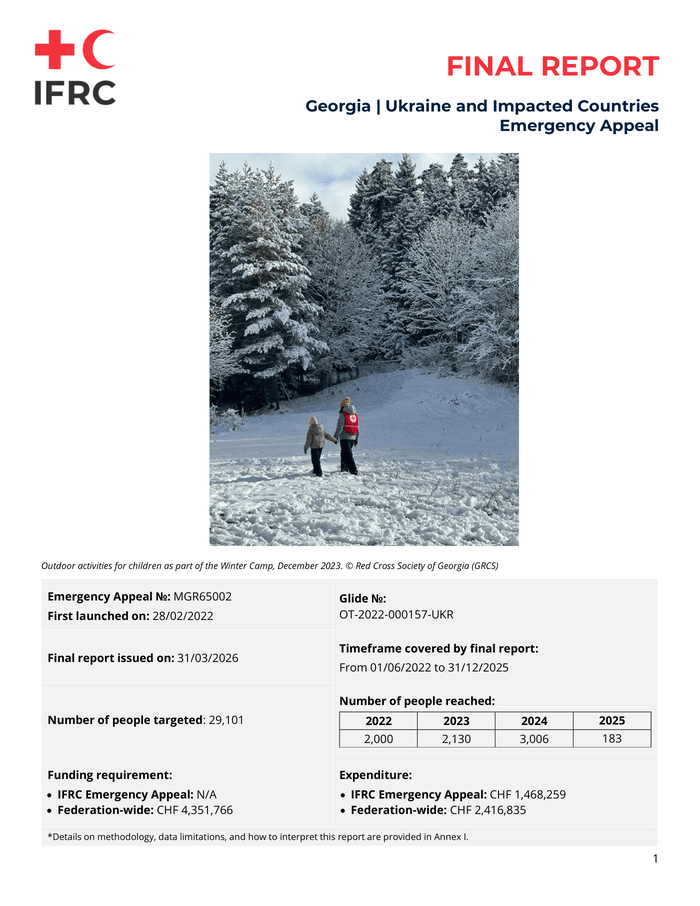
Countries: Georgia, Ukraine Source: International Federation of Red Cross and Red Crescent Societies Please refer to the attached file. A. SITUATION ANALYSIS Description of the crisis Since the escalation of the Russia-Ukraine international armed conflict, Georgia has become both a destination and a transit country for displaced people from Ukraine. According to the Ministry of Internal Affairs of Georgia, around 27, 000 people displaced from Ukraine were staying in Georgia throughout the year of 2023. In February 2023, the Georgian Government extended the legal stay for Ukrainian citizens (visa-free) to two years, amending Resolution No. 255, “On the approval of the list of countries whose citizens can enter Georgia without a visa,” dated June 5, 2015. Consequently, all new arrivals may stay in Georgia for two years, while those in Georgia since 2022 received an additional one-year visa-free. Government services for the people displaced from Ukraine have largely ceased, and many social services, excluding education, are only accessible to those registered in Georgia as protected persons, a step most displaced people from Ukraine avoid due to their intent to return to Ukraine. Assessments conducted during the reporting period revealed the motivation and reasons among the displaced community for choosing Georgia as a destination country, being a) social and cultural similarities between Ukraine and Georgia, b) geopolitical and geographical proximity, and c) family reunifications. Many of the families who stayed in the country included older people and children, resulting in health and PGI/inclusion needs to be the most prioritized ones over the duration of the Response. As of 2024, 63 percent of the families were accompanied by children. Most children displaced from Ukraine in Georgia attended in-person learning, with only three percent exclusively attending online classes through their Ukrainian school, confirming increased protection and inclusion needs among the affected people. Access to health services, including access to primary healthcare (PHC) and access to Human Immunodeficiency Virus (HIV) management services for people living with HIV (PLHIV), were identified as the critical health priority needs among the displaced people, in particular among older people, persons with disabilities (PWDs), pregnant women, and single parents with minors. The Georgia Red Cross Society (GRCS) Response to the humanitarian consequences of Russia-Ukraine international armed conflict addressed the Primary Healthcare and HIV diagnostics and Management access gaps for the displaced people from Ukraine and affected countries, which are not provided by Georgian health authorities. Further priority actions included Mental Health and Psychosocial Support (MHPSS), support to children and parents through Child-Friendly Spaces (CFSs) and Protection, Gender and Inclusion (PGI) activities, development of Cash and Voucher Assistance (CVA) capacity, and continuous evidence-based advocacy for increased attention and support to displaced people from Ukraine.



GrowthPakistan brings you the latest news to keep an eye on Pakistan’s startup ecosystem. Business keeps you growing when you stay aware of your competitors' moves. GrowthPakistan offers Business, Tech, Global Tech, Global, Auto, and Startup News straight from industries all around the globe. This platform will help you identify upcoming opportunities not only in Pakistan but worldwide.
Email : growthpakistan@gmail.com
Whatsapp : +92320-9497079
© growthpakistan