

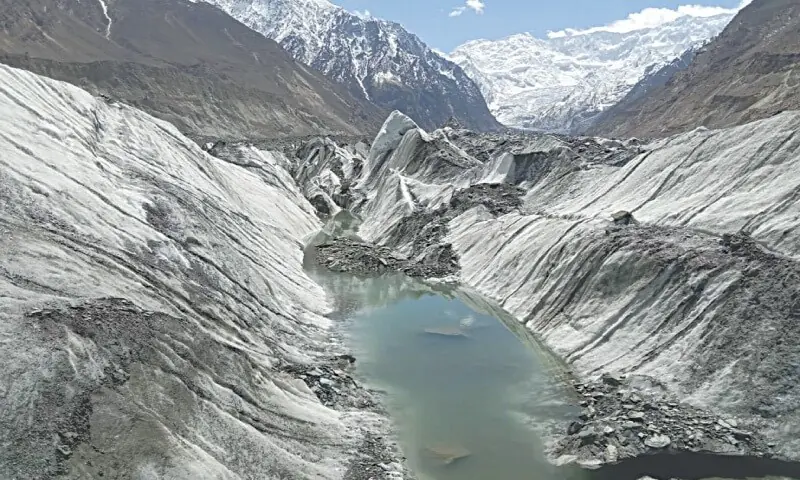
• CM announces specialised committee will draft authority’s framework • PMD warns of Glof risks in GB, KP amid fresh weather system; urges residents to avoid riverbanks, glacial lakes and vulnerable mountain areas; reports above-normal daytime temperatures in glaciated valleys • Disaster Management Authority says emergency plans and 174 early warning systems are in place GILGIT: Gilgit-Baltistan Chief Minister Advocate Amjad Hussain on Saturday announced the establishment of Glaciers Protection Authority to address growing climate change challenges in the region, protect glaciers and attract support from relevant international organisation. Speaking during a departmental briefing by the Gilgit-Baltistan (GB) Forest and Wildlife Department, the chief minister said a specialised committee would be formed to prepare comprehensive recommendations for the establishment of the authority and present it at the relevant official forum. “Forestry is important to mitigate climate change impacts and for protection of glaciers, ” Mr Hussain said during the briefing. The move comes as rapid glacier melting has deepened the environmental crisis in GB. Rising daytime temperatures have sharply increased water discharge and mudflows in regional rivers and streams, causing widespread damage in vulnerable downstream areas. Highlighting the immediate threat, the Pakistan Meteorological Department issued a widespread alert on Saturday for potential glacial lake outburst floods (Glofs) across GB and Khyber Pakhtunkhwa due to a fresh westerly wave expected during the coming week. In its alert, the meteorological department forecast that partly cloudy to cloudy weather accompanied by moderate to heavy rain and thunderstorms was expected to affect the glaciated valleys. It highlighted that daytime temperatures were already “running above normal” in these high-altitude areas. “The combination of substantial warming and precipitation is likely to substantially accelerate snow and ice melt in the glaciated valleys of these regions, ” the department said. Water levels in rivers are likely to remain dangerously high. Existing glacial lakes may expand and new glacial lakes may form entirely due to the large volume of melted water. The department warned that vulnerable downstream settlements and low-lying agricultural areas along riverbanks could face sudden inundation, while flash flooding remained a significant threat in susceptible locations. The rapid expansion of glacial lakes could destabilise natural ice or moraine dams, potentially triggering severe GLOF incidents. “The thawing of permafrost, combined with excess surface water, can trigger heavy mud and debris flows down mountain slopes, ” the weather department warned. The PMD advised residents and visitors in snow-bound and glaciated valleys to strictly stay away from riverbanks, stream beds, and local nullahs, and to closely monitor water bodies for sudden or gradual changes in water levels. The advisory urged people to avoid camping, trekking, or staying near rivers, streams, glacial lakes, and narrow mountain valleys during the forecast period. It advised steering clear of unstable slopes where melting snow could easily trigger massive landslides or debris flows. Residents were further advised to continuously monitor official weather forecasts and alerts issued by the PMD. It also directed disaster management authorities to maintain round-the-clock alertness and immediately take all necessary precautionary measures. Meanwhile, Gilgit-Baltistan Disaster Management Authority (GBDMA) Director General Zakir Hussain said all necessary arrangements are firmly in place to cope with any potential Glof situation. Mr Zakir told Dawn that the provincial Emergency Response Centre currently works around the clock, control rooms of deputy commissioners in all districts are active 24 hours a day, and close liaison is maintained with community-based disaster risk management committees. A community-based early warning system has been evolved through a disaster management risk reduction initiative under the international Glof-II project. The specific interventions include 17 community centres and targeted awareness sessions educating the local community on how to properly cope if a Glof event occurs, how they should respond, and how to rapidly communicate with relevant emergency officials. Mr Zakir said relief activities are currently underway in already affected areas according to the mobilised contingency plan for this ongoing monsoon season. “For reinforcement, the GBDMA has sufficient staff, if anything happens, we have also backup plan, ” he said, adding that 174 early warning systems have been installed across GB, which are fully functional. “Pakistan met department has installed early warning systems, and the department maintains the systems and forwards weather forecast, or alert to relevant organisations, ” he said. Mr Zakir added the GBDMA, NDMA, and provincial disaster management authorities have no expertise to manually operate early warning systems or forecast weather. However, these organisations accurately disseminate the critical information and predictions provided by the Met Office. To ensure constant readiness, he added the GBDMA systematically updates situation reports highlighting the evolving situation in all districts on a daily basis. Published in Dawn, July 12th, 2026
GB moves to establish Glaciers Protection Authority

RELATED ARTICLES


