

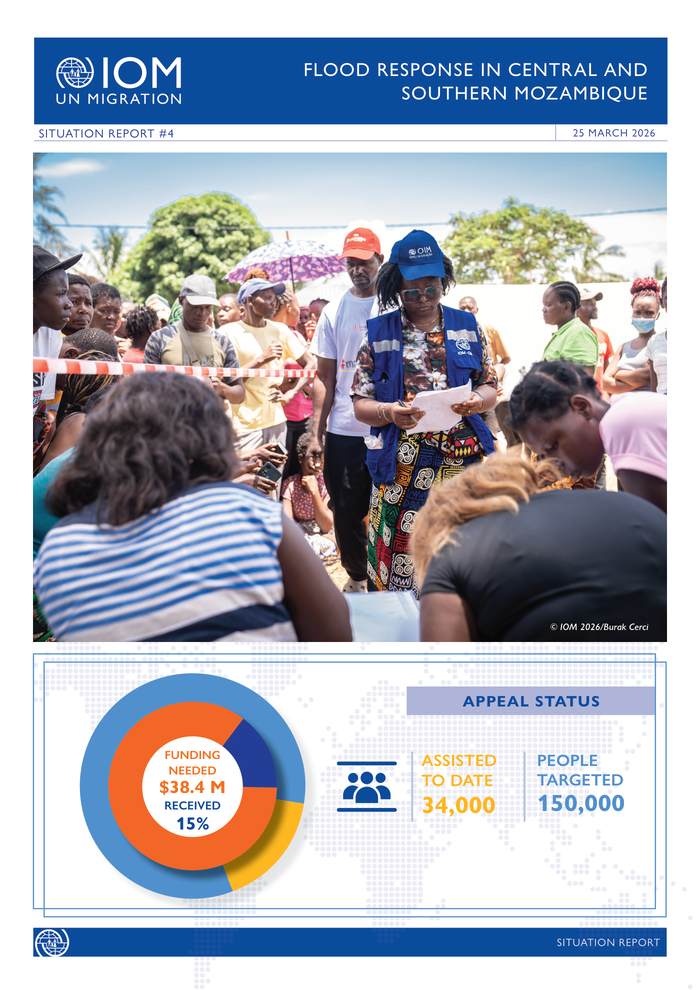
Country: Mozambique Source: International Organization for Migration Please refer to the attached file. SITUATION OVERVIEW Mozambique continues to experience significant humanitarian impacts following extensive flooding, with heavy rainfall continuing to affect much of the country since 1 March 2026, particularly across the southern, central and northern provinces. Continued rainfall since the initial flooding has compounded damage, displacement and humanitarian needs, while river overflow, notably along the Licungo River, has further exacerbated impacts in affected areas. Although water levels have begun to recede in some districts, Gaza Province remains the worst affected, alongside Inhambane, Sofala, Zambézia, Niassa and Tete provinces. The ongoing rains continue to cause widespread damage to homes, public infrastructure and agricultural land, limiting safe returns for many families and prolonging humanitarian needs. Additional rainfall is anticipated across the country in the coming days, with the potential to exacerbate flooding and humanitarian needs. While some affected families have been able to return to their areas of origin, many remain displaced due to ongoing rainfall, damaged or unsafe housing, loss of assets, and limited access to essential services. A significant number of families are residing outside formal accommodation centres, staying with host families or in community facilities and informal sites. Continued monitoring is required to assess conditions in return locations and to ensure that returns are safe, voluntary and sustainable. IOM, in close coordination with the Government of Mozambique, the National Institute for Disaster Management and Risk Reduction (INGD), and humanitarian partners, continues to implement a multisectoral emergency response, including displacement tracking, site management, shelter and non‐food item support, water, sanitation and hygiene assistance, health promotion, protection, and prevention of sexual exploitation and abuse activities. The response prioritizes safe and dignified living conditions, strengthened community engagement mechanisms, and targeted assistance to both displaced and returning populations. As operations adapt to evolving flood‐related impacts and multisectoral support expands across additional districts, IOM interventions have reached an estimated 34, 000 individuals across sectors.
Flood Response in Central and Southern Mozambique – Situation Report #4 – 25 March 2026

RELATED ARTICLES


