

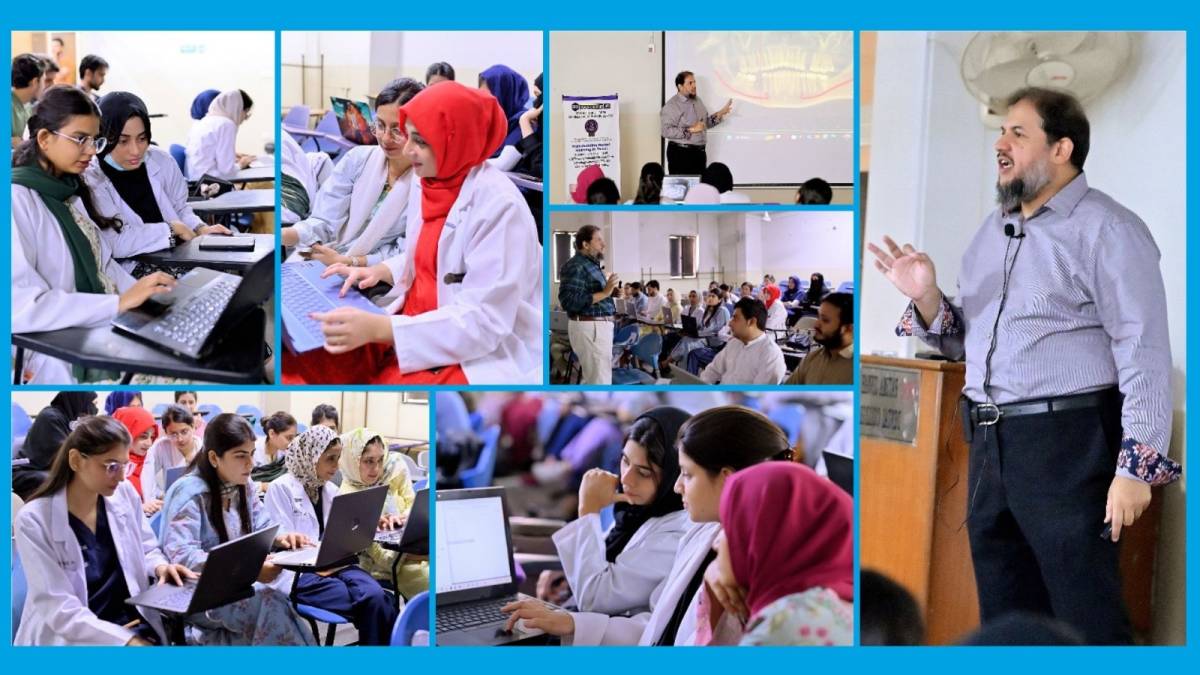
KARACHI: As digital technologies continue transforming healthcare worldwide, Fatima Jinnah Dental College (FJDC), Karachi, has equipped 80 House Officers with advanced Cone Beam Computed Tomography (CBCT) interpretation and virtual implant planning skills, reinforcing Pakistan’s readiness for the next generation of digital dentistry. The two-day hands-on workshop, conducted on July 10 and July 17, 2026, was organized by the Department of Prosthodontics to coincide with World Youth Skills Day, reflecting the global emphasis on equipping young professionals with future-ready competencies. The initiative focused on one of modern dentistry’s fastest-growing technologies—Cone Beam Computed Tomography (CBCT)—a specialized three-dimensional (3D) dental imaging system that provides highly detailed views of the teeth, jaws, facial bones, nerves and surrounding anatomical structures. Unlike conventional two-dimensional dental X-rays, CBCT enables clinicians to assess bone volume, identify critical anatomical landmarks and plan complex procedures such as dental implants with significantly greater precision. Why CBCT skills matter in modern dentistry As digital dentistry becomes increasingly integrated into everyday clinical practice, the ability to interpret CBCT scans has evolved from an advanced skill into an essential professional competency. Traditional panoramic radiographs, commonly known as Orthopantomograms (OPGs), provide only two-dimensional images, which may not adequately reveal the exact location of vital structures such as the inferior alveolar nerve, the width of jawbone available for implants or the spatial relationship between teeth and surrounding anatomy. CBCT overcomes these limitations by generating high-resolution 3D images, allowing dentists to: • Assess bone quality before implant placement. • Identify important nerves and anatomical structures. • Detect hidden pathologies. • Improve treatment planning accuracy. • Enhance patient safety by reducing surgical risks. The technology has become a standard component of implant dentistry, oral and maxillofacial surgery, orthodontics and endodontics across many countries. Eighty House Officers receive practical digital training To maximize practical learning, the 80 House Officers were divided into two groups, allowing instructors to provide closer supervision and individual guidance throughout the workshop. The scientific sessions were led by Dr. Sameer Quraeshi, Prosthodontist and workshop facilitator, who introduced participants to the principles of CBCT imaging, anatomical interpretation, radiographic assessment and digital implant planning. The programme followed a structured learning pathway that combined classroom teaching with software-based practical exercises. Participants installed Planmeca Romexis, an internationally recognized dental imaging software platform, on their personal laptops before navigating real CBCT datasets through multiplanar reconstruction views and simulated implant planning exercises. Rather than limiting training to software navigation, facilitators evaluated each participant individually after completing assigned tasks, providing personalized feedback to reinforce diagnostic accuracy and clinical decision-making. According to the organizers, the objective was to help young dentists develop the ability to think in three dimensions rather than relying solely on conventional two-dimensional radiographs. Industry-academia partnership supports digital education The workshop was conducted in collaboration with Radiodent, which provided technical support for software installation and digital workflow training. Such collaborations are becoming increasingly important as dental schools seek to expose students and young graduates to technologies routinely used in contemporary clinical practice. The organizers said the initiative demonstrates how partnerships between academia and industry can accelerate the adoption of digital healthcare technologies while improving clinical education. As demand grows for safer implant procedures and digitally guided treatments, developing expertise in CBCT interpretation is expected to become increasingly important for dentists entering clinical practice. The workshop concluded with participants returning to their clinical rotations equipped with practical experience in three-dimensional imaging and virtual treatment planning—skills that are rapidly becoming essential across modern dentistry. Stay informed, stay ahead! pk/20-Jul-2026/fjdc-equips-young-dentists-advanced-cbct-skills-strengthening-pakistan-s-digital-dentistry-future” target=”_blank” rel=”nofollow noopener noreferrer”>Read full story on Dental News
FJDC equips young dentists with advanced CBCT skills, strengthening Pakistan’s digital dentistry …

RELATED ARTICLES


