


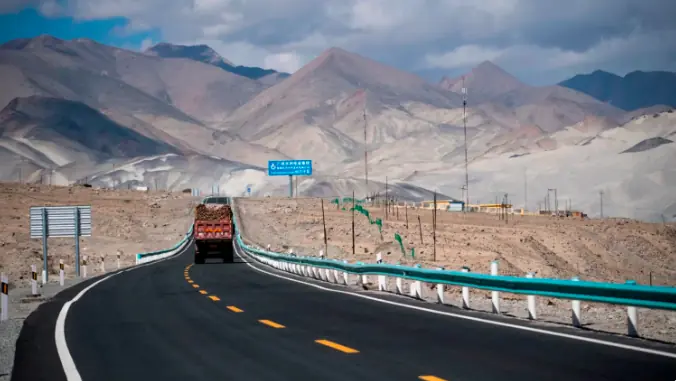
The Central and South Asian countries have a rich and shared history of their mutual trade and the mobilization of human resources from one country to another. The ‘Silk Route’ and the ‘Grand Trunk Road’ (famously known as ‘GT Road’ in Pakistan) have been providing the major source of this connectivity. The Soviet regime diverted the direction of trade and mobility of human resources of the Central Asian Republics from South Asia to Eastern Europe. Now, the visible signs of the revival of historical routes can be observed in this region. The most important institutions that play an important role in boosting the connectivity of Central Asia, the Middle East, and South Asia are the Central Asia Regional Economic Cooperation (CAREC) and the Economic Cooperation Organization (ECO). These two institutions jointly cover 13 countries: Afghanistan, Azerbaijan, China, Georgia, Iran, Kazakhstan, Kyrgyz Republic, Mongolia, Pakistan, Tajikistan, Turkmenistan, Turkiye, and Uzbekistan. These institutions emphasize the construction of economic corridors in these countries. The Central Asia Regional Economic Cooperation (CAREC) introduced the concept of ‘Economic Corridor Development (ECD)’ in 2010. Europe-East Asia Economic Corridor, Europe-Mediterranean-East Asia Economic Corridor, Russian Federation-Middle East and South Asia Economic Corridor, Russian Federation-East Asia Economic Corridor, East Asia-Middle East and South Asia Economic Corridor, and Europe-Middle East and South Asia Economic Corridor are included in the major projects to connect the economic hubs in the landlocked CAREC countries to global markets. The construction of economic corridors and logistic infrastructure in CAREC member countries is largely financed by international development finance institutions, including the World Bank, Asian Development Bank, and Asian Infrastructure Development Bank. The Economic Cooperation Organization (ECO) has also introduced several corridors and trade enhancement projects. Quadrilateral Agreement on Traffic in Transit (QATT), Islamabad-Tehran-Istanbul (ITI) Train Network, Trilateral Transit Trade Agreement (TTTA), Pakistan – Uzbekistan Transit Trade Agreement, Pakistan-Iran- Turkmenistan Commerce Cooperation (PITCC), Central Asia & South Asia (CASA) – 1000 energy corridor, Indus River Trade Corridor, North–South Transnational Corridor (Kazakhstan- Turkmenistan-Iran railway link), Iran-Pakistan Pipeline, Turkmenistan-Afghanistan-Pakistan and India (TAPI) Pipeline, and Trans-Iranian Canal are included in those corridors and projects. Some of those are in active progress, and some have been inactive, amended, or closed because of geopolitical reasons. Several projects to enhance the economic connectivity have been considered by the ECO member countries. The ratification of the Customs Convention on the International Transport of Goods under Cover of TIR Carnets (TIR Convention) by the ECO member countries, the white card scheme to facilitate the drivers to travel across the boarders in ECO member countries, simplification of visa process for travelling ECO member countries, ECO Trade Agreement to enhance the trade among the member countries, Visa sticker scheme for the leading businessmen to allow them visa-free access in the member countries, and the formation of ‘ECO Trade and Development Bank’ and the ‘ECO Insurance Company’ are the steps which have been taken by the organization to revive the historical relations among the member countries. Other than the Central Asia Regional Economic Cooperation (CAREC) and the Economic Cooperation Organization (ECO), there are several other plans to connect the various countries in Asia to Europe that are in progress or under active consideration. One of those big projects is the ‘Trans-Asian Railway (TAR)’ project, which was initiated by the United Nations Economic and Social Commission for Asia and the Pacific (UNESCAP) to create an integrated freight railway network across Europe and Asia. The China-Pakistan Economic Corridor (CPEC), which is an integral part of the ‘Belt and Road Initiative (BRI)’ of China, is an important component of regional integration between South Asia, Central Asia, and the Middle East, though some analysts consider it a political venture rather than an economic project. The basic concept of CPEC is to join Gwadar (Arabian Sea port in Pakistan) with Kashgar (Xinjiang province) in Western China. A comparison of the China-Pakistan Economic Corridor (CPEC) with the Suez and Panama Canals suggests that Pakistan can get maximum benefits if it operates this mega venture purely on economic considerations. Based on the specific economic conditions of Pakistan, it was recommended by various reports that this corridor (CPEC) is beneficial only if it succeeds in attracting domestic and foreign direct investment (FDI). Though the rapid growth in the construction of economic corridors is a worldwide phenomenon, the incredible progress in Central Asian countries seems to be a revival of historical trade routes aimed at providing connectivity to several landlocked countries. The economic corridors can bring the landlocked countries into the mainstream of globalization and economic development. Landlocked countries of Central Asia can depend on Pakistan for goods shipments, which is another important aspect of this connectivity. In comparison with European integration, it can be observed that developing the transit infrastructure among neighbouring countries is essential to raising intraregional trade in the region. The transit trade facilitates the landlocked countries to develop their trade relations worldwide. The transit trade can be helpful during the problematic times and barriers due to wars and destructive conditions. The present Israel/USA-Iran war has exposed the importance of diversity in economic corridors. The role of economic corridors to provide a substitute in case of an unexpected interruption in the global supply chain is another dimension in the geopolitical economy. The impacts of unpredictable interruptions in supply chain activities and the importance of economic corridors have become more important areas after the COVID-19 pandemic, the Russia-Ukraine War, and the blockage of the Hormuz Strait by Iran during the US-Israel and Iran War. However, Pakistan is a big country, and providing a transit facility to Central Asia, the Middle East, and South Asia is not sufficient. The industrialization through domestic and foreign direct investment in the industrial zones adjacent to the economic corridors should be the main purpose. This is the way to get a greater share of the pie. The construction of economic corridors is also a way to develop a compatible infrastructure for connectivity and economic integration. Economic corridors not only connect countries and regions but also strengthen infrastructure, and are attached with different measures to boost economic relations between the participating countries, including telecommunication infrastructure, visa facilitation, customs arrangements, transport agreements, and standardization of products. The arguments in favour and against the construction of economic corridors in economic literature are based on their impacts on the indigenous population, economic prosperity, and the creation of a fiscal burden on the participating economies. Several reports have mentioned the significant improvement in economic growth, employment opportunities, households’ income, living standards, quality of life, growth in the monthly rent on properties, and self-assessed wealth because of the quality of road infrastructure and connectivity. The improvement in connectivity and quality of road infrastructure is much more powerful than subsidies and transfer payments for the alleviation of poverty. The enhancement in merchandising trade, growth in tax revenues, and improvement in labour participation rate are the direct outcomes of economic corridors, and induce many economic activities, including tourism, traveling, catering, and the hotel industry. This is the reason that the development of logistic infrastructure and the construction of economic corridors have become a major part of the developmental strategies in the contemporary world. This is a quickly emerging policy area, next to international trade and foreign direct investment; it encompasses around 14 percent of the global gross domestic product (GDP). Certainly, the financing for economic corridors is a fundamental and critical issue. The development of physical infrastructure in developing countries during the bipolar regime largely depended on subsidized external debts and grants from rich industrialized countries. The majority of the Central Asia Regional Economic Cooperation (CAREC) member countries were part of the Soviet Union, and the infrastructure development in these countries has been entirely based on public sector funding. Now, the funding for investment in economic corridors and trade-related infrastructure is one of the most problematic and complicated areas in macro financing. The huge investment in infrastructure is more critical in low- and middle-income developing countries, because the spending of huge public revenue on infrastructure and economic corridors may affect the required spending on poverty alleviation, subsidies, health, education, and security. Furthermore, the repayment of debt and interest costs can lead to the devaluation of domestic currency and an increase in taxes to generate the funds for repayments. In the contemporary world, the sovereign debt to finance the logistic infrastructure and economic corridors is a common strategy in developing countries. A worldwide comparison of infrastructure financing shows the higher dependency on long-term debt from international financial institutions, bond markets, and borrowing at competitive commercial rates for infrastructure development. The external long-term public sector debt is an indicator of the government’s participation in infrastructure projects, and the lending agencies monitor such developmental works. It is generally considered that external debts are utilized for infrastructure development, reconstruction, and building the institutional foundations, and improvement in business competitiveness, but their use to finance fiscal deficits, manage liquidity, and repayment of previous debts is also questionable. This kind of debt may be used for politically motivated popular projects that are not feasible for sustainable economic growth. The money raised through external debts is used to gain popularity and political benefits, and to enhance the vote bank of the ruling party by paying subsidies and reducing tax collection. It is also a global phenomenon that the governments, in the presence of external borrowing, avoid higher tax collection. One of the feasible ways to finance the infrastructure and economic corridors is to involve the multilateral ‘Infrastructure Development Finance Companies (IDFC)’. The main activity of such companies is to provide financing for economic corridors after the assessment of their feasibility and risk factors. These companies provide bridge financing for investment in economic corridors and ensure the recovery of their principal amount and interest in the future. The governments of the participating countries can repay the financing by utilizing their incremental tax revenues. The ‘public-private partnership’ is another way and a growing trend for investment in economic corridors and infrastructure development, which is a different concept from ‘public-private participation’. The public-private participation includes the participation of the public sector in financing, operation, equity, return, and risk, while in the public-private partnership, the government provides legal and administrative support to the private partner, but usually does not participate in profit. The objective of this partnership is to protect and safeguard the interests of private investors, who have invested their funds in those big, risky, and long-term projects where recovery from the clients or customers is not certain without government support. The private sector financing in such projects requires more prudence in decision-making because of the high political risk, longer duration of projects, higher cash outflow at an earlier stage, and barriers to exit. Because of the ineffectiveness of the market mechanism to determine the user charges in such projects, the regulatory institutions of the participating countries determine the user charges, keeping in view the indirect benefits of the corridors, competitiveness, and affordability of the users. In the construction of the economic corridors, the share in financing the cost of the project is determined by the incremental benefits to the participating countries. The assessment of those benefits can provide a mechanism to estimate the contribution of a country to the cost of economic corridors. It has been noted that growth in tax revenues, enhancement in merchandising trade, and improvement in labour participation rate are the direct effects of improvement in logistic infrastructure. So, the ultimate beneficiaries of economic corridors and logistic infrastructure should be liable to repay the cost of these projects based on their share in these benefits. The incremental tax revenue can be utilized for the redemption of capital invested in economic corridors. Copyright Business Recorder, 2026



GrowthPakistan brings you the latest news to keep an eye on Pakistan’s startup ecosystem. Business keeps you growing when you stay aware of your competitors' moves. GrowthPakistan offers Business, Tech, Global Tech, Global, Auto, and Startup News straight from industries all around the globe. This platform will help you identify upcoming opportunities not only in Pakistan but worldwide.
Email : growthpakistan@gmail.com
Whatsapp : +92320-9497079
© growthpakistan