

Countries: Kyrgyzstan, Tajikistan, Uzbekistan Sources: Agency for Technical Cooperation and Development, IMPACT Initiatives Please refer to the attached file. SUMMARY The Syr Darya River Basin, spanning Kyrgyzstan, Tajikistan, and Uzbekistan, is a crucial water source for many communities in the Fergana Valley. Despite its importance, the basin lacks centralised management, leading to frequent water distribution issues, particularly for downstream countries. 1 Water originating in upstream countries often fails to reach downstream areas in sufficient quantities, exacerbating tension among communities along the border. The river is vital for agriculture, providing irrigation for crops, water for livestock, and supporting hydropower generation. Consequently, effective management and equitable distribution of the Syr Darya’s resources are essential for the region’s stability and prosperity. To address climate change challenges affecting natural resource management in the watersheds of the Fergana Valley, Acted, IMPACT, and International Alert, with support from European Commission and the PATRIP Foundation, launched the STREAM programme in 2022. 3 The findings from the STREAM programme’s inception phase highlighted the interconnectedness of climate change, industrial activities, and natural resource management. 4 A recent comprehensive assessment of the Isfana Watershed, funded by EuropeAid and implemented with partner Central Asian Alliance for Water (CAAWE), revealed systemic water loss in the irrigation network due to outdated and deteriorating infrastructure and lack of data on waterflow. To tackle these challenges with systemic water loss, Acted plans to utilise PATRIP funds for the “hard component” of the programme, focusing on infrastructure rehabilitation and the installation of water measuring devices to improve water monitoring and reduce water loss. A technical feasibility study, conducted by the organisations WAPCOS and KIBERA, was further commissioned by Acted to identify the most suitable locations for water meters and canal rehabilitation, aiming to enhance water efficiency, and was completed in March 2025. In order to ensure that the selected interventions meet the, “do no harm” requirements of both PATRIP’s Environmental and Social Policy requirements, and conform to Acted’s own intervention requirements, the following Environmental and Social Impact Assessment (ESIA) was conducted in order to minimise or prevent negative environmental and social risks and impacts of the programme activities, including irrigation infrastructure rehabilitation and water meter installation, that may occur in the communities of intervention. By enhancing environmental and social benefits at the operational level, this assessment facilitates the identification and mitigation of risks and negative impacts, enabling continuous monitoring and improvement of the programme’s environmental and social performance. To do this, IMPACT adopted a workshop-based approach outlined in the Swiss Agency for Development and Cooperation’s (SDC) Climate, Environment and Disaster Risk Reduction Integration Guidance (CEDRIG) toolkit. 7 This is a participatory methodology that aims to mainstream climate change, environmental sustainability, and disaster risk reduction considerations into development interventions, while also taking an inclusive approach that considers feedback from the community and ensuring Accountability to Affected Populations (AAP). In each location, approximately 18-22 local stakeholders from local government, community leadership, and civil society, were invited for a 1-day workshop. This workshop utilised a series of guided modules, in which participants were asked to provide information in a structured format that could then be systematically analysed by the IMPACT team afterwards. The workshop was divided into 3 parts; 1) the participants were first introduced to the planned infrastructure, its locations, timeframes and outputs; 2) participants then assessed the likely hazards that may affect the successful implementation of the infrastructure, and 3) participants assesses the potential negative impacts that the infrastructure may have on the community. For both the hazards and negative impacts, participants then ranked both their likelihood and severity to determine their overall risk. Of the top selected risks, participants then provided potential locally-based mitigation measures that could be included in the planned construction which could reduce the likelihood or impact of these hazards and negative impacts, thereby ensuring more sustainable and community-lead project outcomes.
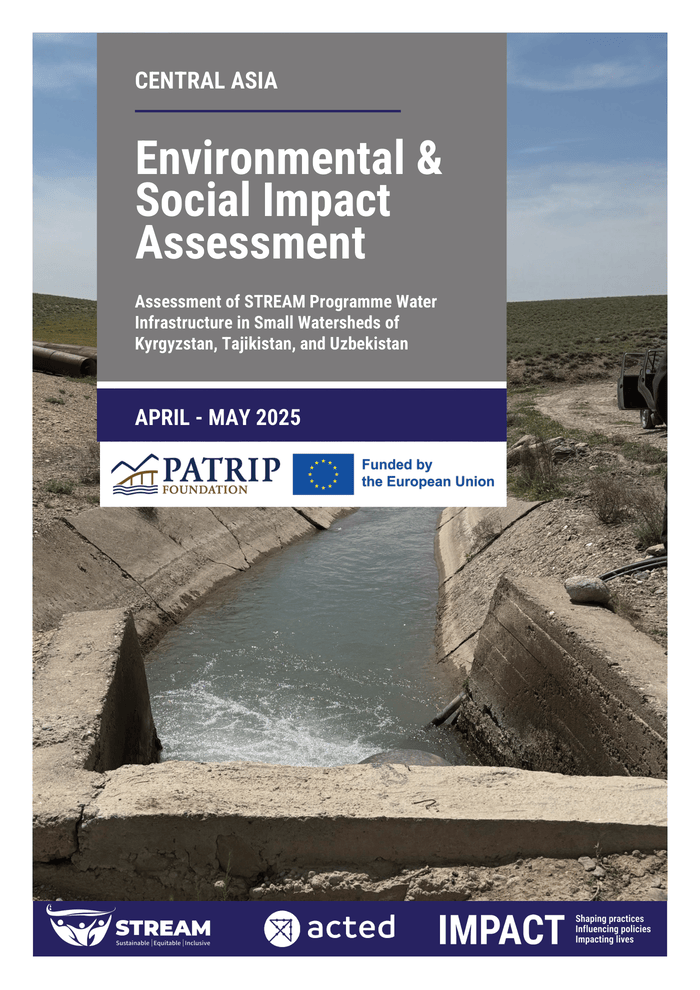
Environmental & Social Impact Assessment: Assessment of STREAM Programme Water Infrastructure in Small Watersheds of Kyrgyzstan, Tajikistan, and Uzbekistan (April – May 2025)

RELATED ARTICLES


