


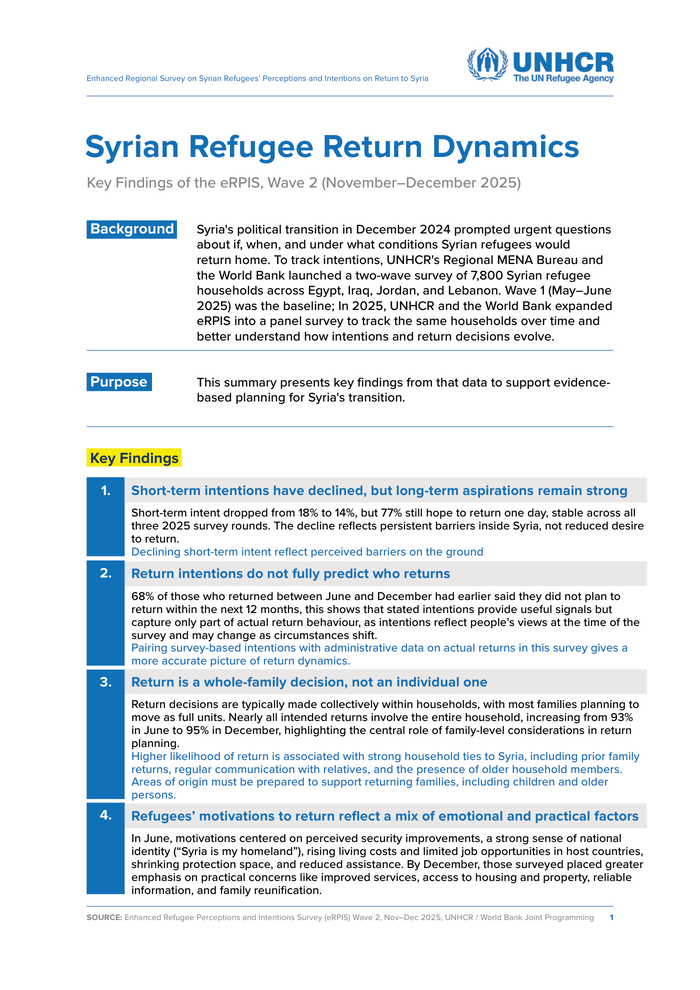
Countries: Syrian Arab Republic, Egypt, Iraq, Jordan, Lebanon Source: UN High Commissioner for Refugees Please refer to the attached files. Executive Summary As of 31 December, over 1. 3 million Syrians have returned back home since December 2024, with more than 3. 7 million registered Syrian refugees continuing to reside in host countries in the region (UNHCR, 2026). Amid a rapidly shifting context, UNHCR and the World Bank have launched a joint initiative to capture refugees’ perspectives on return to Syria and generate evidence that can directly feed into policy, programming, and investment decisions. By recognizing the diversity of refugee experiences, shaped by history, gender, and conditions in displacement, the data will equip governments, donors, UNHCR, the private sector, and partners to design responses that meet refugees’ needs, whether they hope to return or have yet to decide. The November–December 2025 Enhanced Refugee Perceptions and Intentions to Return to Syria Survey (eRPIS) builds on UNHCR’s earlier annual surveys, including Survey Round 1 from May–June 2025. Survey Round 2, from November–December 2025, updates these findings with more detailed insights into Syrian refugees’ return intentions, motivations, and barriers one year after the fall of the Assad government. Its longitudinal panel design, which re‐interviews the same households across successive rounds, enables direct comparison over time, illuminates how intentions evolve, sheds light on the experiences of those who have returned to Syria between survey waves, and supports more targeted policy responses. In December 2025, the eRPIS regional intention survey interviewed 5, 674 refugees in Lebanon, Jordan, Iraq, and Egypt. By comparing survey responses with UNHCR records, 1, 725 households (27%) were identified as having returned to Syria since the previous survey in June 2025. Although some participants did not take part in both survey rounds, the survey design ensures that the results remain reliable and representative at both country and regional levels. Full methodological details, including sampling and weighting, are available in an online appendix here. The December 2025 eRPIS presents detailed findings that capture the complexity of Syrian refugees’ return intentions, the factors motivating their decisions, and the obstacles hindering their return. It examines motivations, structural barriers, household decisionmaking dynamics, economic conditions in host countries, safety and security, and housing, land, and property inside Syria, while highlighting important geographic patterns of return in areas of origin. The findings provide evidence-based insights into priority investment areas inside Syria, particularly improving security, housing reconstruction, basic services, livelihoods, and housing land and property (HLP) documentation- as essential preconditions for voluntary, safe, and sustainable return. At the same time, the survey underscores the continued need for support to host countries, as a large share of refugees continue to reside in neighboring countries. In Lebanon, the context has shifted markedly since data collection, with force majeure driven returns exceeding stated intentions, requiring careful interpretation of the findings and further examination in the next survey wave.



GrowthPakistan brings you the latest news to keep an eye on Pakistan’s startup ecosystem. Business keeps you growing when you stay aware of your competitors' moves. GrowthPakistan offers Business, Tech, Global Tech, Global, Auto, and Startup News straight from industries all around the globe. This platform will help you identify upcoming opportunities not only in Pakistan but worldwide.
Email : growthpakistan@gmail.com
Whatsapp : +92320-9497079
© growthpakistan