

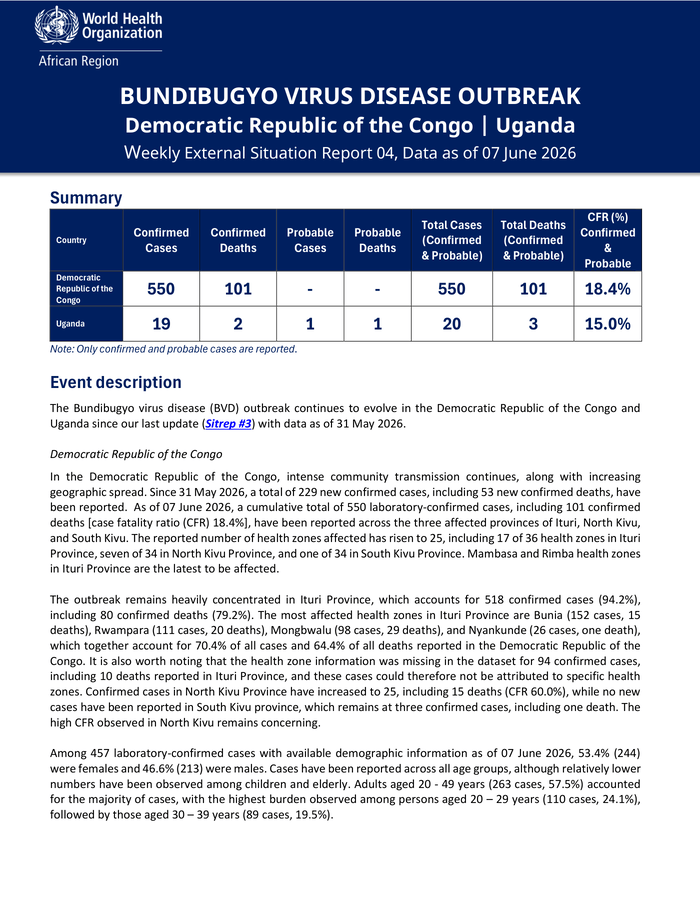
Countries: Democratic Republic of the Congo, Uganda Source: World Health Organization Please refer to the attached file. Event description The Bundibugyo virus disease (BVD) outbreak continues to evolve in the Democratic Republic of the Congo and Uganda since our last update (Sitrep #3) with data as of 31 May 2026. Democratic Republic of the Congo In the Democratic Republic of the Congo, intense community transmission continues, along with increasing geographic spread. Since 31 May 2026, a total of 229 new confirmed cases, including 53 new confirmed deaths, have been reported. As of 07 June 2026, a cumulative total of 550 laboratory-confirmed cases, including 101 confirmed deaths [case fatality ratio (CFR) 18. 4%], have been reported across the three affected provinces of Ituri, North Kivu, and South Kivu. The reported number of health zones affected has risen to 25, including 17 of 36 health zones in Ituri Province, seven of 34 in North Kivu Province, and one of 34 in South Kivu Province. Mambasa and Rimba health zones in Ituri Province are the latest to be affected. The outbreak remains heavily concentrated in Ituri Province, which accounts for 518 confirmed cases (94. 2%), including 80 confirmed deaths (79. 2%). The most affected health zones in Ituri Province are Bunia (152 cases, 15 deaths), Rwampara (111 cases, 20 deaths), Mongbwalu (98 cases, 29 deaths), and Nyankunde (26 cases, one death), which together account for 70. 4% of all cases and 64. 4% of all deaths reported in the Democratic Republic of the Congo. It is also worth noting that the health zone information was missing in the dataset for 94 confirmed cases, including 10 deaths reported in Ituri Province, and these cases could therefore not be attributed to specific health zones. Confirmed cases in North Kivu Province have increased to 25, including 15 deaths (CFR 60. 0%), while no new cases have been reported in South Kivu province, which remains at three confirmed cases, including one death. The high CFR observed in North Kivu remains concerning. Among 457 laboratory-confirmed cases with available demographic information as of 07 June 2026, 53. 4% (244) were females and 46. 6% (213) were males. Cases have been reported across all age groups, although relatively lower numbers have been observed among children and elderly. Adults aged 20 – 49 years (263 cases, 57. 5%) accounted for the majority of cases, with the highest burden observed among persons aged 20 – 29 years (110 cases, 24. 1%), followed by those aged 30 – 39 years (89 cases, 19. 5%). As of 07 June 2026, a total of 5418 contacts were under follow-up across the three affected provinces, of whom 3489 (64. 4%) have reportedly been seen within the previous 24 hours. Follow-up coverage remains suboptimal acrossIturi (60. 1%) and North Kivu (79. 5%) provinces, despite some improvement compared with South Kivu (99. 1%) province. Repeated security incidents continued to challenge response operations in affected areas. On 4 June 2026, a safe and dignified burial team was attacked in Katana, South Kivu Province, forcing responders to abandon a body before safe burial procedures could be completed. In Bunia, Ituri Province, four response personnel were reportedly injured during an attack linked to tensions surrounding outbreak control measures. Recurrent insecurity and armed group activity in and around Mongbwalu and newly affected areas such as Mambasa have also disrupted surveillance, patient referral, and safe burial activities, while earlier incidents resulted in confirmed cases fleeing from treatment facilities. Uganda In Uganda, the outbreak remains epidemiologically linked to transmission originating from the Democratic Republic of the Congo, with evidence of both imported infections and secondary transmission among contacts and healthcare workers. Since our last update, Uganda has reported an additional eight confirmed cases, including one confirmed death. As of 7 June 2026, Uganda has reported 20 cases (19 confirmed and one probable), including three deaths (two confirmed and one probable), spanning two districts (Kampala and Wakiso) within the Kampala Metropolitan Area. Of these, five are healthcare workers. A cumulative total of 783 contacts have been identified as of 7 June. Of these, 368 have completed 21 days of monitoring, while the remaining 415 are under follow-up, with a 91% follow-up rate in the previous 24 hours as of 7 June.
Ebola Bundibugyo Virus Disease Outbreak: Democratic Republic of the Congo | Uganda, Weekly External Situation Report 04 (Data as of 07 June 2026)

RELATED ARTICLES


