


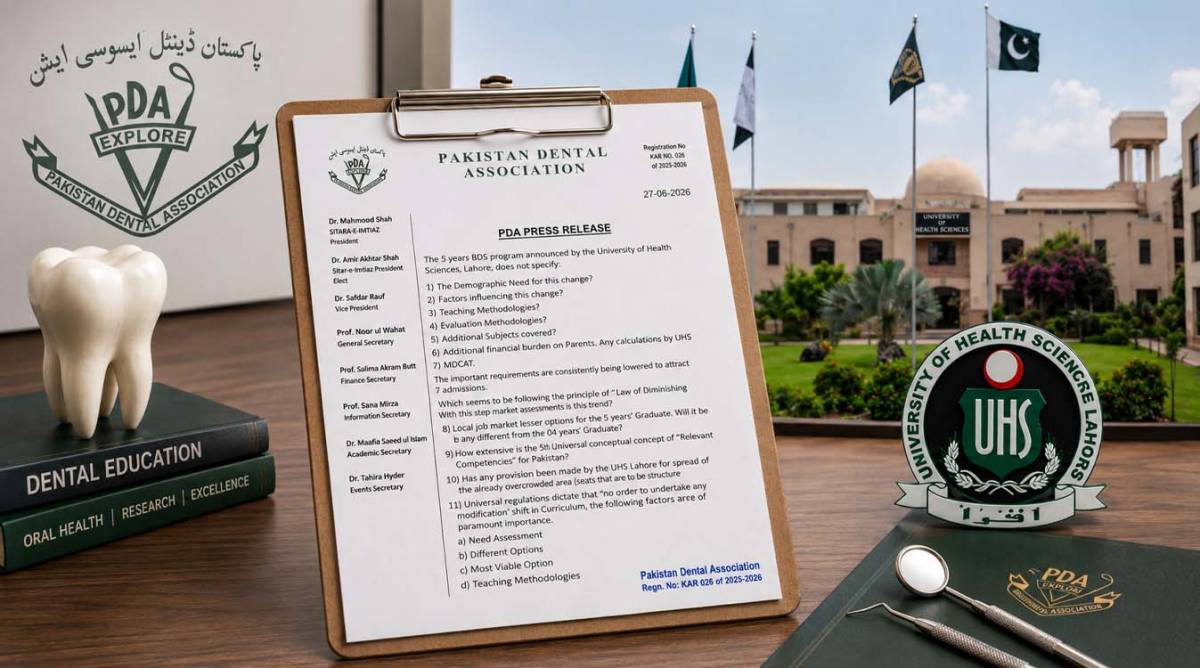
KARACHI: After Pakistan Dental Association response on the University of Health Sciences Lahore’s five-year BDS rollout, the Dr Mahmood Shah-led Pakistan Dental Association, registered in Sindh, has raised fresh questions over the academic, financial, regulatory and workforce rationale behind the major curriculum shift. The concerns have been issued by its President, Dr Mahmood Shah (S. I.), following the UHS notification implementing the Five-Year Modular Integrated Bachelor of Dental Surgery curriculum across its constituent and affiliated dental colleges. The UHS notification formally adopts the BDS Integrated Curriculum 2K25 Version 2. 0 and states that the new curriculum will apply from Academic Session 2025–2026 onward. According to UHS, the curriculum aims to move dental education towards integrated modular teaching, competency-based training, early clinical exposure, evidence-based dentistry, professionalism, ethics, research, patient safety and quality assurance. However, PDA has questioned whether a curriculum change of this scale has been supported by sufficient explanation on why the change is needed, what evidence supports it, how it will be implemented, how students will be assessed, what additional cost it will create, and whether the local job market has been assessed for five-year BDS graduates. PDA asks what need the five-year BDS shift is addressing A central question raised by PDA is whether UHS has clearly identified the demographic need for converting the BDS programme into a five-year structure. According to PDA, any major change in dental curriculum should be based on a clear understanding of population oral health needs, disease burden, dental workforce requirements, access to care, regional gaps and the type of general dental practitioner Pakistan needs. PDA has also asked what specific factors influenced the change. These may include PMDC requirements, international equivalence, competency gaps, clinical training weaknesses, accreditation needs or public health priorities. If the five-year framework is being introduced to improve graduate competence, patient safety, clinical readiness or international recognition, PDA says the basis for this change should be clearly explained and documented. Teaching and evaluation methods need clarity PDA has questioned whether the new five-year programme sufficiently specifies its teaching and evaluation methodologies. UHS has stated that the new BDS curriculum will include modular teaching, clinical training, skills laboratory training, simulation-based learning, workplace-based learning, student portfolios, logbooks, OSPE/OSCE, clinical assessments and continuous internal assessment. However, PDA has raised concerns over operational clarity. For dental colleges, the shift to an integrated five-year curriculum would require trained faculty, module planning, clinical rotation schedules, skills laboratories, simulation capacity, assessment blueprints, student feedback systems and academic monitoring mechanisms. Evaluation methodology would also need to clarify how clinical competence will be measured, how portfolios and logbooks will be validated, how workplace-based assessments will be conducted, and how university examinations will align with the intended competencies. What additional content will justify the fifth year? Another key question raised by PDA is whether the five-year framework clearly identifies the additional subjects, training areas or competencies to be covered. If BDS is extended from four academic years to five, students, parents and dental colleges may reasonably ask what new academic, clinical or professional content justifies the additional year. The UHS curriculum places stronger emphasis on research methodology, ethics, professionalism, communication skills, clinical clerkships, community dentistry, oral health promotion, simulation-based training and workplace-based learning. PDA’s concern is that the additional year should be clearly structured, academically justified and linked to relevant competencies for Pakistan’s oral healthcare needs, rather than being seen as a broad extension of the existing programme. Financial burden on parents remains a major concern PDA has also raised the issue of additional financial burden on parents. It has questioned whether UHS has carried out any calculation of the financial impact of adding another year to BDS education. This concern is particularly significant for students in private dental colleges, where annual tuition, examination charges, instruments, transport, hostel expenses and living costs already place substantial pressure on families. PDA has further asked whether any provision has been made to spread the already high four-year fee structure over five years, instead of adding a full additional year of cost. For parents and students, the question is not only whether dental education should improve, but whether the reform will increase the total cost of becoming a dentist and whether that cost has been transparently discussed before implementation. Admissions trend and job-market relevance questioned PDA has also linked the five-year BDS rollout with broader concerns over dental admissions and the attractiveness of the programme. It questioned whether adding another year to BDS could affect admissions trends, especially in a context where, according to PDA, MDCAT requirements have been lowered to attract admissions. PDA has also asked whether any local job-market assessment has been carried out for five-year BDS graduates and whether their career opportunities will be different from those of four-year BDS graduates. This is a significant policy question. If students spend an additional year in training, stakeholders may expect clarity on whether the change will improve employment prospects, licensing outcomes, professional status, postgraduate access, clinical competence or international mobility. Without such clarity, the additional year may be viewed by students and parents as a cost and delay rather than a clearly defined professional advantage. Relevant competencies for Pakistan must be defined PDA has also asked how the five-year BDS programme relates to the concept of relevant competencies for Pakistan. Competency-based dental education is meaningful only when competencies are linked to the needs of the population, the disease burden, the healthcare system, clinical practice realities and the expected role of a general dental practitioner. For Pakistan, this may include competencies in caries prevention, periodontal care, oral cancer screening, infection prevention, pain and emergency management, community oral health, ethical practice, safe prescribing, referral judgment, communication skills and practice management. PDA has argued that the curriculum must not only use modern terminology, but must also be relevant to the Pakistani oral healthcare context. PDA calls for stakeholder consultation In its broader policy argument, PDA says major curriculum reform requires several steps before implementation. These include need assessment, review of different options, selection of the most viable option, teaching methodologies, assessment methodologies, programme evaluation and interaction with stakeholders. PDA identified key stakeholders as parents, students, Pakistan Dental Association, Higher Education Commission, oral health planners and dental academicians. According to PDA, without these steps, curriculum planning risks becoming only syllabus planning by a limited group, rather than a comprehensive reform exercise shaped by evidence, consultation and implementation readiness. Why this matters for BDS students and dental colleges The UHS five-year BDS rollout has become one of the most closely watched dental education policy issues in Pakistan. For BDS students, the issue affects graduation timelines, fee planning, house job expectations, professional licensure, employment entry, postgraduate planning and international equivalence. For parents, the concern is financial: whether the fifth year will increase the total cost of dental education and whether any fee relief, spreading mechanism or transition arrangement will be introduced. For dental colleges, the issue affects faculty planning, infrastructure, clinical training capacity, curriculum committees, assessment systems, simulation facilities and quality assurance readiness. For regulators and policymakers, the debate raises a broader question: how should Pakistan modernise dental education while ensuring transparency, affordability, stakeholder confidence and relevance to national oral health needs? As the debate continues, the immediate need is for UHS, PMDC, dental colleges and professional stakeholders to provide clear answers on the academic structure, fee implications, house job status, transition policy and job-market relevance of the new BDS framework. Until such clarity is provided, the five-year BDS rollout is likely to remain a major point of concern for dental students, parents, dental colleges and the wider dental community in Pakistan. Stay informed, stay alert! pk/28-Jun-2026/dr-mahmood-shah-led-pda-questions-uhs-five-year-bds-rollout” target=”_blank” rel=”nofollow noopener noreferrer”>Read full story on Dental News



GrowthPakistan brings you the latest news to keep an eye on Pakistan’s startup ecosystem. Business keeps you growing when you stay aware of your competitors' moves. GrowthPakistan offers Business, Tech, Global Tech, Global, Auto, and Startup News straight from industries all around the globe. This platform will help you identify upcoming opportunities not only in Pakistan but worldwide.
Email : growthpakistan@gmail.com
Whatsapp : +92320-9497079
© growthpakistan