

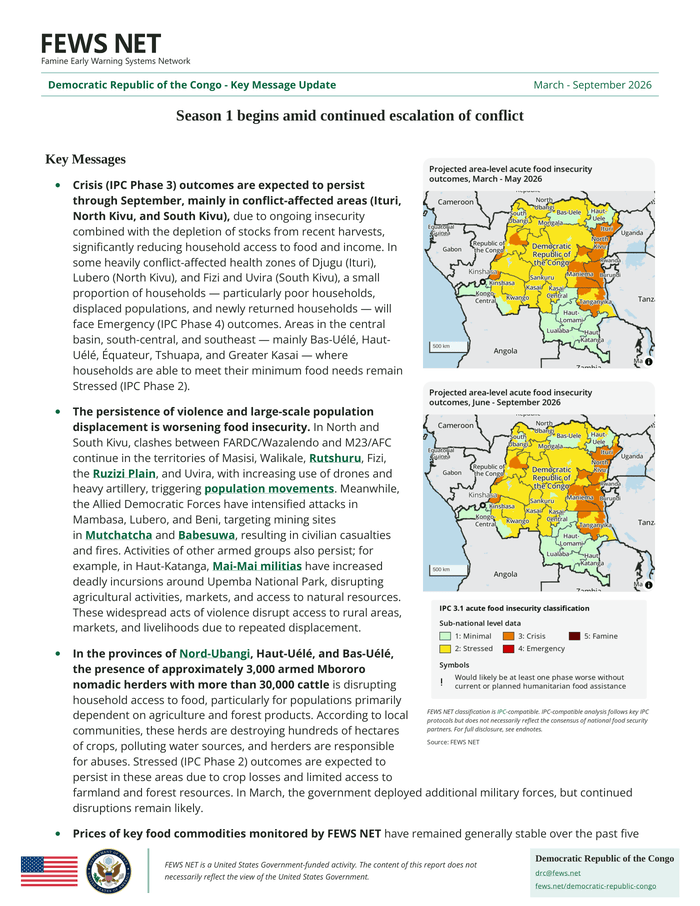
Country: Democratic Republic of the Congo Source: Famine Early Warning System Network Please refer to the attached file. Key Messages Crisis (IPC Phase 3) outcomes are expected to persist through September, mainly in conflict-affected areas (Ituri, North Kivu, and South Kivu), due to ongoing insecurity combined with the depletion of stocks from recent harvests, significantly reducing household access to food and income. In some heavily conflict-affected health zones of Djugu (Ituri), Lubero (North Kivu), and Fizi and Uvira (South Kivu), a small proportion of households — particularly poor households, displaced populations, and newly returned households — will face Emergency (IPC Phase 4) outcomes. Areas in the central basin, south-central, and southeast — mainly Bas-Uélé, Haut-Uélé, Équateur, Tshuapa, and Greater Kasai — where households are able to meet their minimum food needs remain Stressed (IPC Phase 2). The persistence of violence and large-scale population displacement is worsening food insecurity. In North and South Kivu, clashes between FARDC/Wazalendo and M23/AFC continue in the territories of Masisi, Walikale, Rutshuru, Fizi, the Ruzizi Plain, and Uvira, with increasing use of drones and heavy artillery, triggering population movements. Meanwhile, the Allied Democratic Forces have intensified attacks in Mambasa, Lubero, and Beni, targeting mining sites in Mutchatcha and Babesuwa, resulting in civilian casualties and fires. Activities of other armed groups also persist; for example, in Haut-Katanga, Mai-Mai militias have increased deadly incursions around Upemba National Park, disrupting agricultural activities, markets, and access to natural resources. These widespread acts of violence disrupt access to rural areas, markets, and livelihoods due to repeated displacement. In the provinces of Nord-Ubangi, Haut-Uélé, and Bas-Uélé, the presence of approximately 3, 000 armed Mbororo nomadic herders with more than 30, 000 cattle is disrupting household access to food, particularly for populations primarily dependent on agriculture and forest products. According to local communities, these herds are destroying hundreds of hectares of crops, polluting water sources, and herders are responsible for abuses. Stressed (IPC Phase 2) outcomes are expected to persist in these areas due to crop losses and limited access to farmland and forest resources. In March, the government deployed additional military forces, but continued disruptions remain likely. Prices of key food commodities monitored by FEWS NET have remained generally stable over the past five months but often exceed the five-year average. Nationally, maize flour prices remained stable compared to February and the annual average, but were 12. 2 percent above the five-year average. Household incomes and purchasing power have deteriorated following years of local currency instability. Conflict-affected areas, particularly in the east, are experiencing further erosion of already limited purchasing power due to gradual price increases driven by declining local production and market disruptions. In Uvira, maize flour prices increased by 6. 2 percent month-on-month, 22 percent year-on-year, and 26. 9 percent above the five-year average. Average rainfall countrywide from March to June is expected to support a typical progression of the Season 1 (S1) cropping cycle; however, below-typical harvest levels are expected in June in eastern provinces due to conflict escalation. Reduced household participation in S1 agricultural activities will limit access to food from own production. Less conflict-affected regions in the central and northeastern bimodal zones are expected to benefit from a timely onset of the S1 rainy season, though some areas may experience a delayed start following below-average rainfall in March. In the unimodal south, agricultural households are beginning green harvests, improving food access through own production. Global oil prices and freight costs for imports have increased due to maritime disruptions linked to the conflict in the Middle East, disrupting fuel flows and increasing inflation risks. Fuel price increases were already observed in March, driven by speculation over petroleum supply, with increases of 10. 1 percent (gasoline), 7. 9 percent (diesel), and 11. 4 percent (refined oil) compared to February. In the medium term, poor households in insecure areas will be the most affected by rising fuel and transport costs, as well as higher prices for goods and services. This will reduce household purchasing power and worsen food access constraints. Limited use of fertilizers (which are imported) is not expected to significantly affect national agricultural production; however, the DRC depends on imports of sulfur, a key input for mining activities. Disruptions in sulfur supply could slow mining production, reduce employment opportunities, and negatively affect the incomes of households dependent on this sector.
DR Congo: Democratic Republic of Congo Key Message Update – Season 1 begins amid continued escalation of conflict, March – September 2026

RELATED ARTICLES


