


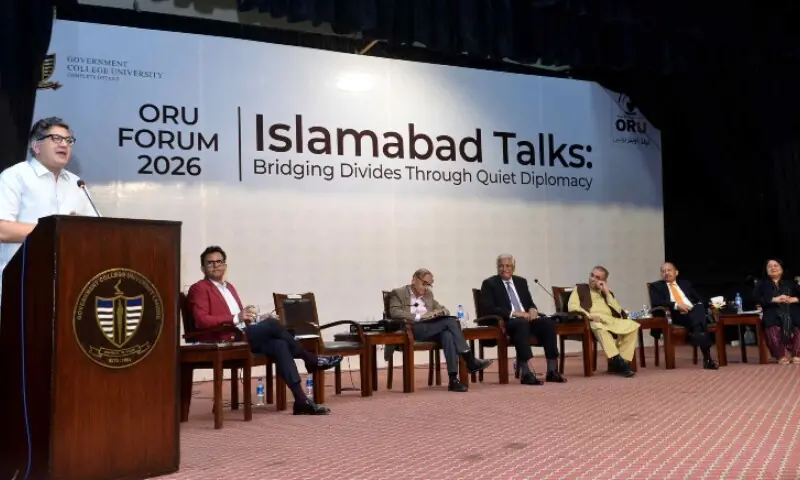
• Speakers at discussion on Islamabad talks warn oil prices may go beyond $120 per barrel if war resumes • Tehran proposal on Hormuz reopening gains traction, ex-envoy claims • Conflict described as ‘non-contact war’ with global economic impact • Pakistan’s role for world peace praised at UK-based forum LAHORE: Intense domestic political pressures in Washington and Tehran could stall a final peace deal, speakers at a panel discussion warned on Wednesday, stressing that failure to reach an agreement might trigger a regional conflict and push global crude oil prices beyond $120 per barrel. The discussion, titled ‘Islamabad Talks: Bridging Divides Through Quiet Diplomacy’, was hosted by the Old Ravians Union (ORU) at Government College University (GCU). Speaking on the occasion, former ambassador Mansoor Ahmed Khan said growing global polarisation had weakened the credibility of traditional mediators such as the European Union and Nato. In this context, he noted, Pakistan’s civil and military leadership had stepped in to facilitate engagement among key international stakeholders. He revealed that a proposal by Tehran to separate the reopening of the Strait of Hormuz from long-term nuclear negotiations was gaining traction and was being actively debated by the US National Security Council. Khan said the conflict had reshaped regional dynamics, leaving Israel politically isolated while positioning Iran as a resilient actor. He added that a new regional security framework involving Pakistan, Saudi Arabia, Turkiye, Egypt, Indonesia and China could emerge, though he cautioned that Pakistan’s peace efforts faced opposition and disinformation campaigns from India. Senior journalist Mujeebur Rehman Shami said Pakistan had acted proactively rather than waiting for external engagement. He warned that a US-led blockade had pushed Iran’s oil storage capacity to its limits, and any forced closure of oil wells could have long-term consequences, creating a strategic deadlock between Tehran’s leverage over the Strait of Hormuz and Washington’s economic pressure. Retired Gen Muhammad Saeed pointed out that while talks in Vietnam and Afghanistan took years to initiate, Pakistan facilitated direct US-Iran engagement shortly after the April 8 proposal. He noted that the US administration faced domestic political constraints in escalating military action, while Iran could not sustain the economic burden of a prolonged conflict. With both sides stepping back from aggressive media rhetoric, he predicted a high probability of secondary, fast-tracked talks returning to Islamabad. He also observed that neither the IAEA nor US intelligence had officially confirmed that Iran was pursuing a nuclear weapon, suggesting alternative motivations behind the US-Israel war on Iran. Political scientist Dr Hasan Askari Rizvi attributed Pakistan’s diplomatic role to its balanced and non-partisan approach, as well as the credibility gained following the May 2025 conflict with India. He said Islamabad’s stance — condemning attacks on Iran while also criticising Iranian strikes on Gulf states — had helped build trust with both Washington and Tehran. He outlined critical hurdles to a final agreement, including domestic political pressures in both countries, ensuring free navigation through the Strait of Hormuz, resolving the nuclear dispute, lifting sanctions, unfreezing Iranian assets and addressing Tehran’s demands for war-related compensation. Terming the hostilities a modern “non-contact war”, Dr Rizvi said economic interdependence meant regional conflicts now had global repercussions. He emphasised the need for universities and research institutions to play a greater role in national security in an era of technology-driven warfare. Dr Asma Faiz said managing the US-Iran rivalry while maintaining strategic autonomy had enhanced Pakistan’s credibility as a regional mediator. Pakistan’s role praised Separately, Pakistan’s efforts to promote dialogue and prevent escalation were acknowledged at the UK-based Defence and Security Forum in London, where a federal minister addressed the forum for the first time. Minister for Board of Investment Qaiser Ahmed Sheikh highlighted Pakistan’s growing role at the intersection of defence and economic diplomacy, describing the country as a strategic gateway linking East and West. The event, held at a venue in Pall Mall, brought together diplomats, parliamentarians, defence experts and business leaders. With input from Amin Ahmed in Islamabad Published in Dawn, April 30th, 2026



GrowthPakistan brings you the latest news to keep an eye on Pakistan’s startup ecosystem. Business keeps you growing when you stay aware of your competitors' moves. GrowthPakistan offers Business, Tech, Global Tech, Global, Auto, and Startup News straight from industries all around the globe. This platform will help you identify upcoming opportunities not only in Pakistan but worldwide.
Email : growthpakistan@gmail.com
Whatsapp : +92320-9497079
© growthpakistan