

Country: Nepal Source: International Water Management Institute Please refer to the attached file. 1. Context 1. 1 Introduction Nepal, a landlocked mountain country of nearly 30 million people, is marked by social and ecological diversity and a largely agrarian economy. Water underpins agriculture, energy, economy, biodiversity, ecosystems, and climate resilience, yet urbanization and disasters—floods, landslides, droughts, heatwaves, and earthquakes—intensify water stress. Despite minimal global emissions, climate change is accelerating glacial melt and intensifying extremes that threaten development. Water risks disproportionately affect women and girls, who often bear responsibility for water, food, and energy provision, yet have limited resources and voice to adapt. Addressing these challenges requires integrated water management, stronger science–policy linkages, better governance, and investments aligned with national priorities—core to IWMI’s mandate on water security, resilience, and just development. 1. 2 Water management in Nepal Water management in Nepal operates within a three-tier federal structure established by the 2015 Constitution, comprising federal, seven provincial, and 753 local governments. The Constitution defines the mandates and jurisdiction of all three tiers of government in managing water resources through exclusive and concurrent powers. The water sector is currently undergoing policy reforms to operationalize these mandates and strengthen subnational policymaking. The Government of Nepal is committed to gender equality, disability, and social inclusion (GEDSI) in water management, as mandated by the Constitution, and sectoral policies. Community institutions remain central, with more than 55% of irrigation command areas managed under farmer managed irrigation systems (FMIS). Although the private sector provides services to FMIS—which are small scale irrigation systems—its role in large scale irrigation remains underdeveloped. Water policies aim to promote growth, food security, socio-economic transformation, integrated water resources management (IWRM), and climate-resilient river basin planning. Yet, gaps remain in policy coherence, institutional capacity, collaborative planning, water data systems, inclusive governance, and innovation in partnerships. 1. 3 Development challenges in Nepal’s water sector Nepal’s development is constrained by interconnected water, climate, energy, food, and governance challenges that require integrated, systems-level responses. Water availability is highly seasonal, with nearly 80% of rainfall occurring during the monsoon, while climate change intensifies floods, droughts, landslides, and glacier melt. Drying springs and increasingly erratic climate patterns are compounding risks, highlighting the need for resilient development based on strong water data, innovation, and institutions. Agriculture employs about 65% of the population but remains highly vulnerable due to unreliable irrigation, low productivity, weak agricultural governance, and limited climate-adaptive capacity. According to the Irrigation Master Plan (updated 2024), only 56% of 2. 54 million hectares of arable land is covered by irrigation infrastructure, of which 39% receives year-round irrigation. Weak innovation systems, poor coordination, limited conjunctive use of surface and groundwater, slow irrigation modernization, and persistent gender barriers constrain food security and livelihoods, especially for smallholders, women, and youth. Energy–water linkages further deepen vulnerability. Reliance on diesel pumps increases costs and emissions, while solar irrigation is constrained by financing gaps, weak business models, multi-stakeholder partnerships, and fragmented coordination among state and non-state actors. Governance challenges cut across all water-related sectors. Federal restructuring has created space for locally responsive management, but overlapping mandates, limited institutional capacity, weak coordination across government levels, and underrepresentation of women hinder effective implementation. Social and spatial inequalities worsen these gaps, as women, persons with disabilities, youth, Indigenous peoples, and marginalized groups face barriers to participation, leadership, and benefit-sharing. Addressing these interlinked challenges requires science- and innovation-driven integrated water systems management, inclusive governance, climate-resilient technologies, nature-based solutions, and agrifood system transformation. 1. 4 Trends and emerging opportunities Nepal is well positioned to transform its water systems, creating jobs, strengthening livelihoods, and enhancing environmental security, through a Climate‐Resilient and Inclusive Development (CRID) pathway. The 16th Five-Year Plan (FY 2024/25–2028/29) aims to increase year-round irrigation coverage from 25% to 50%, reduce food imports, and promote climate-resilient and job-generating agriculture. The Food System Strategic Plan (2024/25–2029/30) prioritizes Water–Energy-Food–Biodiversity–Health nexus solutions, while NDC 3. 0 and the National Adaptation Plan (NAP) commit to resilient water management. Advances in hydrological modeling, climate analytics, and decision-support tools now enable more precise water-risk assessment, future scenarios, and trade-offs across water, energy, food, and ecosystems. Nepal is well positioned to operationalize integrated Water–Energy–Food–Ecosystem (WEFE) solutions by leveraging innovations in climate-resilient farming, digital water data, inclusive business models, and multi-stakeholder platforms. WEFE approaches and public–private–community partnerships (PPCP) can drive action across irrigation. Mobilizing the private sector in agribusiness, particularly by scaling irrigation technologies, is critical for water and food security. Social transformation is reshaping water and agriculture, with increased participation of women and youth in enterprises and peri-urban farming driven by rural–urban and transnational migration. Men’s out-migration has expanded women’s roles in agriculture and water management, with female-headed households now exceeding 31%, underscoring the need for inclusive and women-friendly water technologies. Priority actions include water science- and data-driven planning, climate-resilient water management, localized climate action, blended finance for irrigation innovation, knowledge hubs, groundwater management, spring restoration through nature-based solutions, improved river basin management, and scaling advanced irrigation technologies. Embedding hydrological modeling, climate analytics, and Gender Equality, Disability and Social Inclusion (GEDSI) responsive governance across WEFE systems will accelerate resilient, low-emission water systems across Nepal.
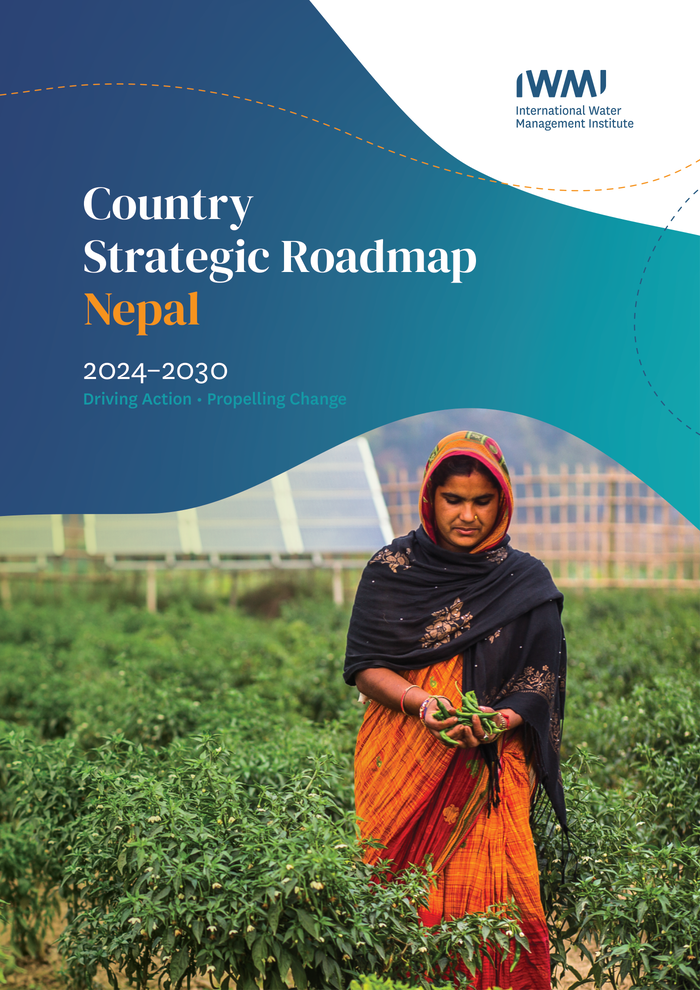
Country Strategic Roadmap: Nepal 2024–2030 (Driving Action – Propelling Change)

RELATED ARTICLES


