

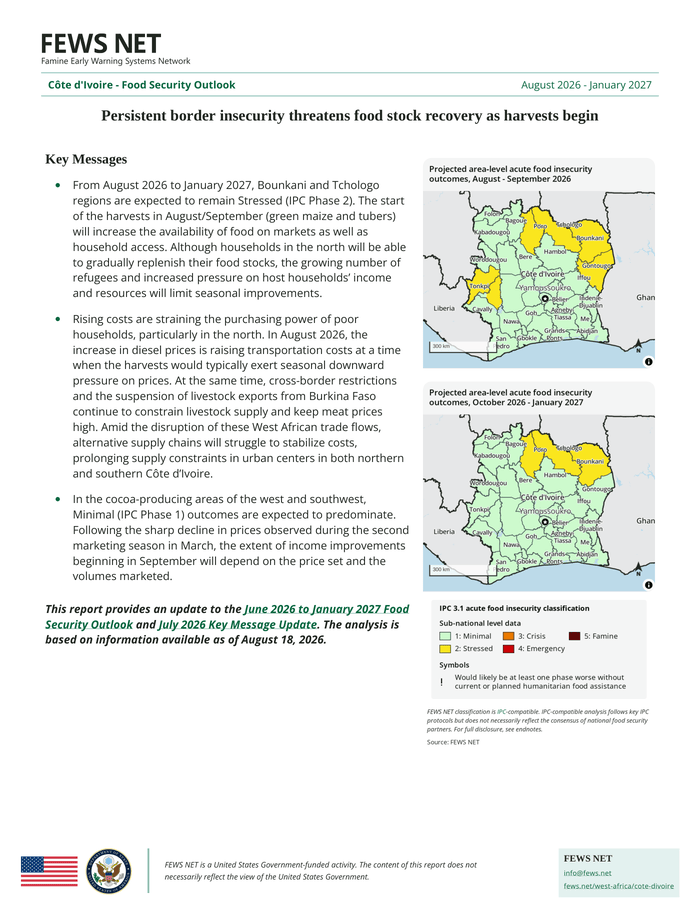
Country: Côte d’Ivoire Source: Famine Early Warning System Network Please refer to the attached file. Key Messages From August 2026 to January 2027, Bounkani and Tchologo regions are expected to remain Stressed (IPC Phase 2). The start of the harvests in August/September (green maize and tubers) will increase the availability of food on markets as well as household access. Although households in the north will be able to gradually replenish their food stocks, the growing number of refugees and increased pressure on host households’ income and resources will limit seasonal improvements. Rising costs are straining the purchasing power of poor households, particularly in the north. In August 2026, the increase in diesel prices is raising transportation costs at a time when the harvests would typically exert seasonal downward pressure on prices. At the same time, cross-border restrictions and the suspension of livestock exports from Burkina Faso continue to constrain livestock supply and keep meat prices high. Amid the disruption of these West African trade flows, alternative supply chains will struggle to stabilize costs, prolonging supply constraints in urban centers in both northern and southern Côte d’Ivoire. In the cocoa-producing areas of the west and southwest, Minimal (IPC Phase 1) outcomes are expected to predominate. Following the sharp decline in prices observed during the second marketing season in March, the extent of income improvements beginning in September will depend on the price set and the volumes marketed. This report provides an update to the June 2026 to January 2027 Food Security Outlook and July 2026 Key Message Update. The analysis is based on information available as of August 18, 2026.
Côte d’Ivoire – Food Security Outlook : Persistent border insecurity threatens food stock recovery as harvests begin (August 2026 – January 2027)

RELATED ARTICLES


