


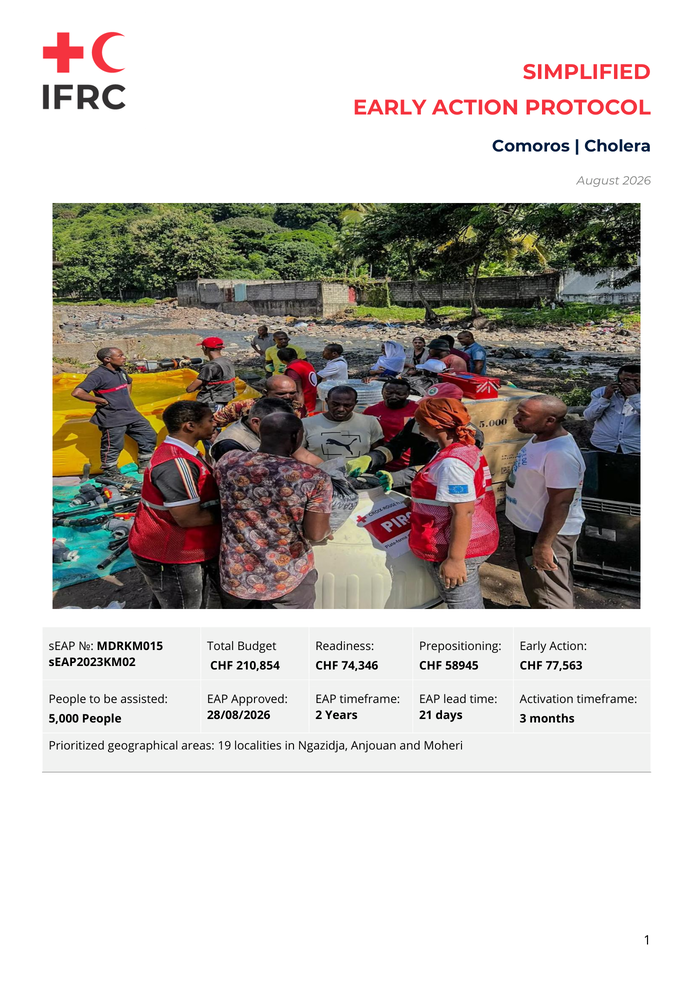
Country: Comoros Source: International Federation of Red Cross and Red Crescent Societies Please refer to the attached file. RISK ANALYSIS Prioritized hazard and its historical impact. Cholera is the prioritized hazard for this Early Action Protocol (EAP) in Comoros, where it remains a significant public health threat. Comoros, though not cholera-endemic, is highly connected, by sea and air, to East and Central African countries with recurrent cholera outbreaks, notably Tanzania, Mozambique, Kenya, the Democratic Republic of the Congo (DRC), Rwanda, Burundi, and Ethiopia. Between December 2024 and January 20261, these seven countries reported a combined 101, 351 cases and 2, 452 deaths – except for Kenya and Rwanda, whose outbreaks ended in December and November 2025 respectively – all reportedly had ongoing active cases through January 2026. The country’s cholera risk is heightened by structural vulnerabilities2, notably its exposure to multiple hazards whose impacts are amplified by climate change3. The principal climate risks facing the Comoros include sea level rise, storm surges, coastal flooding, rising temperatures, and more frequent and intense extreme weather events, alongside the degradation of critical marine ecosystems. Over time, these hazards have evolved from episodic extreme events into a chronic and intensifying multi-hazard regime, characterized by growing variability and the compounding of risks. This transition is evident in both historical trends and future projections of climate variables (see Climate Risk Timeline in Comoros, Annex 1), which indicate a continued escalation in the frequency and severity of extreme events. As a result, climate-related shocks increasingly act as drivers of public health crises, exacerbating vulnerabilities to waterborne diseases such as cholera and other climate-sensitive health risks. In addition, precarious living conditions affecting parts of the population, together with limited access to essential services (health care, safe water, hygiene, and sanitation), increase the likelihood of deteriorating sanitary and environmental conditions. Taken together, these factors can create environments conducive to the survival, circulation, and transmission of Vibrio cholerae, particularly during periods of water stress, heavy rainfall, flooding, or disruptions to basic services. Cholera manifests as acute, profuse watery diarrhea, vomiting, and leg cramps, progressing to severe dehydration and death within hours without treatment. Key risk drivers in Comoros include case importation from neighboring countries, seasonal peaks during the rainy season (November–May), and mass gatherings like “Grand Weddings,” featuring large crowds and shared meals. Cholera has been a recurrent threat in Comoros since 1975, with seven major epidemics documented over nearly five decades, underscoring both the severity and the cyclical nature of outbreaks. Critically, Comoros is not cholera-endemic: the majority of documented epidemics has been traced to an imported source, typically introduced via maritime travel, fishing vessels, or population movement from cholera-affected countries in East Africa and the wider Indian Ocean region, before spreading through local transmission once introduced. This importation pattern reflects Comoros’ geographic position as a maritime crossroads with high population mobility (commercial shipping, fishing, diaspora travel, and migration to/from Mayotte) rather than the persistence of endemic Vibrio cholerae reservoirs within the country. Since 1975, the cumulative burden exceeds 29, 000 cases and 672 deaths, with an average case fatality rate (CFR) of 3. 16%, markedly above the WHO emergency benchmark of 1%. The most recent outbreak, which occurred in 2024, was similarly linked to an imported case – documented as originating from a boat arriving from Tanzania – and coincided with a rainy season marked by severe flooding and significant damage. The floods led to the destruction of essential infrastructure and the contamination of water sources, thereby increasing the risk of spreading cholera and other waterborne diseases. This outbreak was the largest ever recorded in the country, with 11, 171 cases and 153 deaths4. Vulnerable groups were disproportionately affected, with children under 15 accounting for over 35% of reported cases and 67% of deaths. Beyond the immediate health impacts, cholera outbreaks cause major socioeconomic disruptions, including the closure of markets and businesses, a sharp decline in tourism, and the interruption or deterioration of education services.



GrowthPakistan brings you the latest news to keep an eye on Pakistan’s startup ecosystem. Business keeps you growing when you stay aware of your competitors' moves. GrowthPakistan offers Business, Tech, Global Tech, Global, Auto, and Startup News straight from industries all around the globe. This platform will help you identify upcoming opportunities not only in Pakistan but worldwide.
Email : growthpakistan@gmail.com
Whatsapp : +92320-9497079
© growthpakistan