

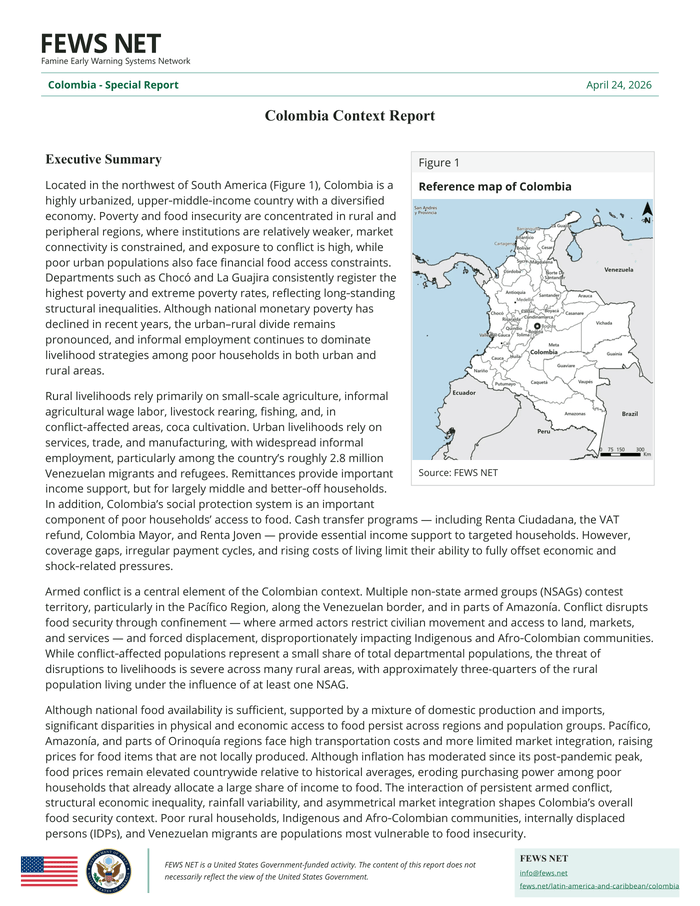
Country: Colombia Source: Famine Early Warning System Network Please refer to the attached file. Colombia Context Report Executive Summary Located in the northwest of South America (Figure 1), Colombia is a highly urbanized, upper‐middle‐income country with a diversified economy. Poverty and food insecurity are concentrated in rural and peripheral regions, where institutions are relatively weaker, market connectivity is constrained, and exposure to conflict is high, while poor urban populations also face financial food access constraints. Departments such as Chocó and La Guajira consistently register the highest poverty and extreme poverty rates, reflecting long‐standing structural inequalities. Although national monetary poverty has declined in recent years, the urban–rural divide remains pronounced, and informal employment continues to dominate livelihood strategies among poor households in both urban and rural areas. Rural livelihoods rely primarily on small‐scale agriculture, informal agricultural wage labor, livestock rearing, fishing, and, in conflict‐affected areas, coca cultivation. Urban livelihoods rely on services, trade, and manufacturing, with widespread informal employment, particularly among the country’s roughly 2. 8 million Venezuelan migrants and refugees. Remittances provide important income support, but for largely middle and better‐off households. In addition, Colombia’s social protection system is an important component of poor households’ access to food. Cash transfer programs — including Renta Ciudadana, the VAT refund, Colombia Mayor, and Renta Joven — provide essential income support to targeted households. However, coverage gaps, irregular payment cycles, and rising costs of living limit their ability to fully offset economic and shock‐related pressures. Armed conflict is a central element of the Colombian context. Multiple non‐state armed groups (NSAGs) contest territory, particularly in the Pacífico Region, along the Venezuelan border, and in parts of Amazonía. Conflict disrupts food security through confinement — where armed actors restrict civilian movement and access to land, markets, and services — and forced displacement, disproportionately impacting Indigenous and Afro‐Colombian communities. While conflict‐affected populations represent a small share of total departmental populations, the threat of disruptions to livelihoods is severe across many rural areas, with approximately three-quarters of the rural population living under the influence of at least one NSAG. Although national food availability is sufficient, supported by a mixture of domestic production and imports, significant disparities in physical and economic access to food persist across regions and population groups. Pacífico, Amazonía, and parts of Orinoquía regions face high transportation costs and more limited market integration, raising prices for food items that are not locally produced. Although inflation has moderated since its post‐pandemic peak, food prices remain elevated countrywide relative to historical averages, eroding purchasing power among poor households that already allocate a large share of income to food. The interaction of persistent armed conflict, structural economic inequality, rainfall variability, and asymmetrical market integration shapes Colombia’s overall food security context. Poor rural households, Indigenous and Afro‐Colombian communities, internally displaced persons (IDPs), and Venezuelan migrants are populations most vulnerable to food insecurity.
Colombia Special Report, April 24, 2026

RELATED ARTICLES


