

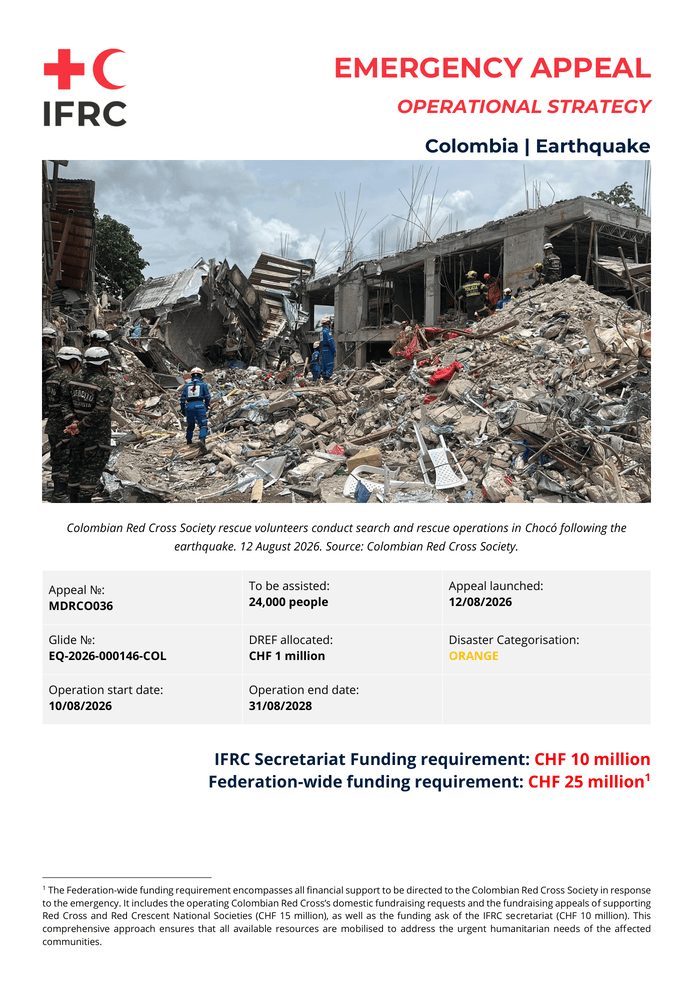
Country: Colombia Source: International Federation of Red Cross and Red Crescent Societies Please refer to the attached file. DESCRIPTION OF THE EVENT On 10 August 2026 at 07: 34 local time, a magnitude 7. 4 earthquake struck western Colombia, with its epicentre near the municipality of San José del Palmar in Chocó Department, at a depth of 96 km. The earthquake was followed by multiple aftershocks and was felt across much of the country, affecting densely populated urban centres and rural communities alike. The departments most severely impacted include Chocó, Valle del Cauca, Risaralda, Caldas, and Quindío, while significant impacts were also reported in Antioquia, Cundinamarca, Huila, Boyacá, Tolima, Cauca, Putumayo, Sucre, and Santander. As of 18 August, the National Disaster Risk Management Unit (UNGRD) reports indicated impacts across 15 departments and 472 municipalities, 2 while the earthquake was felt across much of Colombia and reported in Ecuador, Panama, and Venezuela. According to the latest official information available, the earthquake has resulted in significant loss of life, injuries, and widespread infrastructure damage. Preliminary reports by 18 August indicated 304 deaths, 4, 548 injured people, 426 missing persons, and 356 people rescued. Authorities have also reported 134, 342 damaged homes, 29, 554 destroyed homes, 303 affected health facilities, 3, 443 affected educational facilities, 3, 905 affected community centres, 267 collapsed buildings, 413 damaged roads, and impacts to at least five airports. 3 Critical disruptions to electricity, water supply, telecommunications, and health services have been reported in several affected areas. Airport closures, damaged roads, communication outages, and continuing aftershocks are affecting access to communities and delaying comprehensive damage and needs assessments, particularly in Chocó, where connectivity remains intermittent and some municipalities remain difficult to reach. Pre-existing vulnerabilities, poor health outcomes, and limited access to health services already constrained the ability of communities to cope with additional shocks. On the day of the earthquake, the Government of Colombia declared a national State of Emergency and activated national and departmental emergency management mechanisms. The Colombian Red Cross Society (Cruz Roja Colombiana – CRC) immediately activated its National Crisis Room and emergency response mechanisms.
Colombia | Earthquake – Emergency Appeal Operational Strategy (MDRCO036)

RELATED ARTICLES


