


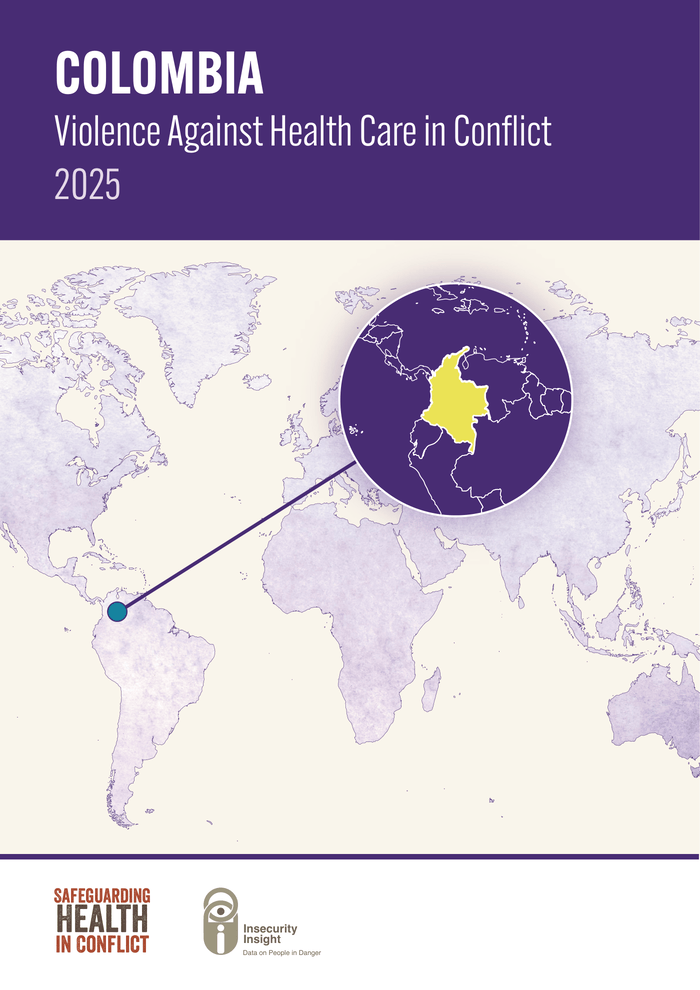
Country: Colombia Source: Insecurity Insight Please refer to the attached file. Using data collected by Insecurity Insight, the Safeguarding Health in Conflict Coalition (SHCC) identified 28 incidents of violence against or obstruction of health care in Colombia in 2025. Health facilities were attacked ten times, seven health workers were killed and were 15 kidnapped. The report examines patterns of attacks affecting health workers, facilities, patients, and transport amid intensifying conflict between armed groups, and explores the consequences for access to health care, particularly in remote and conflict-affected regions. The report notes that the true scale of attacks is likely higher than documented due to underreporting in inaccessible areas and reduced humanitarian presence, including the impact of cuts to USAID funding on health service provision and monitoring. The report forms part of SHCC’s annual report ‘Care in the Crosshairs’. Key findings: As in previous years, most incidents in 2025 were recorded in the Cauca department, with small shifts from Colombia’s peripheral departments, such as Caquetá, Chocó, Magdalena, Nariño, Putumayo, and Santander, located in the Amazon, Pacific coast, Caribbean coast, and eastern border regions, toward more central Andean and plains areas, including Antioquia, Cundinamarca, Meta, Norte de Santander, Tolima, and Valle del Cauca. Incidents continued in Atlántico, Arauca, Amazonas, Bolívar Huila and La Guajira in 2025. Kidnappings of health workers more than doubled compared to 2024, highlighting the increasing use of abductions by armed groups operating in contested territories and the growing risks faced by frontline health personnel. Women and girls were particularly vulnerable to disruptions to health services. In early 2025, Médecins Sans Frontières (MSF) reported a deterioration in community health conditions during its emergency response in the Catatumbo region of Norte de Santander department. Children displayed symptoms of malnutrition, while many pregnant women could not access prenatal care, increasing risks for both maternal and infant health. Full report available in English and Spanish. Insecurity Insight updates data continuously and numbers may change if new information is made publicly available. For the latest available figures, see Insecurity Insight’s global map on attacks on health care since 2016. Other resources Drawing on a decade of systematically collected data, Still Under Attack documents the scale, patterns, and consequences of attacks on health care in conflict-affected settings worldwide since the adoption of UN Security Council Resolution 2286 in 2016: Based exclusively on Insecurity Insight’s data collection, it highlights how violence against health care is becoming normalised, with serious consequences for civilians, disease response and health systems. The report provides detailed analysis of perpetrators, methods of attack and emerging risks, including the growing role of new technologies in conflict environments. It also offers recommendations for governments, international organisations, humanitarian actors and the diplomatic community aimed at strengthening the protection of health care and improving accountability for violations.



GrowthPakistan brings you the latest news to keep an eye on Pakistan’s startup ecosystem. Business keeps you growing when you stay aware of your competitors' moves. GrowthPakistan offers Business, Tech, Global Tech, Global, Auto, and Startup News straight from industries all around the globe. This platform will help you identify upcoming opportunities not only in Pakistan but worldwide.
Email : growthpakistan@gmail.com
Whatsapp : +92320-9497079
© growthpakistan