


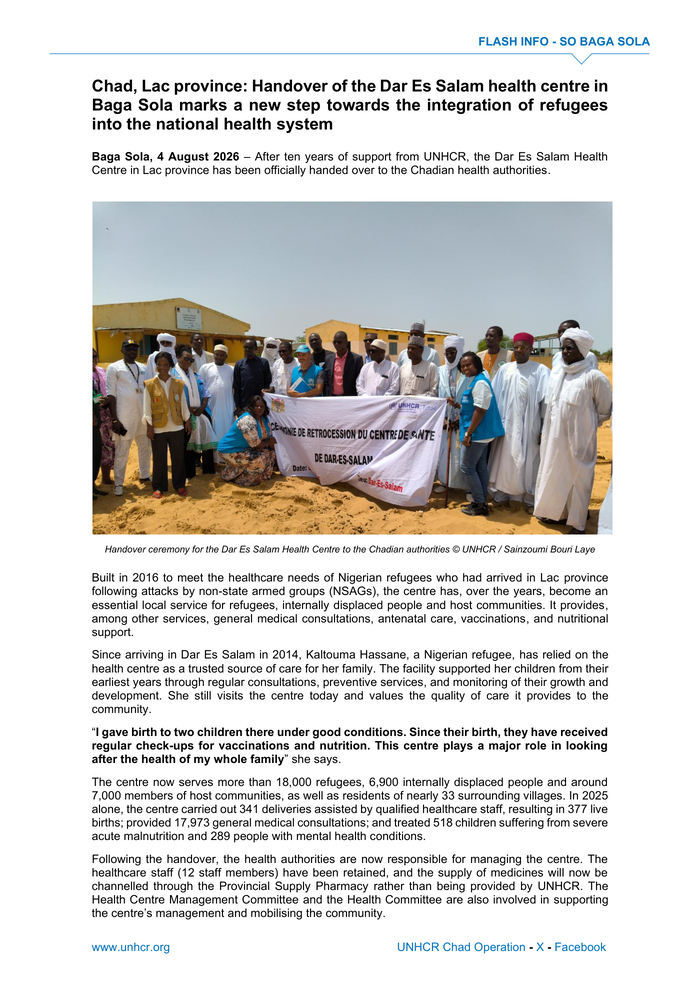
Country: Chad Source: UN High Commissioner for Refugees Please refer to the attached file. Baga Sola, 4 August 2026 – After ten years of support from UNHCR, the Dar Es Salam Health Centre in Lac province has been officially handed over to the Chadian health authorities. Built in 2016 to meet the healthcare needs of Nigerian refugees who had arrived in Lac province following attacks by non-state armed groups (NSAGs), the centre has, over the years, become an essential local service for refugees, internally displaced people and host communities. It provides, among other services, general medical consultations, antenatal care, vaccinations, and nutritional support. Since arriving in Dar Es Salam in 2014, Kaltouma Hassane, a Nigerian refugee, has relied on the health centre as a trusted source of care for her family. The facility supported her children from their earliest years through regular consultations, preventive services, and monitoring of their growth and development. She still visits the centre today and values the quality of care it provides to the community. “I gave birth to two children there under good conditions. Since their birth, they have received regular check-ups for vaccinations and nutrition. This centre plays a major role in looking after the health of my whole family” she says. The centre now serves more than 18, 000 refugees, 6, 900 internally displaced people and around 7, 000 members of host communities, as well as residents of nearly 33 surrounding villages. In 2025 alone, the centre carried out 341 deliveries assisted by qualified healthcare staff, resulting in 377 live births; provided 17, 973 general medical consultations; and treated 518 children suffering from severe acute malnutrition and 289 people with mental health conditions. Following the handover, the health authorities are now responsible for managing the centre. The healthcare staff (12 staff members) have been retained, and the supply of medicines will now be channelled through the Provincial Supply Pharmacy rather than being provided by UNHCR. The Health Centre Management Committee and the Health Committee are also involved in supporting the centre’s management and mobilising the community. For Dr Sam Koulmini, the Health Ministry’s Provincial Delegate for Lac province, this handover goes beyond the management of a single centre. “This handover is a catalyst for the health system. It gives a significant boost to the entire sector, particularly in the Baga Sola district, ” he explains. In fact, the integration process had already begun before the transfer. The refugees from Dar Es Salam are already included in the population data used by the health authorities and are considered in the planning of health activities. The centre itself is one of the 17 health centres in Baga Sola Health District and falls under the supervision of the Lac Provincial Health and Prevention Delegation of the Health Ministry. “The refugees are already integrated and included in Chad’s population data. All activities are planned down to the smallest detail with them in mind” explains Dr Koulmini. Since 2016, UNHCR has supported the centre’s operations alongside the health authorities. This support has focused on health staff, medicines, equipment, medical referrals and capacity-building for staff and the Health Centre Management Committee. At the time of the handover, all the centre’s infrastructure and equipment were transferred to the health authorities, along with a stock of medicines and medical supplies worth over 75, 000, 000 CFA francs (~$133, 500). An amount of 2, 899, 500 CFA francs (~$5, 160), generated through the cost-recovery mechanism, is also available to contribute to the centre’s operational expenses. An ambulance ensures that medical referrals to Baga Sola and Bol can continue. For Abakar Mahamat, who has overseen the centre since July 2026, the priority is now to ensure that services continue without interruption. “Ensuring continuity depends on three things: the presence of healthcare staff, the availability of medicines, and the availability of the ambulance to facilitate referrals to Baga Sola or Bol,” he explains. He is also counting on the Health Centre Management Committee and the Health Committee to support him in managing the centre. However, continuity of care will also depend on the resources available. A large proportion of the population served has low incomes, which could limit the revenue generated from cost-recovery. Yet this revenue is needed, in particular, to help replenish stocks of medicines and keep the centre running. Health authorities also identify energy as a challenge, as the generator requires fuel to operate. For Kaltouma Hassane, these issues boil down to very practical concerns. “For the centre’s future, it is essential that medicines continue to be available and that healthcare staff remain in place to ensure quality care for the population.” UNHCR will remain committed after the handover, in particular through monitoring and advocacy where necessary. For Miguel Urquia, Head of the UNHCR office in Baga Sola, the work of the Health Centre Management Committee will be particularly important in monitoring the centre’s management and alerting the authorities in the event of difficulties. “This is a major step towards inclusion in national systems” he emphasises. “Refugees will have the same access to healthcare as the local population, both now and in the future.”



GrowthPakistan brings you the latest news to keep an eye on Pakistan’s startup ecosystem. Business keeps you growing when you stay aware of your competitors' moves. GrowthPakistan offers Business, Tech, Global Tech, Global, Auto, and Startup News straight from industries all around the globe. This platform will help you identify upcoming opportunities not only in Pakistan but worldwide.
Email : growthpakistan@gmail.com
Whatsapp : +92320-9497079
© growthpakistan